For decades, a November weekend meant a simple instruction for millions of North Americans: set the clock back one hour. In 2026, the instruction is no longer uniform across the border. The United States continues to end daylight saving time on November 1 in most states. British Columbia, however, has moved its main Pacific region to permanent year-round time, while a new Ontario rule addresses communities west of the 90th meridian. What sounds like a minor clock adjustment can alter when a Vancouver meeting begins for someone in Seattle, or how an automated appointment is displayed after a software update.
What happens across most of the United States?
The National Institute of Standards and Technology says US daylight saving time ends at 2 a.m. local time on Sunday, November 1, 2026. In participating places, clocks repeat the 1 a.m. hour and return to standard time. The regular rule runs through the second Sunday of March; the next US spring change is scheduled for March 14, 2027.
Not all places participate. Hawaii and most of Arizona, for example, do not follow the usual seasonal adjustment. That means a description such as 'all of North America turns the clocks back' has never been correct, and it is particularly misleading this year.
Sources: Daylight Saving Time Rules · Daylight Saving Time Ends on Sunday
Why much of British Columbia no longer falls back
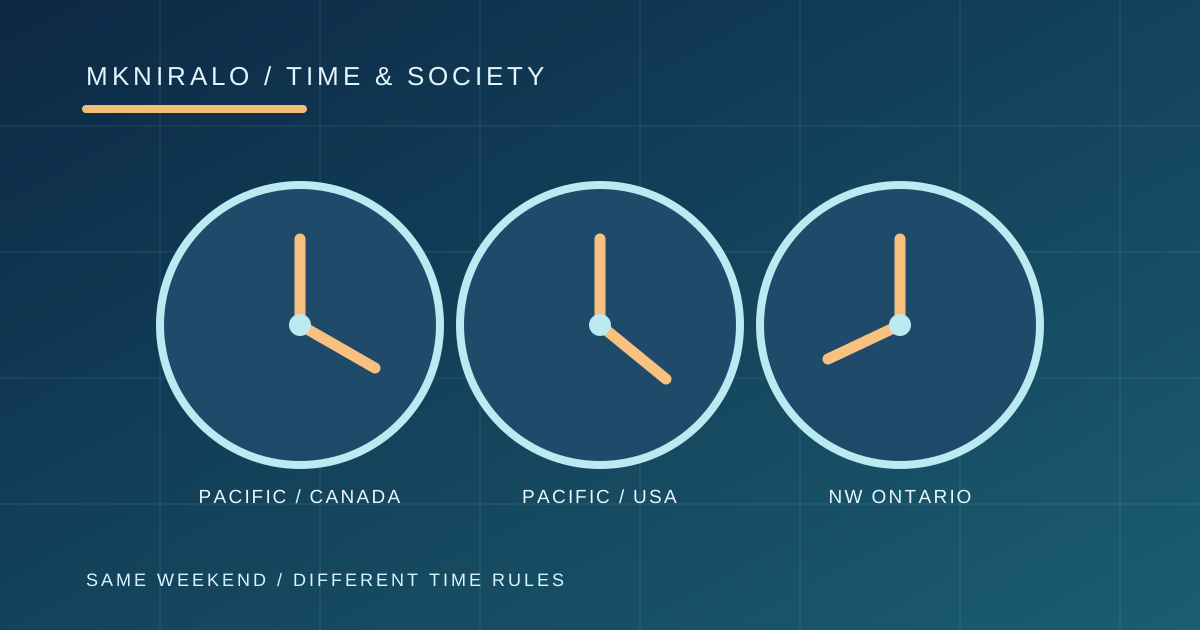
The British Columbia government announced that the March 8, 2026 move to daylight time would be the province's final seasonal clock change for most residents. Its new Pacific time remains UTC−7 all year. On November 1, clocks in those areas therefore stay as they were, while Seattle, Los Angeles and other participating US Pacific communities shift to UTC−8.
The practical result is that Vancouver and Seattle, which usually share the same clock, become one hour apart during the winter. From March into the usual daylight-saving months they match again. This is a consequence of different legal time rules, not a political or technological failure of either region.
Sources: Adopting permanent daylight saving time · Permanent Daylight Saving Time in BC · Daylight Saving Time 2026 in British Columbia
There are important exceptions within British Columbia
The provincial backgrounder says places in northeastern British Columbia that already used mountain standard time year-round will continue doing so. Some southeastern communities, including parts of the East Kootenay region, will keep their Mountain seasonal pattern aligned with Alberta. Local time practice is therefore not perfectly uniform across all of the province.
Travelers should check the particular municipality rather than assume a province-wide label resolves every case. The time zone shown by a train operator, airline, hotel or meeting invitation should be confirmed for the actual location of the event.
Sources: Adopting permanent daylight saving time · Permanent Daylight Saving Time in BC
Ontario's northwest has a separate change
Ontario Regulation 333/26, made in October and scheduled to take effect November 1, governs the part of the province west of 90 degrees west longitude. It sets that area's relevant standard time five hours behind Greenwich and keeps it in effect throughout the year, aligning it with neighboring Manitoba during the months when Manitoba observes daylight saving time.
That is a geographically defined Ontario rule, not a decision to stop seasonal clock changes throughout the province. Toronto and the majority of Ontario remain in a different time regime. An Ontario address alone is not enough information to determine whether this regional regulation applies.
Sources: Ontario Regulation 333/26: Variation of Time in Effect · Ontario Moving to Permanent Daylight Saving Time in Parts of Northwestern Ontario
Why digital calendars deserve special attention
The University of British Columbia warned that computers using an older generic '(UTC−08:00) Pacific Time (US & Canada)' setting could display British Columbia appointments one hour incorrectly after the change. UBC said software providers have issued updates, including a newer Windows time zone and changes to Apple systems, but organizations still need to check their actual configurations.
A calendar appointment typically contains a local time and an associated time-zone rule. If a system assumes Vancouver follows the same daylight-saving transition as Seattle, the rule—not the meeting organizer's clock—can generate the mismatch. Businesses coordinating staff in Canada and the United States should confirm zone settings and use explicitly named locations when scheduling.
Sources: Daylight Saving Time 2026 in British Columbia · BC time zone change: what it means for your calendar and devices
What to check before your next cross-border appointment
Confirm the destination's actual local time, verify that devices and calendar software have current time-zone data, and double-check recurring appointments scheduled before the new rules were installed. Remote teams should distinguish an event's local wall-clock time from an invitation stored as UTC, especially when people cross regions with different seasonal adjustments.
The bigger lesson is about infrastructure hidden inside everyday technology. A law changes when an office opens; a time-zone database decides how a phone represents that law. The clocks on Sunday may appear uneventful for some Canadian residents, but that is exactly why this year's change requires more care than an old 'fall back' reminder.
Sources: Daylight Saving Time Rules · Adopting permanent daylight saving time · Ontario Regulation 333/26: Variation of Time in Effect · BC time zone change: what it means for your calendar and devices