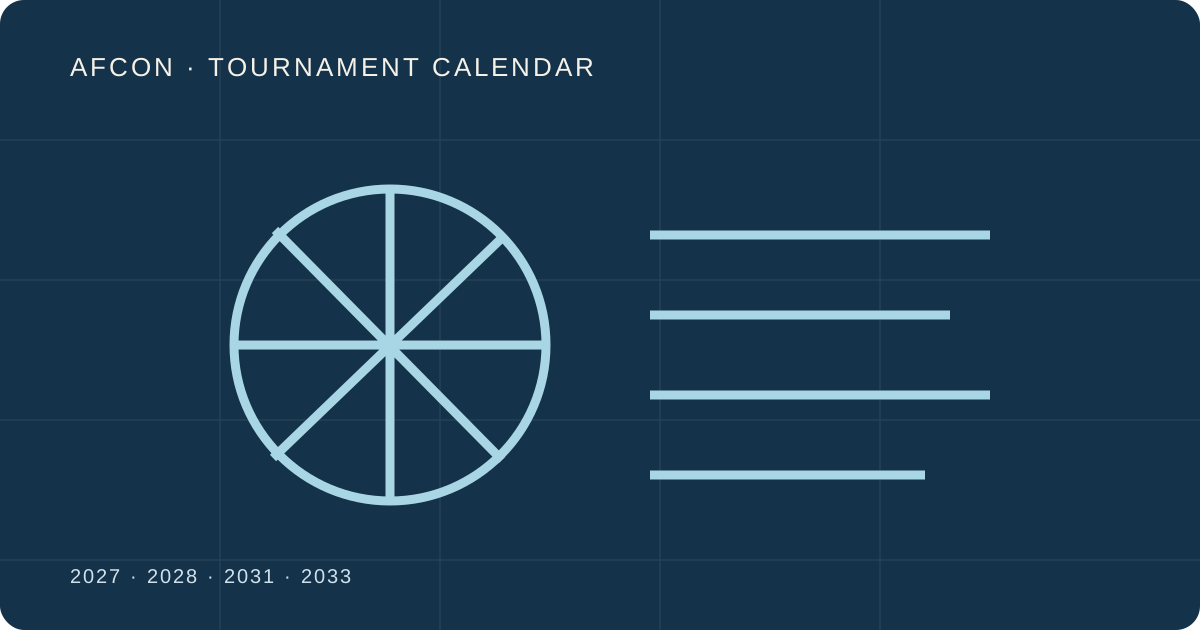
The Confederation of African Football (CAF) voted on 29 October 2026 to restore its flagship Africa Cup of Nations to a two-year cycle. Yet the governing body's own schedule lists 2027, 2028, 2031 and 2033. The distinction between a long-term policy and the first tournament dates is central to understanding what has really changed.
What did CAF decide?
The CAF executive committee unanimously reversed the earlier plan to hold the Cup of Nations every four years. Its official statement says the change is intended to benefit member associations, national teams and players employed by clubs outside Africa.
This is a confirmed institutional decision; it does not by itself announce every later competition date, qualification format or host contract.
Sources: CAF decides AFCON will take place every two years · CAF reverses decision, keeps AFCON biennial
Why are the tournament years not exactly two apart?
CAF identified the next editions as 2027, 2028, 2031 and 2033. Those years have gaps of one, three and two years, rather than following an immediate and uniform biennial pattern.
CAF also cited the 2030 FIFA World Cup as a scheduling consideration. The published dates should be reported as written rather than silently adjusted to match the policy slogan.
Sources: CAF decides AFCON will take place every two years · CAF reverses decision, keeps AFCON biennial · CAF reverses course and returns to two-year cycle
What happened to the proposed Africa Nations League?
CAF had envisaged a new pan-African Nations League to fill the space when AFCON moved toward a four-year cycle. Its president now says the new competition could require years to generate the expected finances and development benefits.
That judgment reflects a policy and financial trade-off, not a verified permanent cancellation or completed commercial assessment of every possible format.
Sources: CAF decides AFCON will take place every two years · CAF reverses course and returns to two-year cycle
What does this mean for footballers and clubs?
AFCON involves players who compete for clubs across Africa and overseas. A change in tournament frequency therefore matters for player-release windows, national-team preparation, league scheduling and fans.
The precise impact depends on later qualification programmes and international calendars. No one has yet published a single verified cost figure that applies to all clubs and players.
Sources: CAF decides AFCON will take place every two years · CAF reverses decision, keeps AFCON biennial
The 2027 East African hosting test
Kenya, Tanzania and Uganda remain CAF's announced joint hosts for 2027. The governing body inspected venues, transport, medical, accommodation and logistical arrangements during a September visit.
Independent East African reporting highlighted visa and accommodation gaps and unfinished works. An official inspection is not proof of complete readiness, just as concern about deadlines is not an announcement that the tournament has been cancelled.
Sources: CAF decides AFCON will take place every two years · CAF inspection of Kenya, Uganda and Tanzania for AFCON 2027 · CAF flags accommodation and visa gaps ahead of 2027
What should be verified next?
Future updates should examine the published qualification dates, the full plan for the unusual 2028–2031 interval and specific construction or operational milestones in the three host nations.
The reversal is a real change to African football's calendar policy. Whether the transition works well for clubs, players and East African host communities remains an implementation question.
Sources: CAF decides AFCON will take place every two years · CAF inspection of Kenya, Uganda and Tanzania for AFCON 2027 · CAF flags accommodation and visa gaps ahead of 2027