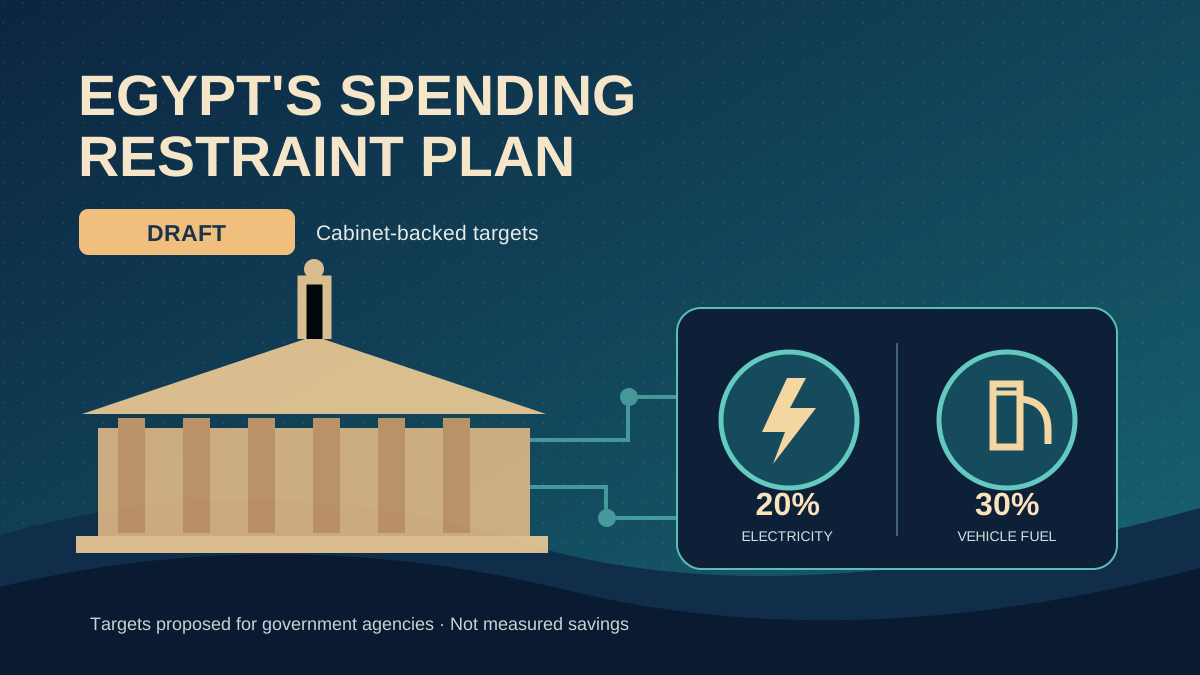
Egypt's government has endorsed a draft package intended to curb energy use and selected public expenditure as it prepares for economic risks linked to regional tensions. The proposal calls for a 20% reduction in electricity consumption at government premises and a cut of at least 30% in fuel allocated to official vehicles. It sets an initial three-month period tied to when the decision takes effect—not automatically to the day ministers approved the draft. Neither target is an achieved saving, and the available record does not establish that the final rules have begun operating.
Cabinet Approval Is Not Yet the Same as Implementation
Egypt's Cabinet endorsed a draft decision on public spending restraint at its November 5 meeting, taking a proposal discussed earlier in the week into a more formal stage of government consideration. The measures envisage lower electricity consumption at state premises, reduced fuel use by official vehicles and restrictions on some categories of expenditure. The reported figures describe obligations proposed for covered agencies, not reductions already achieved.
The distinction matters because the government and the reporting on its meeting used the Arabic phrase for approval of a draft decision. The available announcement does not establish the date on which a final, operative instrument was issued or became enforceable. It would be premature to say that every agency has begun applying the rules, or that Egypt has already saved a stated amount. The Cabinet's public meetings listing confirms the November 5 meeting; local outlets published the substantive terms attributed to the Cabinet statement.
The government links the move to risks arising from current Middle East tensions. On November 2, Prime Minister Mostafa Madbouly discussed a proposed fiscal-resilience framework with finance and planning officials and said its final form would be submitted to Cabinet. Thursday's approval of a draft is a meaningful procedural development, but a later effective date and measurable outcomes remain separate questions.
Sources: Prime Minister Reviews Proposed Framework for Public Spending Restraint and Fiscal Sustainability · Cabinet Meetings: Meeting of 5 November 2026 · Government Approves Draft Three-Month Spending Restraint: Electricity 20%, Fuel 30% · Cabinet Approves Proposed Draft Decision on Public Spending Rationalisation · مصر.. الحكومة توافق على خطة تقشف لمدة 3 أشهر وبيان يكشف التفاصيل
Where the Electricity and Vehicle-Fuel Targets Apply
Under the proposed rules, covered government entities would cut electricity and lighting consumption by 20% compared with average actual consumption during the corresponding period of Egypt's 2025–26 fiscal year. That is a defined comparison, not a claim that the country's total electricity use will fall by one-fifth. It also does not say that private homes face mandatory outages or a 20% reduction in their own consumption.
Government spokesman Mohamed Adel specifically clarified on November 6 that the electricity measure concerns government premises, not households. The separate vehicle provision calls for a reduction of at least 30% in fuel allocated to government vehicles. It should not be read as a cut in national petrol sales, a 30% reduction in fuel prices or a saving already recorded in official accounts.
For national projects intensive in diesel, heavy fuel oil or petrol, the proposal calls for a separate implementation plan addressing electricity and fuel use. Responsible authorities would need to approve those plans and send them to relevant ministries and Cabinet. That administrative requirement underscores why a headline percentage alone cannot demonstrate how much energy will actually be conserved.
Sources: Government Approves Draft Three-Month Spending Restraint: Electricity 20%, Fuel 30% · Cabinet Approves Proposed Draft Decision on Public Spending Rationalisation · Government Spokesman Explains Scope and Timing of Spending Curbs
The Three-Month Clock Has a Starting Condition
The proposed spending-restraint rules would apply to the state administrative apparatus, local administration, public service bodies and public economic authorities for three months from the date the decision takes effect. The draft allows the period to be extended. November 5 was the date of Cabinet approval of the draft; the reports do not justify treating it automatically as day one of a three-month operating period.
The timing of infrastructure measures is related but not identical. The draft envisages postponing or slowing national projects that consume large amounts of petroleum products for at least three months, with reassessments and possible extension if conditions warrant. Describing the whole package as a fixed, nonrenewable 90-day programme would therefore miss an important qualification.
Another date runs considerably further ahead: the draft includes a restriction on contracting for passenger-car purchases until June 30, 2027. That deadline belongs to a particular procurement provision, not to the initial three-month period. Final publication and any implementation circulars will determine how these separate timeframes operate in practice.
Sources: Government Approves Draft Three-Month Spending Restraint: Electricity 20%, Fuel 30% · Cabinet Approves Proposed Draft Decision on Public Spending Rationalisation · Government Spokesman Explains Scope and Timing of Spending Curbs
The Package Goes Beyond Energy
The draft would defer spending on requirements that are not strictly essential. It would also restrict decisions increasing expenditure beyond the budget's relevant allocations without prior coordination with the Finance Ministry and Cabinet consideration. Expenditure involving foreign currency would require authorisation from the Finance Ministry's financing and debt management division, in coordination with the central bank and the relevant bodies.
In the goods-and-services budget chapter, the proposals would prohibit several forms of advertising, promotional, ceremonial and hospitality spending. They also call for freezing at least 20% of remaining appropriations for other items in that chapter. That 20% is a separate budget-appropriation rule and should not be confused with the 20% electricity target; neither is a confirmed percentage reduction in total public expenditure.
Officials' travel abroad would be tightly limited, with exceptions subject to approval. The proposed investment controls would delay some newly listed projects and bar certain new contracts until June 2027. These provisions would change what agencies may commit or disburse, while leaving the eventual cash saving dependent on compliance, exemptions and the timetable of projects already under way.
Sources: Government Approves Draft Three-Month Spending Restraint: Electricity 20%, Fuel 30% · Cabinet Approves Proposed Draft Decision on Public Spending Rationalisation · مصر.. الحكومة توافق على خطة تقشف لمدة 3 أشهر وبيان يكشف التفاصيل
Exemptions Matter for Services and the Budget
The proposal does not treat every government activity identically. Reported exemptions include health and medical-care bodies, national-security purposes, debt-service payments, specified treatment allocations, social-protection payments and essential food-subsidy appropriations. Certain infrastructure and investment activities would also be protected, including water and sanitation and specified food, energy and cybersecurity needs.
The government says its restraint measures must not prevent public bodies from performing their assigned services. That is an explicit policy objective, not independent proof that there will be no disruption. The way ministries classify essential expenditure, apply exemptions and adjust project schedules will determine how the restrictions are experienced outside budget documents.
A savings programme can preserve the headline allocations for essential services yet still create operational tensions if supporting purchases, maintenance or travel are delayed. That possibility is a policy question rather than a documented outcome in this case. Evidence of service effects would require agency-level implementation records, not inference from the draft alone.
Sources: Government Approves Draft Three-Month Spending Restraint: Electricity 20%, Fuel 30% · Cabinet Approves Proposed Draft Decision on Public Spending Rationalisation · Government Spokesman Explains Scope and Timing of Spending Curbs
What Has Not Been Verified—and What Comes Next
As of November 6, the available sources support Cabinet approval of a draft with numerical targets, scope and proposed restrictions. They do not establish a published final decision with a verified commencement date, nor do they contain audited three-month energy-use figures or a realised fiscal-savings total. No savings total had been announced; the Finance Ministry was still assessing the fiscal impact.
The next documents to watch are the final instrument or official-gazette publication, any Finance Ministry instructions to budget entities, the agencies' consumption baselines and their submitted implementation plans. Later figures should be compared with the correct year-earlier period and with changes in the activity of covered buildings and government fleets. Without those denominators, apparent percentage declines can be misleading.
For now, the news is that Egypt's Cabinet has backed a defined programme of public-sector restraint in response to economic uncertainty. Whether the draft becomes operative as described—and whether it saves resources without impairing essential services—remains to be demonstrated by subsequent official acts and performance data.
Sources: Prime Minister Reviews Proposed Framework for Public Spending Restraint and Fiscal Sustainability · Cabinet Meetings: Meeting of 5 November 2026 · Government Approves Draft Three-Month Spending Restraint: Electricity 20%, Fuel 30% · Cabinet Approves Proposed Draft Decision on Public Spending Rationalisation · Government Spokesman Explains Scope and Timing of Spending Curbs · مصر.. الحكومة توافق على خطة تقشف لمدة 3 أشهر وبيان يكشف التفاصيل