Fiji's Parliament has deferred the report on Constitution (Amendment) Bill No. 32 to a later sitting, with Prime Minister Sitiveni Rabuka targeting 30 November for the committee report and a third-reading vote expected in the first four days of December. The extension gives the committee more time for public submissions and to complete its work. Meanwhile, the Republic of Fiji Military Forces has submitted proposals that bring constitutional immunity, civilian oversight and military accountability into sharper focus. The Government's proposed 9 December referendum date remains contingent on the bill passing the required parliamentary stages and on the formal electoral steps that follow.
What Parliament has now postponed
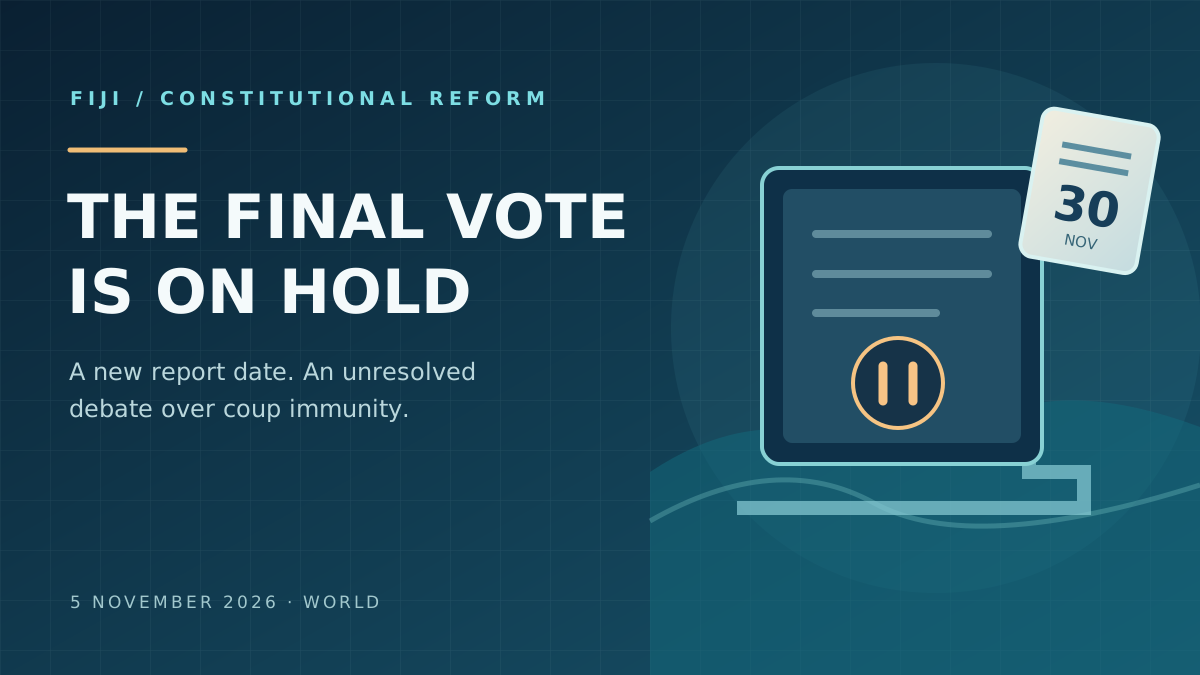
On 2 November, Parliament agreed to defer the Special Parliamentary Committee's report on the Constitution (Amendment) Bill 2026 to a later sitting. The Fiji Times reported that the motion was unanimously supported. Prime Minister Sitiveni Rabuka said the report would be presented on 30 November, with the third-reading vote expected during the first four days of December. These are the revised timetable announced by the Government, not completed legislative steps.
The same motion replaced National Federation Party leader Biman Prasad on the committee with independent MP Sachida Nand. Rabuka said Prasad had told him the NFP would not participate in the committee's deliberations. The committee is expected to advertise for further written submissions and announce dates and venues for oral submissions. The additional time changes the review process; it does not determine the content of the final report or the bill's fate.
Sources: Rabuka aims to present Constitution Amendment Bill report on 30th November · Fiji Parliament extends Constitution Bill review as parties raise concerns over rushed process · Parliament extends consultation period · Constitution Bill report delayed, vote set for December
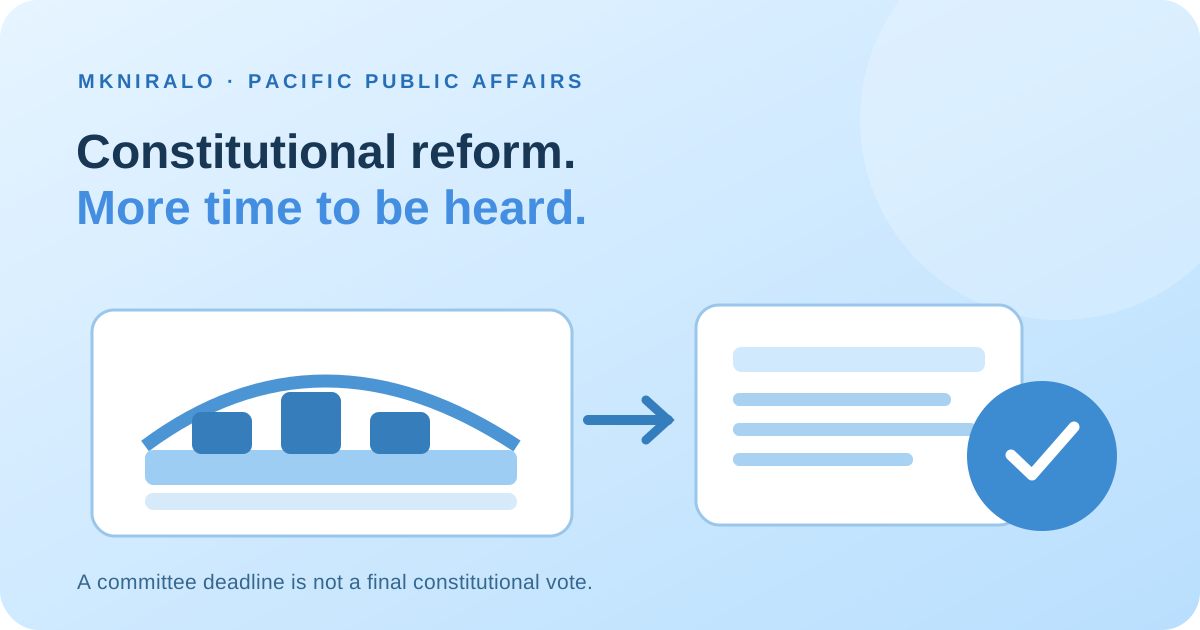
Why a committee report is not a new constitution
Fiji's current reform process has several stages. The government's bill was introduced on September 30 and passed its second reading on October 2, after which it went to the special committee. Consultation on the government's legislative text began in mid-October. Committee findings, a third reading, subsequent constitutional requirements and any referendum are separate procedural events, each with its own threshold and timetable.
The Centre for Democracy and Dialogue's public constitutional timeline distinguishes the independent review commission's earlier work from the government's later bill. That distinction matters to readers assessing the amount of consultation on the precise language Parliament may ultimately vote on. Even a completed committee report would not by itself put a revised constitution into force.
Sources: 2026 Constitution: Reform process and timeline · Fiji Constitution Hub · Referendums
The government says consultation needs more time
Rabuka said an extended period would permit more people to submit views and would help the parliamentary secretariat process written accounts of the consultations. He also described a difference in participation between rural settings, where groups sometimes provided collective submissions, and urban areas where turnout or participation had been more uneven.
The prime minister said the revised schedule could still fit within the legal timetable for the next general election and a possible referendum. That is his stated assessment of the remaining time. It should not be confused with a separate ruling by an election authority or a guarantee that every subsequent step will occur on his target date.
Sources: Rabuka aims to present Constitution Amendment Bill report on 30th November · Rabuka assures election timeline intact · PM Announces Revised Timetable for Constitution Bill, Targets November 30 for Report
Other parties question the process and its legitimacy
National Federation Party leader Biman Prasad had argued that a few additional weeks would not resolve concerns about the pace of constitutional review and that the process should continue after the next general election. The Fiji Times later reported that the NFP would not participate in the committee's deliberations and that Prasad was replaced by independent MP Sachida Nand. The formal extension motion itself was reported as unanimously supported by Parliament; that outcome should be distinguished from the NFP's objections to the wider process.
Opposition Leader Inia Seruiratu said his members would remain on the committee to scrutinise the proposals and represent public concerns, while stressing that participation did not amount to support for the Government's bill or process. The disagreement concerns both the substance of constitutional change and the legitimacy, duration and inclusiveness of the process.
Sources: Fiji Parliament extends Constitution Bill review as parties raise concerns over rushed process · Committee role does not signal support: Seruiratu · Parliament extends consultation period · NFP withdraws from Constitution committee process
The military's submission adds a separate accountability debate
On 31 October, RFMF Commander Major-General Jone Kalouniwai presented the military's position to the Special Parliamentary Committee. FBC News reported that the RFMF said it would remain politically neutral, supported civilian oversight and the restoration of the Ombudsman, and proposed replacing existing immunity provisions with a Truth, Accountability and Reconciliation Commission framework based on accountability and full disclosure. These are the military's recommendations, not amendments already adopted by Parliament.
On 1 November, FBC News reported that Kalouniwai warned that passing the bill's third reading could make immunity permanent under section 207. He said the RFMF wanted constitutional immunity removed and did not want legal protection from accountability for past wrongdoing. He also referred to a declaration on constitutional immunity signed on 16 October.
The Fiji Times reported that the RFMF made nine recommendations. Alongside replacing Chapter 14 with a Truth, Accountability and Reconciliation Commission framework in which protection would follow full disclosure and exclude the gravest crimes, the submission called for soldiers to refuse manifestly unlawful orders and for parliamentary oversight of internal military deployments. It also addressed children's and disability rights, anti-corruption safeguards and judicial independence. The committee's response to these proposals, and the text ultimately put to a vote, remain separate questions.
Sources: RFMF submits position on Constitution Bill · RFMF rejects immunity to break coup cycle · Military makes nine pointed submission on Constitution Bill
What happens to the proposed referendum date?
The Government previously announced 9 December as its intended referendum date. The revised timetable now places the committee report on 30 November and the third-reading vote in the first four days of December. The date remains a Government-announced proposal, not proof that the referendum writ has been issued or that polling arrangements are final.
ABC Pacific reported on 3 November that the National Federation Party and SODELPA had said they would vote against the bill, potentially leaving the Government short of the two-thirds majority required for passage. That is a report of the parties' stated positions, not a final parliamentary vote. The constitutional sequence still matters: a committee report, a third-reading vote and a referendum writ are distinct steps.
Sources: 2026 Constitution: Reform process and timeline · Fiji Constitution Hub · National Referendum Set for 9 December 2026 · Referendums · Constitution Bill report delayed, vote set for December · Fiji PM delays final reading of Constitution Amendment Bill
The next evidence will be in submissions and parliamentary records
The immediate developments are the publication of further written-submission notices, dates and venues for oral hearings, and the committee's report targeted for 30 November. Readers should be able to see how the committee handled the RFMF's immunity and civilian-oversight recommendations, how it recorded public views and whether its report identifies changes to the bill.
The next parliamentary test is the third-reading vote expected in early December, including whether the bill secures the required majority. After that, any referendum writ and formal arrangements would need separate confirmation. The quantity of submissions alone will not show whether the debate was representative or whether objections were considered.
The evidence now establishes a delayed committee report, a changed committee membership, an RFMF submission and competing political positions. It does not establish that the proposed constitutional amendments have been adopted or that the 9 December referendum is certain to take place.
Sources: Military makes nine pointed submission on Constitution Bill · Parliament extends consultation period · Constitution Bill report delayed, vote set for December · Fiji PM delays final reading of Constitution Amendment Bill · NFP withdraws from Constitution committee process