Fiji’s water data show pressure at two scales: a national count of critical sources and a local flow reading feeding Tamavua. On 3 November, Minister Ro Filipe Tuisawau delivered a parliamentary statement on the dry-season outlook. The Fiji Times attributed to him 19 of 44 sources classed critical, about 24,600 people affected and Savura flow down from 25.56 to 19.86 ML/day. The arithmetic defines what those figures show.
The national count is a source count, not a household count
The minister’s reported figures describe sources, not treatment plants or households. As of 1 November, 19 of WAF’s 44 operational water sources were critical; seven were approaching critical and 18 were normal. That puts about 43.2 per cent of the monitored sources in the critical category. WAF’s August statement describes the 44 as main operational sources it gauges nationwide. The ratio is not the share of Fiji’s population or water demand affected.
The estimate of about 24,600 people refers to those experiencing intermittent supply or relying on water carting. The Fiji Times reported 18,798 in the Western Division, 3,510 in the Northern Division and 2,276 in the Central-Eastern region. The 2,276 is a regional total, not a Tamavua-only count. A separate Fiji Times breakdown placed 2,000 people in the Tamavua supply area, 200 in Levuka, 43 in Navua and 33 in Vunidawa. The 2,000 is therefore a subset of the regional total, not an additional figure. Nor is 24,600 a verified count of people whose taps were completely dry: intermittent service and reliance on carted water are different kinds of disruption.
Sources: 19 water sources now critical as drought worsens · El Niño drought: 19 water sources critical, 24,600 people affected · National Warning for Careful Water Use as the Dry Season Continues
Savura’s arithmetic changes the meaning of the shortfall
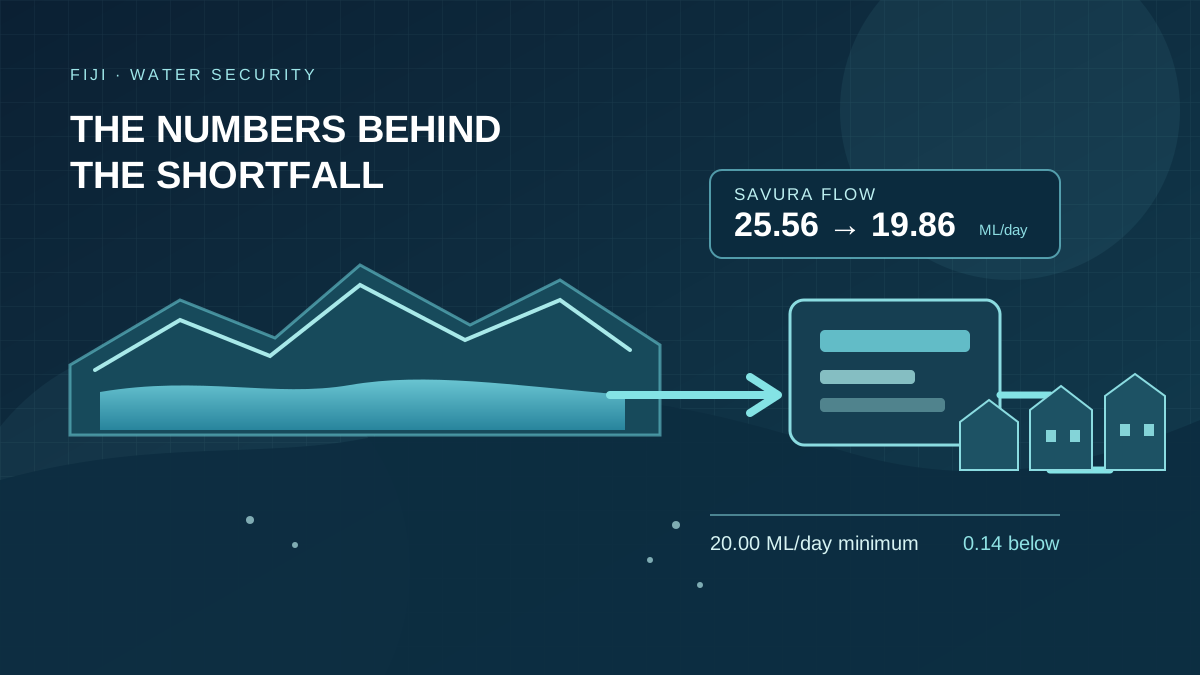
The Savura Cascade feeds the Tamavua Water Treatment Plant. The figures attributed to the minister put flow at 25.56 million litres a day before it fell to 19.86 ML/day, measured as of 1 November. The stated minimum requirement was 20.00 ML/day. Subtracting the two readings gives a decline of 5.70 ML/day.
Relative to the earlier 25.56 ML/day reading, the fall is 22.3 per cent. Compared with the 20.00 ML/day minimum, 19.86 is 0.14 ML/day lower — a gap of 0.7 per cent. These calculations answer different questions: 22.3 per cent measures the change from the earlier flow, while 0.7 per cent measures the distance below the threshold. The 5.70 figure is a volume per day, not a percentage.
A reading below a minimum signals less raw water entering treatment, but it does not show treated water delivered to each neighbourhood, reservoir storage or pressure at individual properties. It is a 1 November snapshot, not a 7 November measurement; without a daily series, it cannot show whether Savura has recovered. The figures are not a daily trend.
Sources: Savura Cascade falls below minimum flow, putting Suva water supply under pressure
What Parliament’s record confirms — and what it does not
The official minutes for Parliament’s sitting on Tuesday, 3 November, record that the Minister for Public Works, Meteorological Services and Transport, Ro Filipe Tuisawau, delivered a ministerial statement and that Jone Usamate responded. The minutes establish that the statement was made in the House, but do not reproduce its wording, figures or data tables. No verbatim Hansard transcript for that sitting was listed in the parliamentary record checked for this article.
The numerical claims are therefore attributed to the minister as reported by The Fiji Times and Fiji Sun, not presented as direct Hansard quotations. WAF’s 7 August warning separately described its national gauge network as 44 main operational water sources. That helps establish what the denominator refers to; it does not independently verify the November classifications or the Savura readings.
Sources: 19 water sources now critical as drought worsens · Savura Cascade falls below minimum flow, putting Suva water supply under pressure · El Niño drought: 19 water sources critical, 24,600 people affected · MINUTES of Proceedings of Parliament at Suva on Tuesday, Third day of November, 2026 · National Warning for Careful Water Use as the Dry Season Continues
The overnight controls are an operational response, not a customer tally
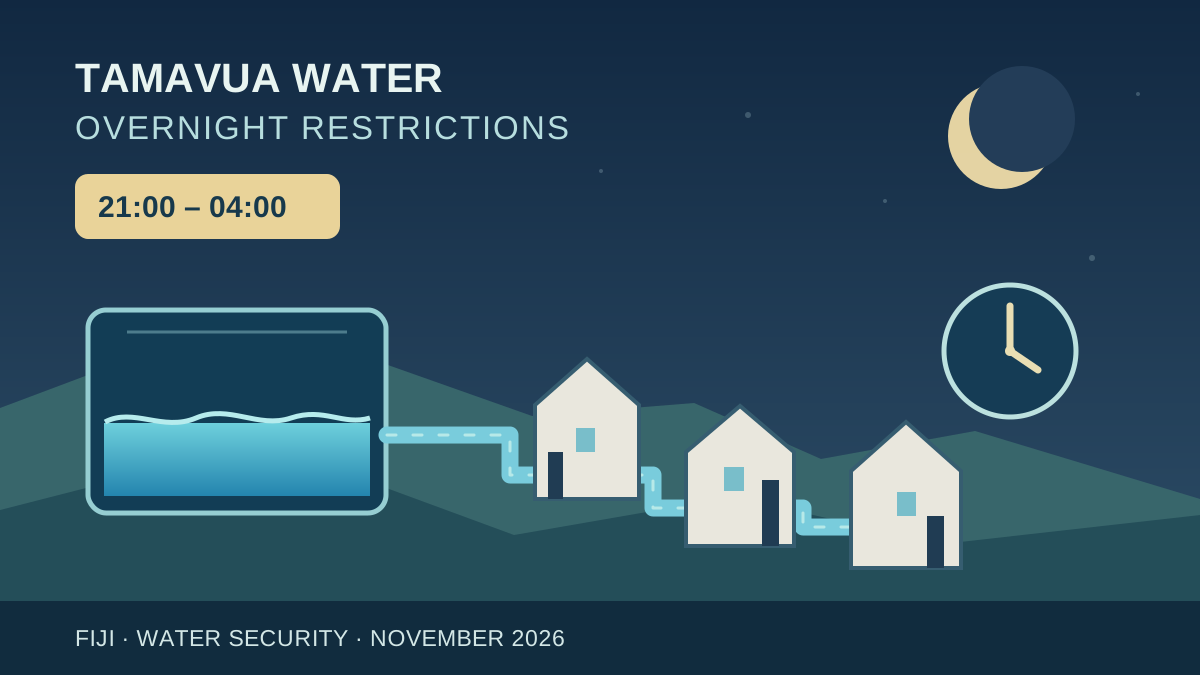
On 5 November, The Fiji Times reported WAF would operate controlled valves from 9 p.m. to 4 a.m. daily in parts of Tamavua until further notice. FBC News said on 6 November that rationing had begun the previous day and described the aim as letting the reservoir recover overnight. Fiji Sun’s 7 November report repeated the same hours and status; it announced no revision or lifting.
The original dated WAF advisory was not retrieved in this review, so the schedule is attributed to WAF as quoted by those outlets, not represented as a direct quotation from an inspected notice. A seven-hour operating window does not prove every affected customer is without water for seven hours. Pressure and restoration can vary by location and elevation, and the reports provide no verified household outage hours or customer-hours affected.
An earlier report already covered the 5 November Tamavua notice and the roughly 15 per cent inflow reduction quoted from WAF. This follow-up examines the separate parliamentary figures rather than presenting the rationing as new news.
Sources: WAF introduces overnight water rationing in parts of Suva · WAF announces 9pm to 4am water rationing in Tamavua supply areas · Overnight water rationing begins
The service baseline and long-term projects need separate labels
A parliamentary answer on 28 April provides an older service baseline. In its response to Written Question 24/2026, the Government reported 81,906 metered connections in the Central Division, representing approximately 94 per cent of households receiving consistent 24-hour supply at that time. The answer named Tamavua, Sakoca, Nagatugatu, Dokanaisuva, Tacirua and Colo-i-Suva among areas with intermittent disruptions. This is an April cross-section, not a November performance measure.
Long-term investment is relevant, but it is not an immediate substitute for the Savura flow being discussed. The Asian Development Bank says the Rewa River Water Treatment Plant at Viria has supplied 40 million litres a day since April 2024 to a reticulation system serving more than 360,000 Fijians across the Suva–Nausori corridor. WAF’s planned expansion to 80 MLD is a capacity provision. That is not achieved capacity, and the project figures do not show that Viria has directly offset the Tamavua system’s reported shortfall.
Sources: DAILY HANSARD TUESDAY, 28TH APRIL, 2026 · 49001-003: Urban Water Supply and Wastewater Management Investment Program, Tranche 1 · Minister for Public Works, Transport and Meteorological Services, Hon. Ro Filipe Tuisawau inspected the progress of works of the Rewa River Water Supply Scheme Project in Viria.
The missing evidence is a dated operational series
WAF’s 7 August warning said most of its 44 main operational sources were yielding less than treatment plants needed for normal output without support. It listed contingency measures including supplementary pumping, managed flows, pressure and pumping schedules, valve operations, leak repairs and water carting. This is useful dry-season context, not a November operating log for Tamavua or proof that any one measure caused a particular interruption.
The Fiji Meteorological Service’s November 2026 outlook, issued on 30 October, is a forecast. It is not an observation of rainfall at the Savura catchment, a raw-water inflow reading or a record of reservoir storage. A seasonal outlook cannot calculate household outage hours or establish a quantified link between rainfall, the reported flow decline and the duration of interruptions at taps.
A useful update would publish dated source inflow, plant intake and output, reservoir storage, valve schedules, affected service areas and pressure. To count customer impacts, WAF would also need affected connections and interruption duration. Those matched measures are absent. The reported 1 November Savura flow was 22.3 per cent below the earlier reading and 0.7 per cent below 20.00 ML/day; that does not establish household outage hours or a later schedule change.
Sources: WAF introduces overnight water rationing in parts of Suva · WAF announces 9pm to 4am water rationing in Tamavua supply areas · National Warning for Careful Water Use as the Dry Season Continues · Fiji Climate Outlook