Four years after NASA deliberately struck the asteroid Dimorphos, a European spacecraft has arrived to examine the result. Hera reached the Didymos–Dimorphos system on 4 November 2026, according to Japan’s space agency. The mission has already distinguished the two asteroids in visible images, while a Japanese thermal camera has recorded the smaller body cooling as it enters its neighbour’s shadow. The new observations begin to fill in what the 2022 impact experiment could not reveal from a distance.
Hera reaches a two-asteroid target
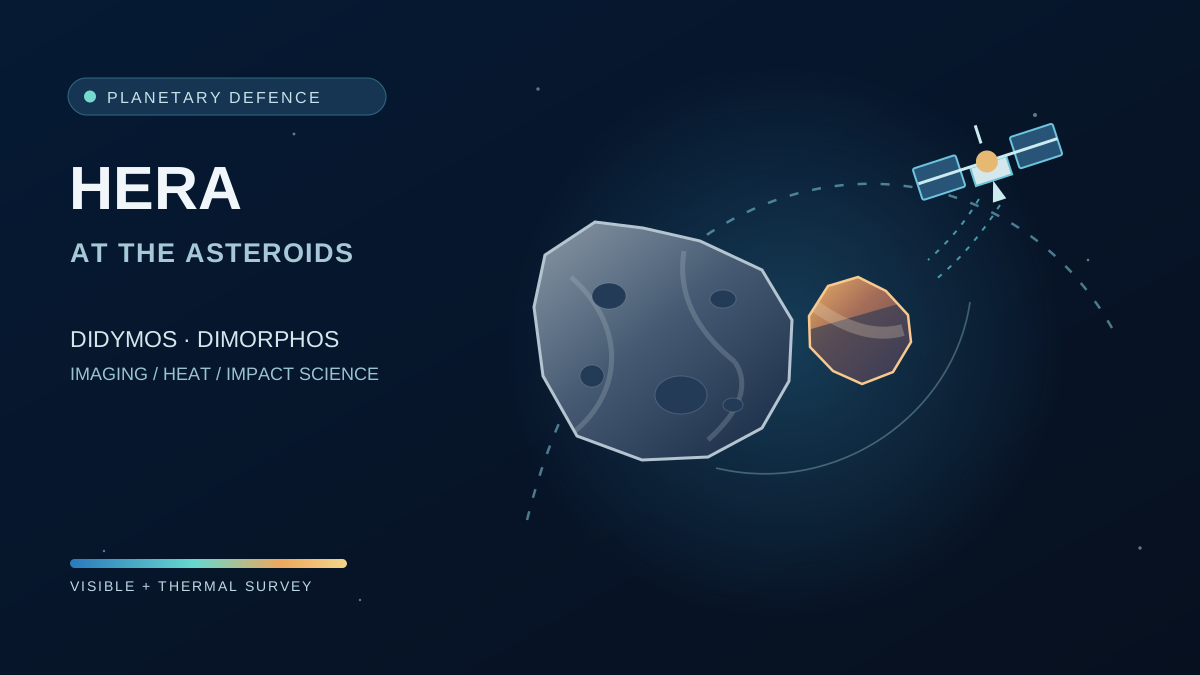
Europe’s Hera spacecraft has reached the Didymos–Dimorphos asteroid system, opening a close-up investigation of the first asteroid whose orbit humans deliberately changed. Japan’s space agency says the spacecraft arrived on 4 November 2026, Japan time, after braking manoeuvres that brought it into the neighbourhood of the two bodies. The mission launched on a SpaceX Falcon 9 on 7 October 2024 and spent roughly two years travelling to its destination. Arrival begins an observing campaign; it does not mean scientists already know what NASA’s earlier collision did to the smaller asteroid.
Didymos, the larger body, is about 780 metres across. Its companion Dimorphos measures roughly 151 metres and moves around it at a separation of about a kilometre. The pair offers an unusually valuable natural laboratory: researchers can compare precise measurements of the smaller body’s orbit with the scars, debris and physical structure revealed by a visiting spacecraft. Hera’s instruments will study both objects rather than treating the smaller moon as an isolated target. The immediate task is to map a system still difficult to understand from Earth alone.
Sources: First Thermal Imaging of a Binary Asteroid System · Upcoming Observation and Mission Operations Plan for the Hera Spacecraft in the Binary Asteroid Exploration Mission · First light: Hera resolves two asteroids instead of one
Two separate worlds emerge from a single point
The first visible milestone came before the formal arrival. On 18 October, Hera’s Asteroid Framing Camera resolved Didymos and Dimorphos as separate objects from about 1,280 kilometres away. In the early view, Dimorphos occupied only around one image pixel. Earlier approach pictures showed the two asteroids merged into a single point of light. Detecting that faint companion was a practical demonstration that the camera and navigation sequence were bringing the spacecraft close enough to distinguish its intended targets.
Sharper views followed. In a report published on 5 November, the European Space Agency showed a close-up look at the larger Didymos, revealing a pronounced equatorial ridge alongside boulders, craters and other surface features. The smaller Dimorphos was largely hidden in shadow in that image. That is why the picture should not be confused with a completed survey of the DART impact site. ESA plans to present its first detailed Dimorphos images on 25 November, a date that remains an upcoming release rather than a result available today.
Sources: Upcoming Observation and Mission Operations Plan for the Hera Spacecraft in the Binary Asteroid Exploration Mission · First light: Hera resolves two asteroids instead of one · Hera’s first close-up view of Didymos asteroids
A Japanese camera detects a moon cooling in shadow
Hera is also seeing the pair in a different kind of light. Japan’s Aerospace Exploration Agency published its first TIRI thermal-infrared observations on 6 November. One set of images was taken on 31 October from approximately 57 kilometres away, before Hera’s reported arrival date. Unlike an ordinary camera, TIRI measures infrared radiation emitted by the asteroid surfaces in the 8–14 micrometre range. Scientists can use calibrated readings to estimate temperatures and investigate how different parts of the surfaces retain and release heat.
An earlier sequence, obtained over 28–29 October, shows Dimorphos becoming cooler as it passes into the shadow of Didymos, according to JAXA’s analysis. The agency says that changing brightness provides a way to study thermal behaviour that visible-light images cannot reveal directly. It is an observation, not yet a finished map of the asteroid’s composition: detailed interpretation of the temperature measurements is still under way. By comparing heating and cooling, researchers hope to infer whether the surface behaves more like loose grains, solid boulders or a mixture of materials.
What DART proved—and what it left unanswered
Hera’s investigation follows NASA’s Double Asteroid Redirection Test, or DART, which deliberately hit Dimorphos on 26 September 2022. Ground-based observations established that the moonlet’s orbit around Didymos became shorter. Rounded to whole minutes, the orbital period changed from 11 hours 55 minutes to approximately 11 hours 23 minutes. Subsequent analysis refined the change to roughly 33 minutes. That was a striking demonstration that a spacecraft impact can alter the motion of a small celestial body.
But measuring the orbital shift was not the same as reconstructing the collision. Material thrown off Dimorphos carried momentum away and increased the overall push. Researchers still need direct information about its mass, interior and altered shape to understand why the response was as large as it was. DART was designed to strike, not to stay and inspect the outcome. Hera’s role is different: observe the aftermath closely enough to connect the orbital measurements with the properties of the object that absorbed the impact.
Sources: NASA Study: Asteroid’s Orbit, Shape Changed After DART Impact · Planetary Defense – DART
Small satellites will look beneath the surface
The main spacecraft will not work alone. Hera carries two small CubeSats intended for deployment during the mission. Milani is designed to measure reflected light across multiple wavelengths, searching for differences in surface minerals and the dust environment around the pair. Juventas will use low-frequency radar to investigate the interior of Dimorphos. A small, weak-gravity asteroid can respond to an impact quite differently depending on whether it consists of tightly consolidated rock, loosely bound fragments or layers with contrasting properties.
These are planned investigations, not completed measurements. Radar readings could reveal structure beneath the visible surface, while spectroscopy could show how materials vary across the bodies. Combined with imaging, thermal measurements and gravity-related observations, such evidence should help scientists distinguish between explanations that look equally plausible from telescope data alone. Operating the CubeSats close to two mutually orbiting asteroids is itself a demanding engineering test, with the mother spacecraft acting as a communications relay.
Sources: First light: Hera resolves two asteroids instead of one · Hera’s CubeSats
A test of deflection, not a ready-made shield
The stakes extend beyond this asteroid pair, although neither Didymos nor Dimorphos currently threatens Earth. Planetary defence depends on knowing how a dangerous object would respond if a spacecraft were deliberately sent to strike it. A successful impact on one moonlet is encouraging, but planners cannot assume the same result for every possible asteroid. Size, structure, rotation and available warning time all matter, and the momentum transferred through escaping debris may vary widely from one surface to another.
Hera’s next releases will provide the first detailed views of Dimorphos and, later, a more complete physical account of the target. The 25 November image presentation is one near-term marker, not a deadline for solving every question about the impact. Over the following observing phases, the mission will work toward the measurements that make a demonstrated manoeuvre more predictable. The practical achievement this month is that a scientific spacecraft has reached the aftermath of a real deflection experiment, with instruments capable of asking questions Earth-based telescopes could not answer.
Sources: Upcoming Observation and Mission Operations Plan for the Hera Spacecraft in the Binary Asteroid Exploration Mission · First light: Hera resolves two asteroids instead of one · Hera’s first close-up view of Didymos asteroids · Planetary Defense – DART · Hera’s CubeSats