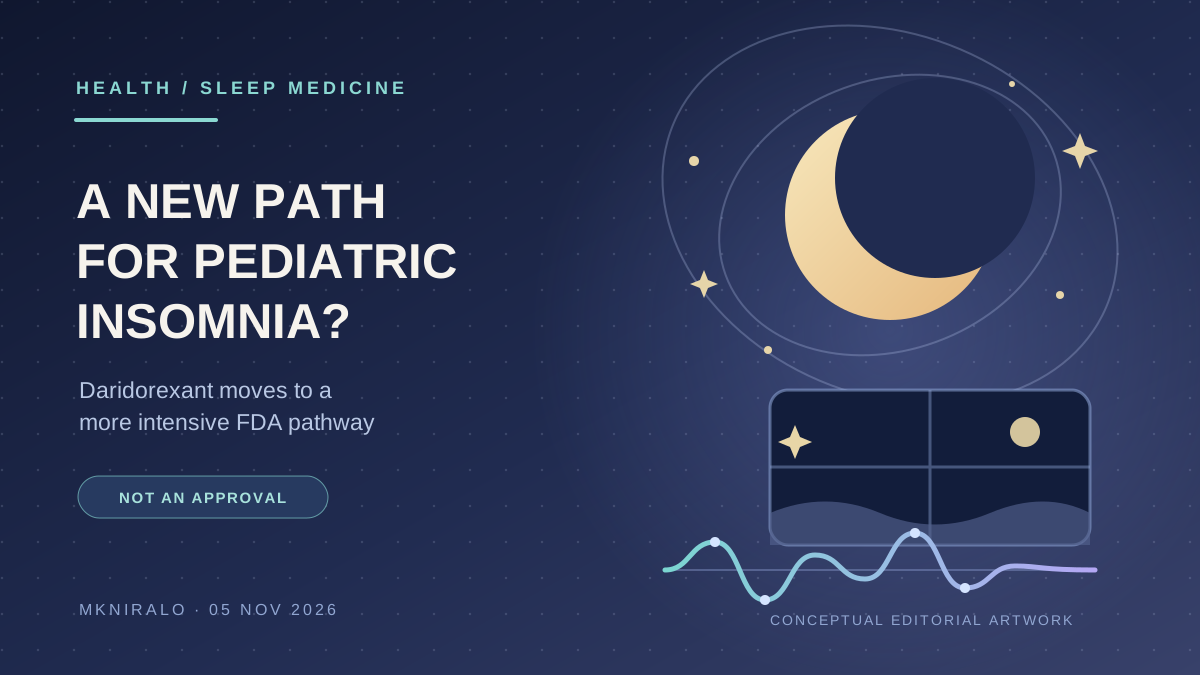
Idorsia said on November 4 that the U.S. Food and Drug Administration has granted Breakthrough Therapy Designation to daridorexant for insomnia disorder in patients aged 10 to under 18. The decision is a development milestone, not permission to market the medicine for children. The company points to a two-week Phase 2 study and says it is preparing a Phase 3 programme. The full study manuscript was still being evaluated by a scientific journal when the company announced the designation. Daridorexant remains investigational for pediatric use and is not approved or marketed for children or adolescents in any country.
What the breakthrough designation changes — and what it does not
The FDA describes Breakthrough Therapy Designation as a way to speed the development and review of a medicine intended for a serious condition when preliminary clinical evidence suggests it may offer a substantial improvement over available therapy on a clinically significant endpoint. A designated programme can receive the features of Fast Track, intensive FDA guidance on an efficient development plan and greater involvement from senior agency managers.
That closer regulatory engagement is meaningful, but it is not a marketing approval, a finding that the medicine is already proven safe and effective for children, or a guarantee that it will eventually be approved. Further studies must establish the benefit-risk profile for the proposed pediatric use, and the company must still complete the regulatory steps required for a marketing application. The product-specific announcement on November 4 came from Idorsia; the FDA source cited here explains the general designation framework.
Sources: Breakthrough Therapy Designation granted by the FDA for daridorexant in pediatric insomnia disorder · Breakthrough Therapy
A two-week study, with a small but important enrolment discrepancy
The supporting study, NCT05423717, was a multicentre, randomized, double-blind, placebo-controlled Phase 2 dose-finding trial. It evaluated 10 mg, 25 mg and 50 mg daridorexant, or placebo, over two weeks in patients aged 10 to under 18 with insomnia disorder. The primary objective was to assess the dose-response relationship for objectively measured total sleep time, using polysomnography. The primary endpoint was the change from baseline to Day 1.
There is a one-participant difference in the public counts. Idorsia's November 4 announcement and its October results release describe 165 children and adolescents; the ClinicalTrials.gov record lists actual enrolment as 166. The public materials reviewed do not explain the difference, so the figures should not be silently merged. The company also reports that more than half of participants had a diagnosed or subthreshold neurodevelopmental condition, including autism-spectrum or ADHD traits.
Sources: Breakthrough Therapy Designation granted by the FDA for daridorexant in pediatric insomnia disorder · NCT05423717: Dose-finding Study Assessing the Efficacy, Safety, and Pharmacokinetics of Daridorexant in Subjects Aged 10 to under 18 Years With Insomnia Disorder · Idorsia presents outstanding results with daridorexant in children and adolescents with insomnia at Sleep Europe 2026
The signal: more sleep after the first dose, but not yet a complete evidence base
Idorsia reported that the study met its primary endpoint, with a statistically significant dose-response improvement in total sleep time on Day 1 (p=0.0185). In the 50 mg group, objectively measured sleep time increased by 50 minutes from baseline, compared with 20 minutes in the placebo group. Among participants with neurodevelopmental disorders, the corresponding changes were 64 minutes and 27 minutes. After two weeks, caregiver-reported total sleep time in the overall 50 mg group had increased by about 69 minutes from baseline, compared with about 30 minutes with placebo.
These are sponsor-reported results, not yet a complete peer-reviewed publication. The 50-minute figure is a change from baseline, not 50 additional minutes attributable to the drug over placebo; the placebo group also improved. Idorsia said the full manuscript was under journal evaluation. That matters because readers and clinicians still need the full methods, analysis, missing-data handling, subgroup definitions and complete outcome tables before judging how robust and clinically meaningful the signal is.
The company reported that adverse-event incidence at 50 mg was similar to placebo and that no events suggesting abuse potential or physical dependence, or withdrawal symptoms after stopping treatment, were observed during the study. A two-week trial with roughly 165 participants cannot establish long-term pediatric safety or rule out uncommon adverse events. The findings are a reason to continue testing, not a basis for treating the medicine as an established pediatric option.
Sources: Breakthrough Therapy Designation granted by the FDA for daridorexant in pediatric insomnia disorder · Idorsia presents outstanding results with daridorexant in children and adolescents with insomnia at Sleep Europe 2026
Pediatric insomnia is not one uniform problem
Insomnia in children and adolescents can involve difficulty falling asleep, staying asleep or both, but the reasons and consequences vary with age and with coexisting conditions. Sleep problems may be intertwined with neurodevelopmental conditions, anxiety, other medical issues, irregular schedules or learned sleep behaviours. A drug that changes sleep duration in a trial does not by itself answer which children should receive medication, or whether the underlying cause has been correctly identified.
A 2026 review in Pediatrics in Review describes cognitive behavioural therapy for insomnia (CBT-I) as the most effective treatment approach and notes evidence for melatonin in some children with autism or ADHD, while emphasizing that other pharmacological options need further study. The American Academy of Neurology's guidance for children and adolescents with autism also places behavioural strategies first, with melatonin considered when those strategies and contributing conditions have been addressed. The absence of an FDA-approved drug specifically for pediatric insomnia, as described by Idorsia, does not mean that no care options exist or that medication is appropriate for every child.
Sources: Breakthrough Therapy Designation granted by the FDA for daridorexant in pediatric insomnia disorder · Pediatric Insomnia · Practice guideline: Treatment for insomnia and disrupted sleep behavior in children and adolescents with autism spectrum disorder
Adult approval does not establish pediatric safety or dosing
Daridorexant is a dual orexin receptor antagonist. It acts on the orexin signalling system involved in wakefulness, rather than working like a traditional sedative that broadly suppresses central nervous system activity. In the United States, the branded product QUVIVIQ is approved for adults with insomnia. The FDA-approved prescribing information states that its safety and effectiveness have not been established in pediatric patients.
The Phase 2 trial tested 10 mg, 25 mg and 50 mg, with 50 mg also being the highest recommended adult dose. That does not make 50 mg a recommended dose for children. The adult label includes warnings about next-day impairment, worsening depression or suicidal thinking, sleep paralysis, hallucinations and complex sleep behaviours. Those adult-label warnings are not pediatric trial rates, but they underline why a dedicated pediatric evidence package is necessary before any child-use claim can be made.
Sources: QUVIVIQ (daridorexant) Prescribing Information · NCT05423717: Dose-finding Study Assessing the Efficacy, Safety, and Pharmacokinetics of Daridorexant in Subjects Aged 10 to under 18 Years With Insomnia Disorder · Idorsia presents outstanding results with daridorexant in children and adolescents with insomnia at Sleep Europe 2026
Phase 3 is the next test
Idorsia said it was consolidating feedback from health authorities on the pediatric Phase 3 protocol and expected to begin the programme in the second half of 2027. That is a company forecast, not a confirmed trial start date. The next studies will need to test whether the early sleep-time signal is reproducible, whether benefits persist, how doses should be selected for different ages and clinical profiles, and what longer-term safety looks like.
For families, the announcement does not change what can be prescribed today: pediatric daridorexant remains investigational. For regulators, the designation creates a more intensive development relationship. For the science, the central question remains open — whether a short-term improvement in measured sleep can translate into durable, meaningful benefit for children without unacceptable risks. The breakthrough is a faster route through development, not the end of that route.
Sources: Breakthrough Therapy Designation granted by the FDA for daridorexant in pediatric insomnia disorder · Breakthrough Therapy · QUVIVIQ (daridorexant) Prescribing Information · Pediatric Insomnia · Practice guideline: Treatment for insomnia and disrupted sleep behavior in children and adolescents with autism spectrum disorder