Japan’s lawmakers have taken an important step toward cheaper-taxed groceries, not completed a tax overhaul. The lower house voted on November 6 to advance a two-year food consumption-tax reduction and income-linked worker payments. A minority governing coalition in the upper chamber, unanswered fiscal questions and unsettled payment criteria stand between the proposal and implementation.
A decisive vote, but not an enacted law
Japan’s House of Representatives approved the government’s food consumption-tax reduction bill on November 6, moving Prime Minister Sanae Takaichi’s cost-of-living initiative into a more difficult legislative phase. The governing Liberal Democratic Party and Japan Innovation Party supported the measure, while opposition parties voted against it. Approval followed a vote in the chamber’s Financial Affairs Committee earlier the same day. The bill was then sent to the House of Councillors; neither the lower-house vote nor the transfer to the upper chamber makes it law.
The government’s draft, formally submitted as Cabinet Bill No. 1 in the 222nd Diet session, combines a temporary food-tax reduction with a new income-linked worker support payment. The lower house’s published legislative progress page still did not show the November 6 vote when checked for this article, even though multiple same-day Japanese news reports and the governing party confirmed the passage. That discrepancy is a reporting-status lag, not evidence that the reported vote did not occur.
Sources: 第222回国会閣法第1号 法律案等概要 · 閣法 第222回国会 1 租税及び社会保険料による負担の軽減のための飲食料品に係る消費税率の臨時的な引下げ及び就業者負担軽減支援金の支給に関する法律案 · 「経済の好循環」で財源確保 消費税・支援金法案が衆院通過 · 消費減税関連法案が衆議院通過 与党などの賛成多数で可決 野党は全党が反対
What would actually change at the checkout
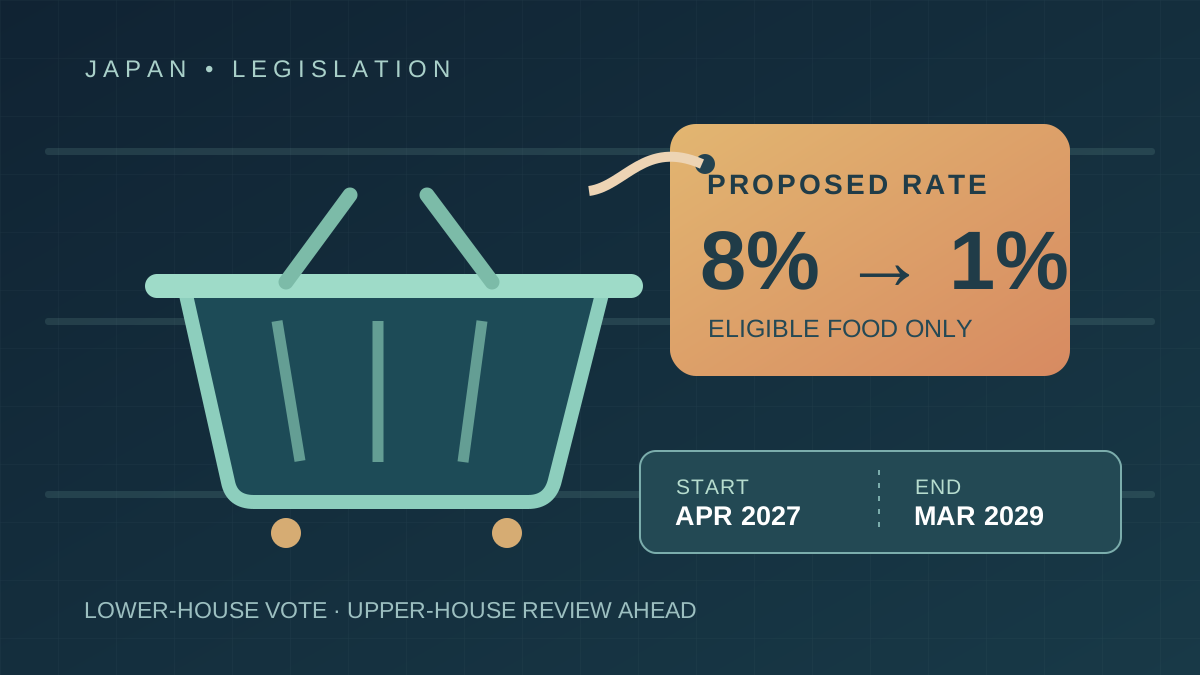
If enacted without a change to its dates, the bill would lower the combined national and local consumption-tax rate on eligible food from 8% to 1% from April 1, 2027, through March 31, 2029. The official bill summary specifies a 0.78% national component, with local consumption tax bringing the total to 1%. This is a temporary, narrowly defined rate, not the abolition of Japan’s consumption tax and not a permanent reduction across all purchases.
The affected category follows the existing reduced-rate treatment of food and nonalcoholic beverages. Alcoholic drinks and restaurant meals are excluded; other goods generally continue under the standard 10% rate. Even for eligible groceries, a 1% tax is not zero. A shop that passed the entire rate change through would charge less tax on an unchanged pretax price, but retailers’ pricing decisions, supply costs and competition would determine whether shelf prices fall in the same proportion. Consumers should not treat the tax-rate arithmetic as a guaranteed discount.
Sources: 第222回国会閣法第1号 法律案等概要 · ●租税及び社会保険料による負担の軽減のための飲食料品に係る消費税率の臨時的な引下げ及び就業者負担軽減支援金の支給に関する法律案 · 「軽減税率制度」について教えてください。
The cash payment is a separate, unfinished promise
The proposal pairs the remaining 1% food-tax charge with a support payment aimed at lower- and middle-income workers. Government supporters describe this combination as effectively eliminating the food-tax burden for recipients. That is a policy characterization, not a universal exemption: the tax would still be collected at the register, and a payment would depend on a person meeting the final eligibility rules and receiving the money.
The bill’s published outline says support amounts would take account of employment income and the number of dependent children. It envisages decisions through applications and, for some holders of registered public-benefit payment accounts, administrative determination. The fuller income-linked scheme is planned from fiscal 2029, when the temporary tax reduction ends. Crucial parameters—including precise income limits, individual payment sizes and implementation procedures—had not been fixed publicly by the lower-house vote.
Takaichi told lawmakers the government was examining coverage for roughly 30% or more of working people, according to the ruling party’s account and Japanese television reporting. This is a direction under discussion, not a published list of eligible households. Widening coverage while keeping the same payment envelope generally means smaller amounts per recipient; narrowing it means fewer people receive help.
Sources: 第222回国会閣法第1号 法律案等概要 · ●租税及び社会保険料による負担の軽減のための飲食料品に係る消費税率の臨時的な引下げ及び就業者負担軽減支援金の支給に関する法律案 · 「経済の好循環」で財源確保 消費税・支援金法案が衆院通過 · 石破前首相ら自民4人が退席 衆院採決「懸念払拭できず」 · 消費税減税法案、衆院通過…今後の焦点は? 支援金の対象・給付額、具体像なく
How the price tag reaches the public finances
Funding is the unresolved question at the centre of the debate. An earlier TV Asahi report, citing the government’s tax-policy outline, put the expected fiscal hole at roughly ¥5 trillion annually, or around ¥10 trillion over the two-year period. Those are planning estimates rather than money already spent. The eventual cost depends on the taxable food base, purchasing patterns, administrative design and the support payments that are ultimately authorized.
The proposed early worker payment is linked to the equivalent of one percentage point of food consumption tax. A November 6 Yomiuri Shimbun report described an envelope of about ¥600 billion per year in fiscal 2027 and 2028—not ¥600 billion for both years combined. That figure describes the reported funding scale, not confirmed cash disbursement or a fixed benefit per worker. The official summary also directs the government to seek financing through expenditure and revenue reviews without relying on special deficit-financing bonds, while addressing the effects on local governments.
Takaichi has pointed to revenue growth and a review of existing funds and subsidies as possible ingredients, but the cabinet had not produced a detailed, itemized financing plan by the vote. The distinction matters: identifying a broad category of potential savings is different from passing a budget that specifies how and when those savings are achieved.
Sources: 第222回国会閣法第1号 法律案等概要 · 「経済の好循環」で財源確保 消費税・支援金法案が衆院通過 · 消費税減税法案、衆院通過…食料品の消費税率を2年間「1%」に引き下げ · 消費減税の大綱決定 5兆円の財源は?来年4月から「食料品消費税が1%」
Why the upper house is a real obstacle
The governing coalition controls the lower house but lacks a majority in the House of Councillors, so it cannot assume the next vote will repeat Friday’s result. After the bill passed, governing and opposition parliamentary managers agreed to begin upper-house plenary deliberations on November 11, according to TBS. A special committee is expected to examine the measure. That opening date is not a final enactment timetable, and amendments, negotiations or defeat remain possible.
The coalition’s challenge is not simply counting votes. Opposition lawmakers objected that the financing source and the beneficiaries of the new payment remained undefined when the bill was pushed through the lower house. Winning additional support may require concrete concessions on eligibility, funding or implementation. The government wants passage before the extraordinary Diet session ends on December 12, but that goal is an intention, not an assured legislative outcome.
The dissent also reached the ruling party. Former prime minister Shigeru Ishiba and three other Liberal Democratic Party lawmakers left the chamber before the vote. In remarks reported by Kyodo and local broadcasters, dissenters raised concerns about the missing financing plan, the purpose of consumption-tax revenue and uncertainty over whether stores would pass the reduction along to shoppers. Their walkout did not reverse the lower-house result, but exposed unresolved objections inside the coalition’s principal party.
Sources: 消費減税関連法案が衆議院通過 与党などの賛成多数で可決 野党は全党が反対 · 消費税減税法案、衆院通過…食料品の消費税率を2年間「1%」に引き下げ · 食料品の消費税減税法案 参議院は11日の本会議で審議入りへ 与野党国対委員長会談で合意 · 石破前首相ら自民4人が退席 衆院採決「懸念払拭できず」
What consumers should watch next
Three developments will determine whether Friday’s vote changes household finances. The first is the actual upper-house decision, including any amendments to the planned 1% rate or the April 2027 start. The second is a published funding package showing how the anticipated revenue loss and worker payments would be covered. The third is a detailed set of payment rules stating who qualifies, how claims are processed and when support would arrive.
Businesses would also need practical guidance for invoicing, registers and tax administration before a new rate takes effect. Households, meanwhile, face two distinct questions: how much the tax component of eligible food prices could decline, and whether they would qualify for a separate cash transfer. Even passage of the bill would not settle both questions immediately. As of November 6, the verified event is a lower-house approval of a proposal, not a nationwide tax change already in force.
Sources: 第222回国会閣法第1号 法律案等概要 · 「軽減税率制度」について教えてください。 · 閣法 第222回国会 1 租税及び社会保険料による負担の軽減のための飲食料品に係る消費税率の臨時的な引下げ及び就業者負担軽減支援金の支給に関する法律案 · 消費税減税法案、衆院通過…食料品の消費税率を2年間「1%」に引き下げ · 食料品の消費税減税法案 参議院は11日の本会議で審議入りへ 与野党国対委員長会談で合意 · 消費税減税法案、衆院通過…今後の焦点は? 支援金の対象・給付額、具体像なく