A spacecraft looking through Mars's thin atmosphere has found an unusual clue near one of the Solar System's widest volcanoes. A study published online on 4 November 2026 in Science Advances links localized hydrogen chloride signals around Alba Mons with narrow, apparently young surface fissures. Researchers argue that gases from a buried, still-warm magmatic system may explain the pattern. It is not a report of a witnessed eruption: no new lava, glowing vent, or directly measured surface hot spot has been presented.
Why hydrogen chloride was a surprise
Hydrogen chloride, or HCl, is a gas that can be released when chlorine-bearing material in magma loses pressure. On Earth, it is one ingredient in some volcanic emissions. But finding HCl in the air above Mars does not, by itself, identify a volcano: sunlight, dust, water vapor, ice and surface salts all complicate the Martian chlorine cycle. When the ExoMars Trace Gas Orbiter first reported atmospheric HCl in 2021, its broad distribution and association with weather were reasons to resist an immediate volcanic explanation.
The new claim is narrower. This time the researchers examined exceptions to that familiar pattern: distinct detections in early northern summer, during the colder part of the Martian orbit, concentrated around the northern Alba Mons region. Normal seasonal HCl is more widespread during warmer, dustier conditions and generally fades in the season under study. A localized signal when the usual atmospheric conditions are unfavorable warrants a search for a nearby source; it does not prove where that source lies.
Alba Mons sits within the enormous Tharsis volcanic province, which also contains Olympus Mons. Its broad footprint approaches the area of the contiguous United States.
Sources: European orbiter detects hints of volcanic activity on Mars · European orbiter detects hints of volcanic activity on Mars · Pungent gas above Martian fissures hints at ongoing volcanism · Something Weird is Seeping Out of Mars
What the orbiter actually measured
The instrument was the Atmospheric Chemistry Suite aboard the European Space Agency's ExoMars Trace Gas Orbiter. Its infrared spectrometers use solar occultation: as the Sun rises or sets behind Mars from the spacecraft's viewpoint, sunlight passes through successive layers of atmosphere. Each gas absorbs particular wavelengths, allowing scientists to detect trace molecules and estimate where in the atmospheric column they occur. This is spectroscopy, not a direct photograph of gas pouring from a hole.
A research-team conference abstract released in 2025 documented two exceptional observations north of Alba Mons in Mars Year 35 and described a subsequent targeted search in Mars Year 37. The November 2026 study brings that atmospheric search together with geological interpretation. Repeated signals in the same broad region strengthen the case that the anomaly deserves investigation, but a targeted campaign is not the same as an independent instrument confirming a vent on the ground.
Even the phrase 'above a fissure' describes a spatial association assembled from atmospheric observations and orbital images, not an observed jet moving continuously from one identified crack into space.
Sources: European orbiter detects hints of volcanic activity on Mars · On HCl in the Martian atmosphere during northern summers · European orbiter detects hints of volcanic activity on Mars · 'Living organisms might wait for us to discover them': Mars may host an environment similar to hydrothermal vents on Earth, where life first arose
Why the surface fissures matter
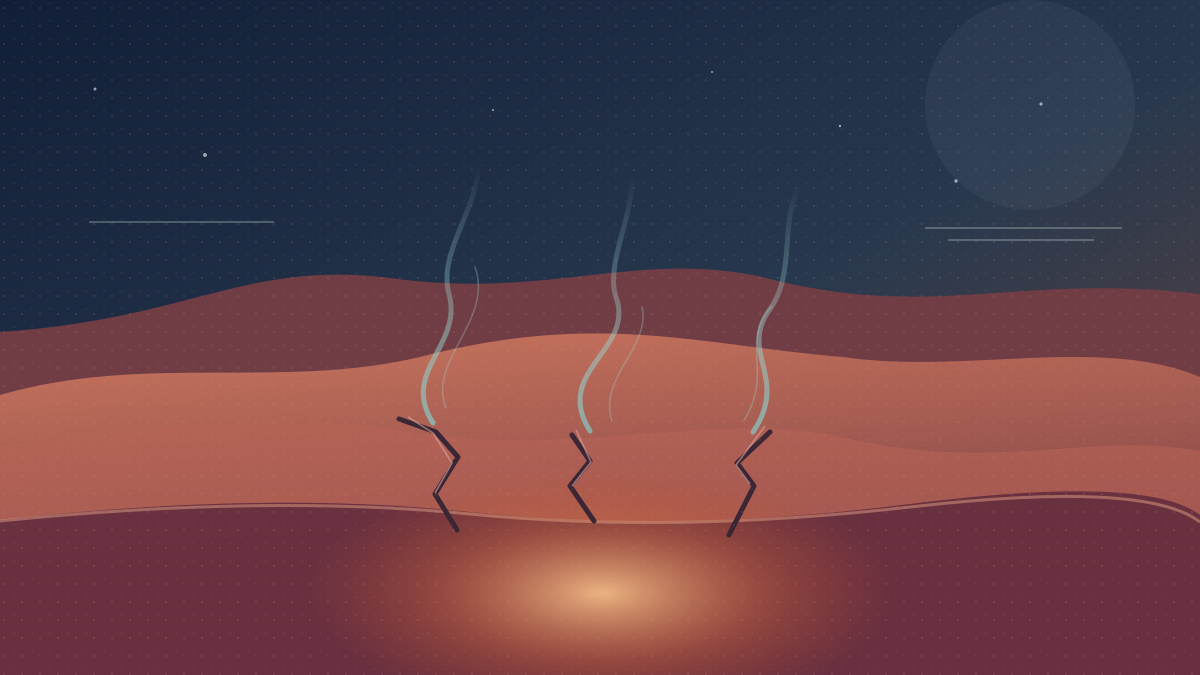
After studying the atmospheric readings, researchers looked more closely at the terrain using the orbiter's CaSSIS camera and other high-resolution orbital imagery. They identified swarms of slender cracks, some stretching hundreds of meters, with nearby patches of lighter or darker ground. On Earth, some volcanic fumaroles leave mineral deposits around vents. That resemblance offers a geological lead, but Martian color differences are not chemical proof of volcanic deposits.
The team's earlier planetary-science conference abstract says the fissures cross ice-rich mantle and patterned, periglacial ground thought to be younger than roughly one million years. If the interpretation of those relationships holds, the cracks are exceptionally young on a planet about 4.5 billion years old. Here 'recent' means geological recency, not a crack known to have opened last week, or even during the age of human spaceflight.
A proposed sequence follows: winter frost or ice plugs openings, subsurface gas accumulates, and early-summer warming turns the ice directly into vapor, allowing HCl to escape. The timing could help explain short-lived detections. Yet nobody has demonstrated that a particular photographed fissure is actively venting the measured HCl. Matching two datasets is an important step, not a direct measurement of the proposed connection.
Sources: European orbiter detects hints of volcanic activity on Mars · On HCl in the Martian atmosphere during northern summers · European orbiter detects hints of volcanic activity on Mars · Something Weird is Seeping Out of Mars
The magma explanation—and its rivals
The volcanic interpretation is physically plausible. Magma can contain dissolved chlorine compounds; as that magma rises, pressure falls, and volatile substances can separate from the melt. If a magmatic body persists beneath Alba Mons, fractures may offer a route for gas to work toward the surface. Researchers describe a possible dormant magma chamber, meaning a proposed subsurface plumbing system rather than a chamber that has been located or imaged.
But HCl is not a unique label stamped 'magma.' The ordinary Martian chlorine cycle is still incompletely understood, and reactions involving water, salts and warm rock could also produce chlorine-bearing gases without fresh molten rock directly below the fissures. Independent reporting also notes that the study team cannot be certain which, if any, of the visible cracks release the gas.
The new work makes a specific argument about the most convincing explanation of an unusual signal, rather than supplying a thermal image of active magma. No observed lava flow, eruption, fumarole temperature or measurable surface heat accompanies the atmospheric readings. Nor does the observation establish that an eruption is imminent.
Sources: European orbiter detects hints of volcanic activity on Mars · Pungent gas above Martian fissures hints at ongoing volcanism · Something Weird is Seeping Out of Mars · 'Living organisms might wait for us to discover them': Mars may host an environment similar to hydrothermal vents on Earth, where life first arose
How the finding fits earlier Martian evidence
The harder question is whether any part of its interior still supplies melt, and at what rate. NASA's InSight lander recorded marsquakes after arriving in 2018, demonstrating that the planet is not seismically silent. However, as National Geographic reported, InSight did not identify convincing magmatic seismic signals originating from Alba Mons or the wider Tharsis region. Quakes elsewhere cannot be converted into a confirmed active magma chamber under this particular volcano.
Earlier evidence has come from a different region. In a 2021 Icarus study, researchers examined a possible explosive volcanic deposit near the Cerberus Fossae fissures of Elysium Planitia and estimated a model age of roughly 53,000 to 210,000 years. They treated the material's volcanic origin as an interpretation. That older work and its crater-based dating are useful historical context, not methods or results from the new Alba Mons gas study.
Yet the evidence comes from different locations, techniques and levels of certainty. A young-looking surface feature, an atmospheric gas detection and a marsquake each answer different scientific questions; no one observation can substitute for the others.
Sources: Something Weird is Seeping Out of Mars · Evidence for geologically recent explosive volcanism in Elysium Planitia, Mars · Pungent gas above Martian fissures hints at ongoing volcanism
What a future investigation must still prove
A sufficiently warm hydrothermal setting could, in principle, provide chemical energy and protection from the harsh surface. That is a possible habitat, not evidence that liquid water exists at the Alba Mons fissures today, and certainly not evidence that microbes live there.
Future observations could look for the same localized chemical anomaly across additional Martian seasons, compare it with other gases, and seek changes on the surface at the candidate sites. Better measurements might distinguish gas released by stored chemistry from gas continually replenished by molten material. Researchers would also want independent observations that tie atmospheric signals to specific vents or show a thermal or seismic signature consistent with a local magmatic system.
For now, the compelling result is a testable connection between an oddly timed atmospheric signal and youthful fractures at a long-dormant volcano. Mars may have retained more volcanic potential than its quiet landscape suggests. The discovery gives researchers a stronger place to look, while leaving the central question—whether magma is active beneath Alba Mons—open.
Sources: European orbiter detects hints of volcanic activity on Mars · European orbiter detects hints of volcanic activity on Mars · Pungent gas above Martian fissures hints at ongoing volcanism · Something Weird is Seeping Out of Mars · 'Living organisms might wait for us to discover them': Mars may host an environment similar to hydrothermal vents on Earth, where life first arose