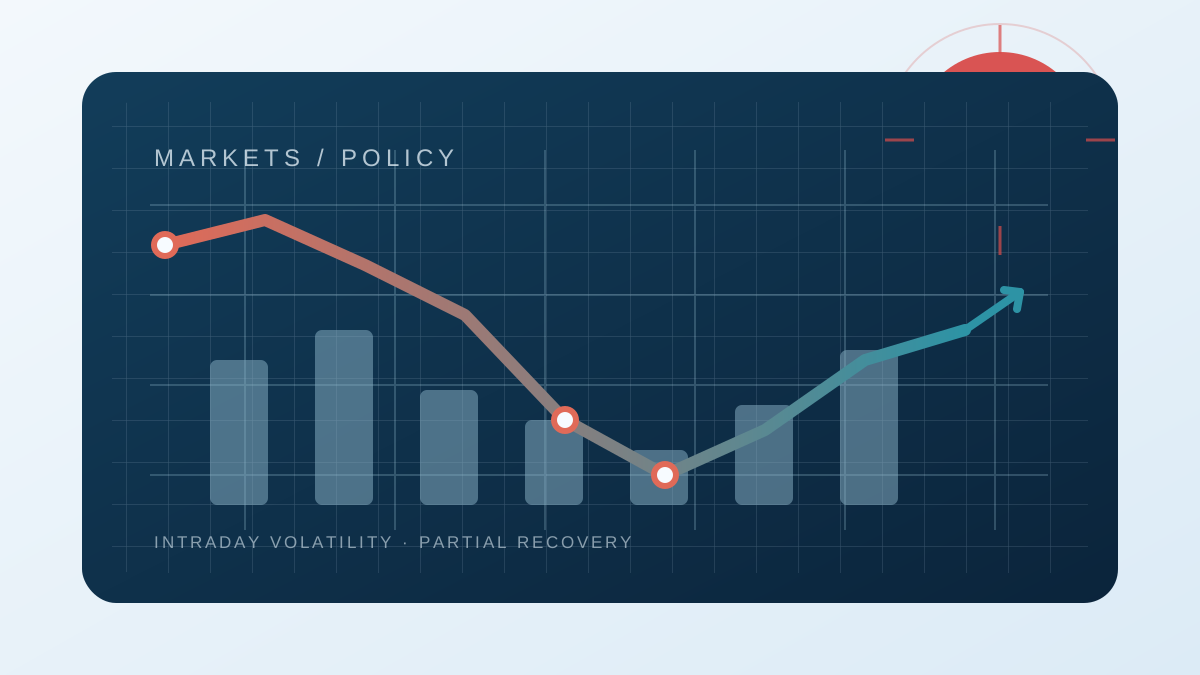
The Nikkei 225 briefly fell about 4.8% from its previous close on November 4, after Democrats won control of both chambers of the US Congress, according to the Associated Press. But the index recovered much of the intraday loss and closed down 1.42%. Official index data and market reporting point to concern about the future of AI and data-centre investment—not an immediate change in US law—as one important part of the reaction.
The 4% figure describes the session’s low
The Nikkei 225 did fall by more than 4% during Wednesday’s trading, but that was an intraday move rather than its closing result. Nikkei’s official daily summary records a low of 60,030.10 at 13:37 Tokyo time. Compared with the previous trading session’s close of 63,081.86, that low represents a decline of about 4.84%.
By the close, the index had recovered to 62,188.63, down 893.23 points, or 1.42%. The distinction matters: a report that says simply that the Nikkei “fell 4%” can make the whole session sound like a closing collapse. The official record instead shows a sharp midday sell-off followed by a substantial recovery before the market finished.
Sources: Daily Summary — Nikkei Stock Average (Nikkei 225), November 4, 2026 · Historical Data (Nikkei 225)
The political shift changed expectations, not the law overnight
The market move came as the Associated Press reported that Democrats had won control of both the House and Senate in the 2026 US midterm elections. The result changes the political balance in Washington and gives Democrats more power to block legislation, scrutinise the administration and shape congressional investigations. It does not, by itself, put a new regulatory regime into force.
That distinction was central to the early market debate. Reuters noted that President Donald Trump retains veto power and that Democrats do not have a veto-proof Senate majority. Investors were therefore responding to the possibility of a different policy environment, not to a set of new federal rules already enacted.
Sources: The Latest: Voters give Democrats control of Congress in rebuke to Trump · Morning Bid: Markets fret blue wave will drown data centres
Japan’s technology exposure magnified the move
The Nikkei’s own sector data help explain why the reaction in Tokyo was pronounced. Technology accounted for 40.75% of the index’s sector weight on November 4. The technology sector subtracted 755.23 points from the day’s change, while information and communications removed another 123.06 points. Consumer goods moved in the opposite direction and provided a partial offset.
This is not evidence that every Japanese company was hit equally. The index’s decline was concentrated in sectors whose valuations and growth expectations are closely linked to global technology spending. When investors reassess the prospects for AI infrastructure, data-centre construction or the cost of capital, a benchmark with a large technology weighting can react more sharply than the wider domestic economy.
Sources: Daily Summary — Nikkei Stock Average (Nikkei 225), November 4, 2026
Data centres became the bridge between politics and earnings
Reuters’ market coverage identified a specific concern behind the technology sell-off: investors were considering whether Democratic gains could lead to tougher scrutiny of artificial-intelligence development and data-centre expansion. The issue is not limited to federal legislation. State governments and local authorities can influence projects through land-use decisions, permitting, water requirements and access to electricity.
That creates a complicated policy channel. Data centres have become a major source of demand for chips, servers, power equipment, construction and electricity. If new projects face longer approval processes or higher operating requirements, investors may revise assumptions about the pace and profitability of future investment. But Reuters also reported that passing broad federal rules could be difficult under the current constitutional balance. A political signal is not the same thing as an implemented restriction.
Sources: Morning Bid: Markets fret blue wave will drown data centres · Dollar retreats as Democratic wins in US midterms stoke AI regulation jitters
A recovery by the close is not an all-clear
The index’s recovery from its low shows that the first market reaction did not remain intact through the close. It does not establish why prices recovered, nor does it prove that investors have dismissed the election’s implications. A single session combines many moving parts: global equity positioning, currency moves, bond yields, company-specific news and the changing interpretation of political risk.
The more defensible reading is narrower. The election result coincided with a repricing of technology-related expectations across Asian markets, while the Nikkei’s sector composition made that repricing especially visible. The closing loss was materially smaller than the intraday decline, and neither number alone tells us whether the market has begun a lasting trend.
Sources: Daily Summary — Nikkei Stock Average (Nikkei 225), November 4, 2026 · Historical Data (Nikkei 225) · Morning Bid: Markets fret blue wave will drown data centres
What investors will need to see next
The next useful signals will be concrete rather than rhetorical: proposed bills, committee investigations, state-level data-centre permitting decisions, utility investment plans and any changes companies make to capital-expenditure guidance. Those developments can show whether the political debate is turning into a real constraint on projects or remaining a source of uncertainty.
For readers trying to understand the market reaction, three questions should stay separate: what voters decided, what elected officials can legally change, and what companies actually do in response. The first is now clear enough for markets to react to. The second will depend on legislative and administrative processes. The third will emerge through investment decisions and earnings reports, not from one volatile trading session.
Sources: The Latest: Voters give Democrats control of Congress in rebuke to Trump · Morning Bid: Markets fret blue wave will drown data centres · Dollar retreats as Democratic wins in US midterms stoke AI regulation jitters