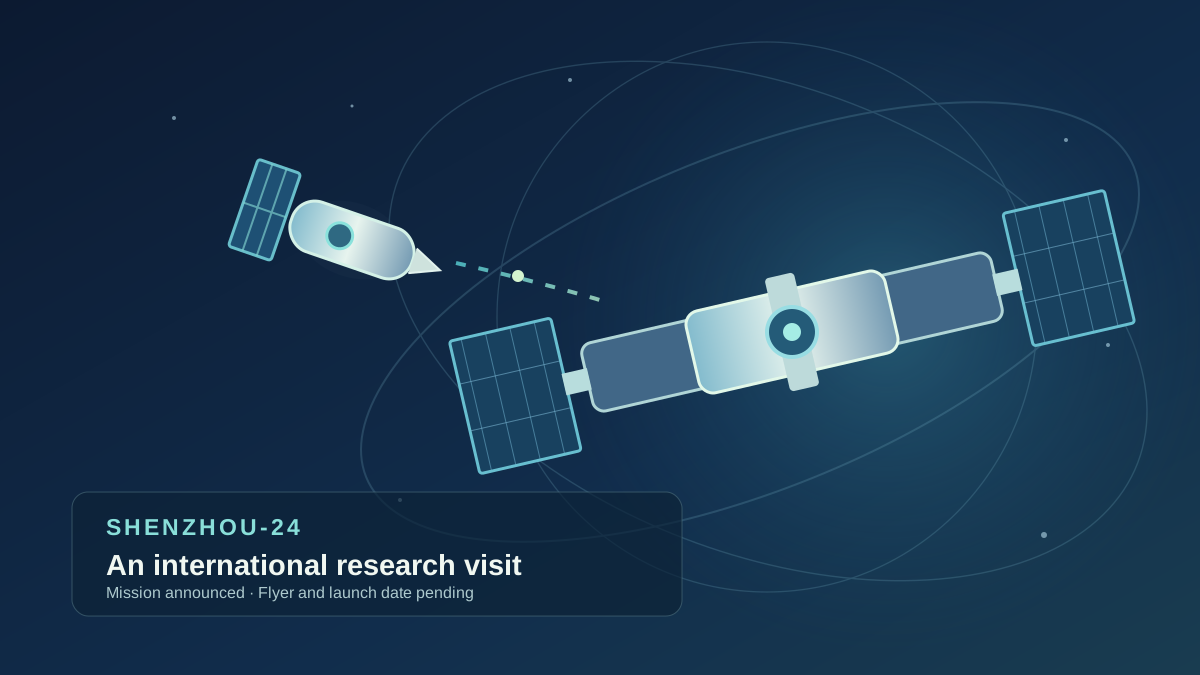
China has formally identified the mission that is expected to bring the first foreign visitor to its Tiangong space station. In an announcement on November 7, the China Manned Space Agency said one Pakistani astronaut would fly as a payload specialist aboard Shenzhou-24, complete a short stay in orbit and return on Shenzhou-23. The agency called it the first joint flight involving Chinese and foreign astronauts in the history of its crewed space programme. That is a significant policy and operational step, but not a report of a launch already completed. It also leaves two details unresolved: which of the two Pakistani candidates will fly and precisely when the mission will depart. A date previously given by a Pakistani minister should not be mistaken for a confirmed Chinese launch notice.
A named mission, not an announced launch
The November 7 notice changes the status of the story from a general plan for a Pakistani flight to a specific assignment on Shenzhou-24. It identifies the visitor’s role as payload specialist and says the astronaut will return aboard the Shenzhou-23 spacecraft following a short-duration visit. Those are the operational facts China’s crewed-spaceflight authorities have chosen to make public. The statement does not identify the astronaut, specify a departure time, or give a precise length for the stay.
According to the agency, Tiangong will receive its first foreign visitor and the programme will conduct its first combined flight with Chinese and non-Chinese astronauts. The distinction matters: this is a first for China’s own space station and crewed programme, not a claim that no foreign national has ever flown in space. Reuters and the Associated Press reported the announcement while preserving its forward-looking language. A planned historic flight is not yet a completed one.
Sources: 中国空间站将迎来首位外籍航天员 · Pakistani astronaut to join China space station's Shenzhou-24 mission · Pakistani astronaut to board Shenzhou 24 and become the first foreigner on China’s space station · First foreign astronaut to board Chinese space station
Two trained candidates, one seat still publicly unassigned
The two candidates are Muhammad Zeeshan Ali and Khurram Daud. China’s official reports named them in April, after the selection process ended in early April, and said they entered the Astronaut Center of China in Beijing on April 24. Both were selected as reserve astronauts; one is intended to take the flight and the other to remain as backup. The November announcement repeats that structure without making a public choice between them.
The preparation is practical rather than ceremonial. In interviews published by Reuters in September, officials from Pakistan’s space agency, SUPARCO, described Mandarin instruction, spacecraft-system familiarisation, high-gravity centrifuge work and learning to function in microgravity. The two pilots emerged from a selection pipeline narrowed to roughly 20 finalists, Reuters reported. An anticipated decision window in October has passed, but an earlier forecast of when a decision might be made is not evidence that a winner has been formally disclosed.
Sources: 中国空间站将迎来首位外籍航天员 · Two Pakistani astronauts arrive in China for space mission training · 神舟二十三号载人飞行任务新闻发布会召开 · China's space diplomacy lifts Pakistani astronaut toward orbit
Why November 25 is not yet an official launch date
Pakistan’s Planning Minister Ahsan Iqbal said at the closing ceremony of World Space Week in Narowal on October 18 that Pakistan’s first astronaut would undertake a mission from China on November 25. Radio Pakistan carried that statement the same day; Dawn reported it in its October 19 edition. It is a clearly attributable ministerial announcement, and there is no reason to conceal it from readers. There is, however, an equally important limit to its status.
Reuters reported on November 7 that Beijing had not announced a date for Shenzhou-24, and the agency’s own November 7 notice gives none. The responsible reading is therefore that November 25 was the Pakistani minister’s stated target, not a date subsequently confirmed by China’s mission authority. Launch schedules depend on technical readiness and other operational decisions. Until an official mission notice appears, publishing the date without that distinction would turn a projection into a certainty.
Sources: 中国空间站将迎来首位外籍航天员 · Pakistani astronaut to join China space station's Shenzhou-24 mission · Pakistan’s first astronaut heads to space on Nov 25: Ahsan Iqbal · Pakistan’s first astronaut to embark on space mission in November 2026: Ahsan
How the return on Shenzhou-23 fits the station plan
The spacecraft numbers can look backwards at first: the Pakistani visitor is expected to arrive on Shenzhou-24 yet return on Shenzhou-23. That is exactly the arrangement in the new official notice. China had earlier announced that one member of the Shenzhou-23 crew would undertake a year-long orbital-residency experiment instead of following the usual shorter rotation. The agency described the experiment at its May 23 Shenzhou-23 press conference as a test of human adaptation and health support during longer stays in space.
Reuters’ earlier reporting, based on Pakistani space officials, explains the seating logic: the foreign payload specialist is expected to use a return position made available while one Chinese astronaut remains in orbit. That is a reported explanation of the arrangement, not a reason to invent an exact landing date or mission duration. The confirmed requirement is a short orbital visit followed by the Shenzhou-23 return. Details of the full crew and final flight sequence remain subject to the operators’ announcements.
Sources: 中国空间站将迎来首位外籍航天员 · 神舟二十三号载人飞行任务新闻发布会召开 · China's space diplomacy lifts Pakistani astronaut toward orbit · First foreign astronaut to board Chinese space station
A scientific passenger, with experiments still ahead
A payload specialist is aboard principally to work with research equipment and experimental procedures, rather than to pilot the spacecraft. SUPARCO officials told Reuters in September that Pakistani universities had submitted more than 300 proposals and that Chinese institutes had selected four biotechnology experiments for the mission. They described intended applications related to food security and climate change, with hardware developed and tested at SUPARCO before Chinese engineering clearance. These are reported preparation plans, not completed results from orbit.
Tiangong already supports research in areas such as life science, materials and microgravity physics, as the Chinese agency outlined during its Shenzhou-23 briefing. That wider station research should not be confused with the specific Pakistani payload: the publicly described Pakistani selection concerns biotechnology. No findings from the proposed Pakistani experiments can be claimed in advance. Their value will have to be assessed after the experiments actually fly, operate as intended and produce data researchers can examine.
Sources: 神舟二十三号载人飞行任务新闻发布会召开 · China's space diplomacy lifts Pakistani astronaut toward orbit
A diplomatic first that still has practical tests ahead
The flight builds on an agreement signed in Islamabad in February 2025 covering the selection and training of a Pakistani astronaut and participation in China’s space-station operations. Chinese authorities have presented the programme as an opening to international partners; Reuters places it within a wider relationship that includes satellites and other space technology. Pakistan is gaining access to an orbital laboratory through another country’s launch vehicle, training system and spacecraft, not launching its own independent human-spaceflight capability.
That distinction does not diminish the mission. It helps define what success would demonstrate: safe integration of a foreign crew participant, a workable division between visiting research duties and station operations, and an opportunity to run Pakistani-designed experiments in orbit. The next verifiable milestones are an official identification of the selected astronaut, an authoritative launch notice, confirmation of the crew and payload, and eventually the flight itself. Until then, the most accurate headline is about a confirmed assignment to Shenzhou-24—not a confirmed November 25 launch or an accomplished historic visit.
Sources: 中国空间站将迎来首位外籍航天员 · Pakistani astronaut to join China space station's Shenzhou-24 mission · Pakistani astronaut to board Shenzhou 24 and become the first foreigner on China’s space station · Two Pakistani astronauts arrive in China for space mission training · China's space diplomacy lifts Pakistani astronaut toward orbit · First foreign astronaut to board Chinese space station