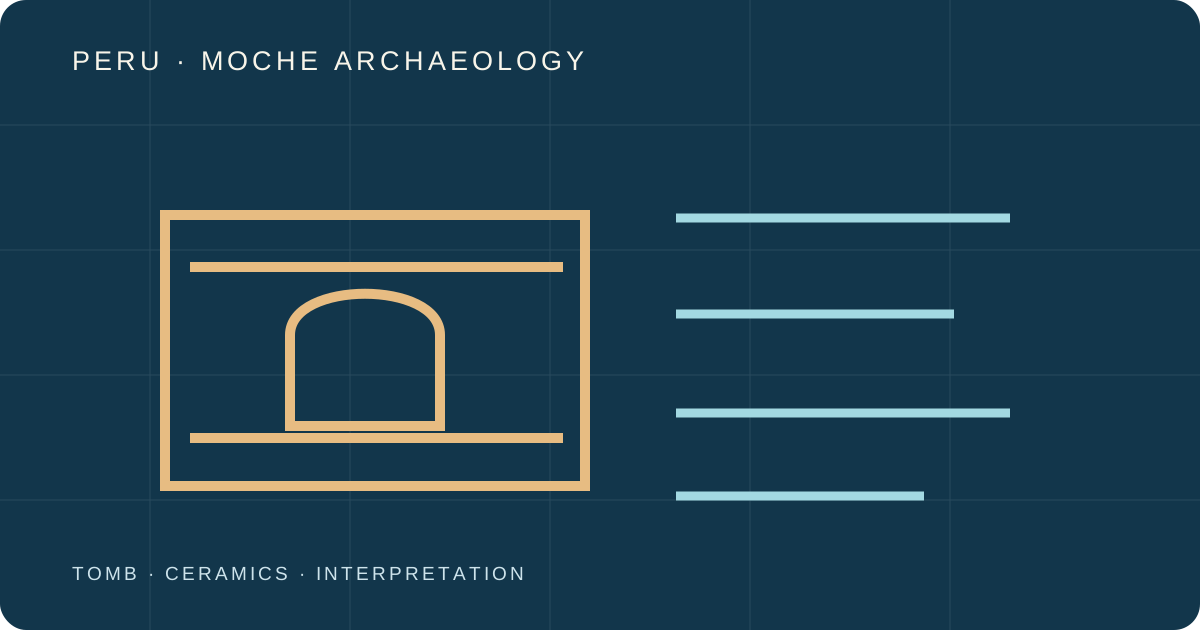
At the Huaca de la Luna temple complex near Trujillo in northern Peru, an infant burial discovered during October excavations has raised a difficult question about status in Moche society. A child believed to have died more than 1,400 years ago was buried with 32 ceramic objects and pieces of metal, including a possible copper face covering. The objects are striking, but investigators have not established the child's name, sex, family relationships or exact social position.
Where was the burial discovered?
Archaeologists working at the Uhle funerary platform beside the Courtyard of the Serpents at the Huacas de Moche complex reported the tomb in October 2026. The platform sits near Huaca de la Luna, a major ceremonial centre of the Moche culture.
Project director Carlos Rengifo said important earlier burials on that platform had belonged to adults apparently accorded elevated status. This child's burial is unusual in that setting, but the archaeological record at one platform cannot be assumed to describe every Moche community.
Sources: Peru: Elite Moche infant's tomb discovered at Huaca de la Luna · Moche infant tomb and 32 offerings in Trujillo · Elite infant burial discovered at Moche temple
What was placed in the tomb?
The burial structure measured about 1.20 metres in length, 70 centimetres in width and 1.20 metres in depth. Excavators described a collection of 32 ceramic pieces including plates, bottles and representations of captives, conflict, deities and bird-like figures.
Investigators also reported a metal covering near the skull that may be copper and another metallic object by the feet. These preliminary material identifications are not the same as a laboratory-confirmed alloy analysis.
Sources: Peru: Elite Moche infant's tomb discovered at Huaca de la Luna · Moche infant tomb and 32 offerings in Trujillo
Why does the child's age change the questions?
The excavators' interpretation is that the many offerings and their location suggest high status, despite the short life of the person buried. Previously documented rich graves at the same platform involved adults whose standing may have developed during life.
One possibility is that family or inherited position played an important role in the burial ceremony. That is a hypothesis rather than proof of a hereditary royal title, and there is no basis in the available reporting to assign the child a definite sex or to identify a named ruler.
Sources: Peru: Elite Moche infant's tomb discovered at Huaca de la Luna · Elite infant burial discovered at Moche temple · Moche tomb, 32 objects and interpretation
What do the pottery scenes show?
Some vessels contain imagery associated with prisoners, sacrifice and combat, themes present in Moche religious and ceremonial art. Other objects feature birds, fish and frogs, which researchers connected to water and fertility symbolism.
The presence of those images does not establish that the child was sacrificed, nor does it tell us the precise reason each item was included. The pottery needs iconographic study, excavation context and comparison with other sites before deeper claims can be made.
Sources: Peru: Elite Moche infant's tomb discovered at Huaca de la Luna · Moche infant tomb and 32 offerings in Trujillo · Moche tomb, 32 objects and interpretation
How do archaeologists protect and interpret the finds?
Archaeologist Enrique Zavaleta said the excavation team planned conservation of the ceramics after removal, preserving their colour and physical condition. Further work on the surrounding platform was scheduled beyond the initial grave excavation.
Archaeological conservation is not the same as having artefacts ready for public exhibition. The team's goal of eventually integrating finds into a museum or visitor route remains a proposed presentation step, not a confirmation that all objects are on display today.
Sources: Moche infant tomb and 32 offerings in Trujillo · Elite infant burial discovered at Moche temple · Moche tomb, 32 objects and interpretation
What questions remain open?
Researchers still need to establish the precise dating, details of the human remains, the metal composition, how objects were arranged in relation to the body and how this tomb compares statistically with other Moche burials.
The durable discovery is not a ready-made story of a prince or princess. It is evidence that may change how archaeologists understand childhood and funerary status in a complex society whose material culture still raises new questions.
Sources: Peru: Elite Moche infant's tomb discovered at Huaca de la Luna · Elite infant burial discovered at Moche temple · Moche tomb, 32 objects and interpretation