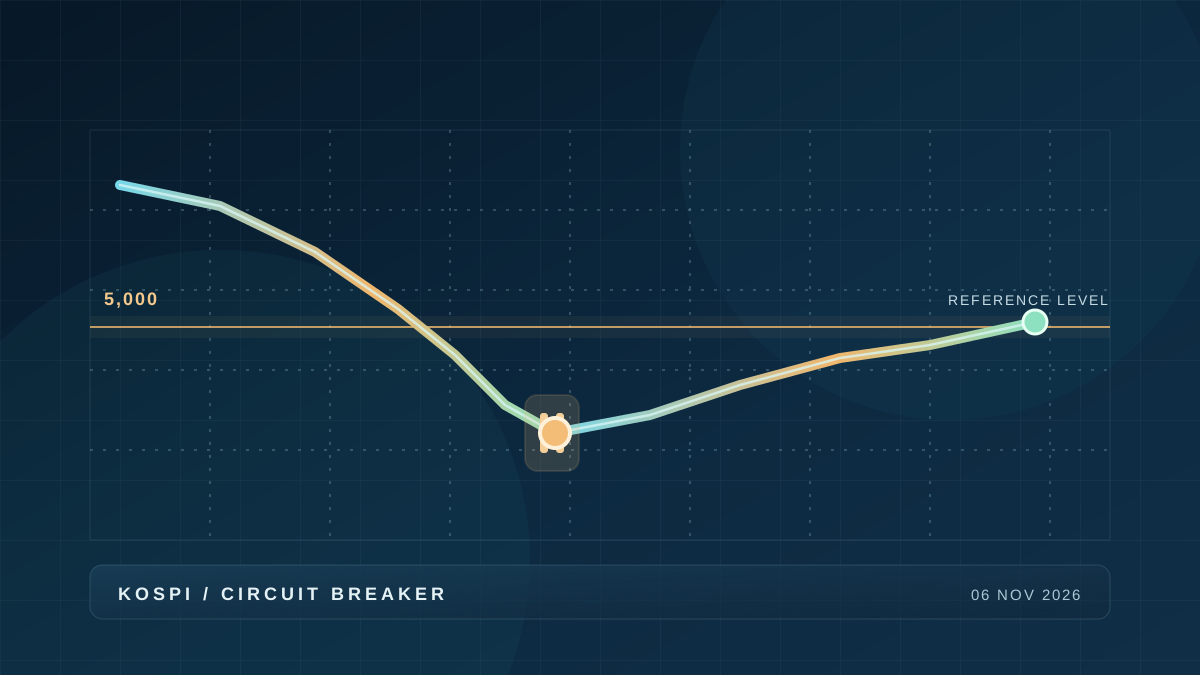
The KOSPI opened on Nov. 6 at 5,263.26, already 2.24% below the previous close. Within minutes it had fallen below 5,000; at 9:02 a.m. it touched 4,911.28. At 9:03, the Korea Exchange suspended trading for 20 minutes after the index reached 4,924.61, down 8.52%. The KOSPI later ended at 5,059.69, down 324.11 points, or 6.02%. The KOSDAQ closed at 644.27, down 5.03%. Those final figures matter: after Thursday’s 5.28% fall, the main index had endured two consecutive sessions of sharp losses, crossed below 5,000 intraday and only narrowly finished above it. The circuit breaker interrupted trading, but it could not remove the losses or promise a recovery.
A three-minute fall triggered the market-wide pause
The exchange activated a Stage 1 circuit breaker at 9:03 a.m. Korea time, after the KOSPI fell 459.19 points from Thursday’s close of 5,383.80 to 4,924.61, an 8.52% decline. The threshold had remained breached for one minute. Trading in KOSPI-listed shares was halted for 20 minutes; trading then resumed through a 10-minute single-price call auction before continuous trading returned.
The halt was the KOSPI’s 11th circuit breaker of 2026 and 17th on record, according to KRX-attributed reports from Financial News and KBS World. That count fits the previous KOSPI halt on Oct. 15, which eDaily identified as the 10th this year and 16th overall. AsiaToday and Yonhap both called the Nov. 6 event the 10th, but that figure conflicts with the October count and the later exchange-attributed reporting. The more consistent total is 11th this year and 17th historically.
Sources: KOSPI Plunges over 8% in Morning Trade, Triggering Circuit Breaker and Sidecar · KOSPI Circuit Breaker Followed by Sell-Sidecar; Semiconductor Stocks Plunge Around 10% · [속보]코스피·코스닥 8%대 폭락…사이드카 이어 서킷브레이커까지 · Trading of KOSPI stocks suspended amid tech sell-off · KOSPI falls below 5,000 in 8% plunge, triggering circuit breaker
A circuit breaker is a time-out, not a price floor
South Korea’s rules use three stages. Stage 1 is triggered when the KOSPI or KOSDAQ index falls at least 8% from the previous session’s close and remains there for one minute; the relevant stock market is then suspended for 20 minutes. Stage 2 requires a fall of at least 15% from the previous close and a further decline of at least 1% from the Stage 1 trigger level, again sustained for one minute. Stage 3 requires a 20% fall and a further 1% drop from the Stage 2 trigger level; it closes the market for the day.
The purpose is to interrupt an accelerating sell-off and give participants time to reassess prices and information. It does not guarantee that prices will stabilize when trading restarts, set a minimum value for shares or compensate investors for losses. The morning low of 4,911.28 and the 6.02% closing decline show the distinction: the halt created a pause, not a shield against further selling.
Sources: Guide to Trading in the Korean Stock Market · 주식투자자 > 주식시장 감시제도 > 매매거래중단·정지 및 시장경보제도 이해하기 > 서킷브레이커·매매거래정지 및 시장경보제도 · KOSPI Circuit Breaker Followed by Sell-Sidecar; Semiconductor Stocks Plunge Around 10%
Sidecars apply a narrower brake to program trading
A sidecar is different. It temporarily suspends the effectiveness of program-trading orders rather than stopping all trading in the market. On Nov. 6, a sell-sidecar was activated on the KOSDAQ at about 9:06 a.m. A separate KOSPI sell-sidecar followed at about 9:34 a.m., after the main market reopened. At the KOSPI trigger, the front-month mini KOSPI 200 futures contract was down 6.77%, from a reference price of 837.80 to 781.00.
Under the KRX guide, the KOSPI sidecar threshold is a move of at least 5% in KOSPI 200 futures sustained for one minute; the program-order curb lasts five minutes. The KOSDAQ uses a separate test involving KOSDAQ 150 futures and the cash index. This is a targeted brake on automated order flow, not a second circuit breaker: ordinary orders can still be entered, and the broader market is not shut down.
Sources: Guide to Trading in the Korean Stock Market · 주식투자자 > 주식시장 감시제도 > 매매거래중단·정지 및 시장경보제도 이해하기 > 서킷브레이커·매매거래정지 및 시장경보제도 · KOSPI Circuit Breaker Followed by Sell-Sidecar; Semiconductor Stocks Plunge Around 10% · KOSDAQ triggers sell-sidecar as index teeters on 630-point level
The 5,000 line mattered because it had been tested before
The KOSPI’s fall below 5,000 was its first intraday breach since Feb. 6, not Feb. 2. The index also fell below 5,000 on Feb. 2, closing at 4,949.67 after reaching 4,933.58. But it dipped again on Feb. 6, reaching 4,899.30 before recovering to close at 5,089.14. Feb. 6 was therefore the more recent previous intraday break. The February 2 reference identifies an earlier session below the level, not the latest prior breach.
The 5,000 mark is a widely watched round number, not the legal trigger for a circuit breaker. The rule is based on the percentage fall from the previous close. Still, the level carries meaning for investors who entered the market around the index’s climb above it and for retail accounts exposed to borrowed money. The KOSDAQ’s close at 644.27, down 34.14 points or 5.03%, showed that the pressure was broader than the largest KOSPI shares.
Sources: KOSPI Plunges over 8% in Morning Trade, Triggering Circuit Breaker and Sidecar · KOSPI Plunges 6.02% to Close at 5,059.69 · KOSDAQ Closes Down 5.03% at 644.27 · KOSPI avoids a ‘Black Friday’ crash as retail investors defend the 5,000 level [fn Closing Market] · KOSPI Closes below 5,000 after Dipping over 5%
AI-policy fears were an explanation, not a proven cause
The immediate backdrop was a sharp overnight fall in U.S. technology shares after the U.S. midterm elections. Investors and analysts focused on the possibility that Democratic gains could strengthen calls for tighter controls on AI data-center construction, raising questions about the pace and profitability of the infrastructure build-out. That was a market interpretation of the political result, not evidence that a new federal restriction had already been enacted or that a specific project had been cancelled.
Samsung Electronics and SK hynix were central to the Korean sell-off. The two chipmakers fell as much as 11% and 14% intraday before trimming losses to close down 6.4% and 10.4%, respectively. South Korea’s finance ministry described the decline as the product of several factors, including uncertainty over AI-industry policy and weaker global investor sentiment, and said the domestic market appeared to be reacting excessively. The official assessment is a useful counterweight to any single-cause explanation.
Sources: Market Situation Review Meeting (Nov.6, 2026) · South Korea stocks plunge 8%, circuit breaker triggered as chip shares tumble · U.S. Data Center Regulation Concerns Send KOSPI Plunging 6%... Foreign Investors Net Sell 2.8 Trillion Won [fn Market Close]
The government moved to limit forced selling
Deputy Prime Minister and Finance Minister Lee Hyoung-il chaired a Market Situation Review Meeting on Nov. 6 with relevant financial authorities. The government said it would waive, for three months from Nov. 9, the requirement for securities firms to maintain a 140% collateral ratio on margin loans. The stated aim was to prevent forced selling after steep share-price declines from amplifying volatility. Officials also said they would monitor markets and capital flows and prepare further stabilization measures if conditions worsened.
The distinction matters for retail investors. The waiver does not forgive loan balances, reverse share-price losses or guarantee that no account can be liquidated. It relaxes the regulatory requirement for securities firms to maintain the 140% ratio; borrowers still owe their debts, and broker-specific account terms may continue to matter. A circuit breaker can slow a rush for the exit, a sidecar can briefly curb program orders, and a temporary collateral-rule waiver can reduce one source of forced selling. None can make a leveraged position risk-free or turn a volatile market into a guaranteed recovery.
Sources: Market Situation Review Meeting (Nov.6, 2026) · U.S. Data Center Regulation Concerns Send KOSPI Plunging 6%... Foreign Investors Net Sell 2.8 Trillion Won [fn Market Close]