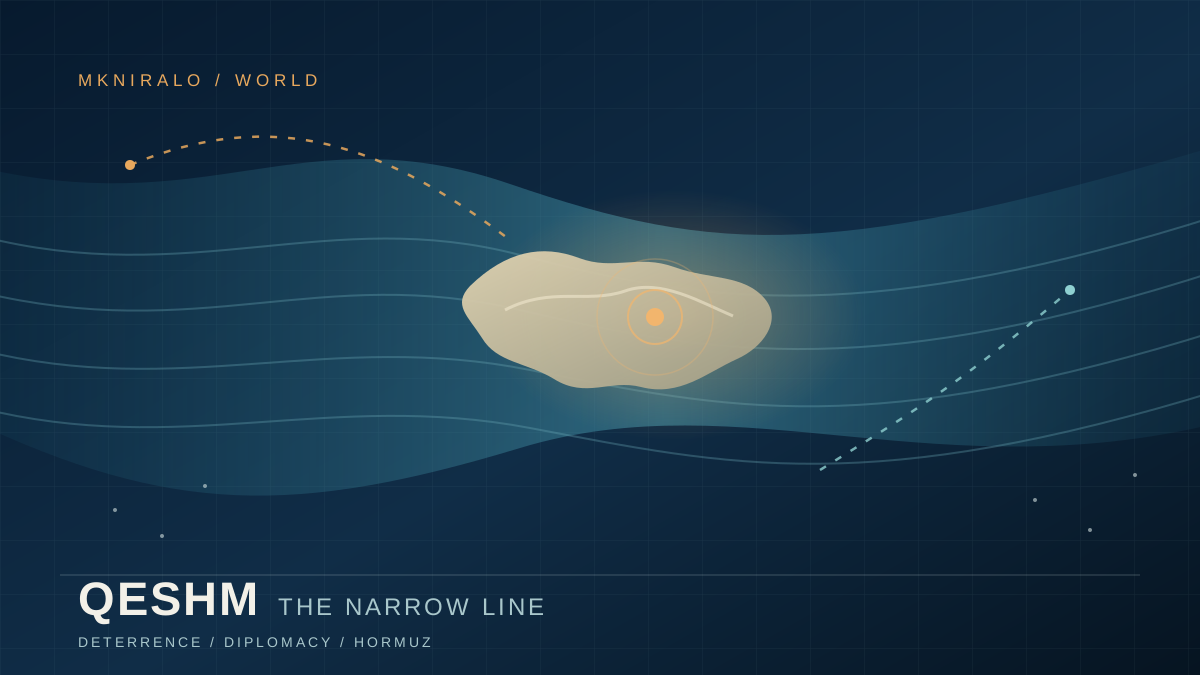
President Donald Trump has lowered the public temperature on the prospect of a renewed US offensive against Iran, telling CNN on November 8 that fresh strikes are “highly unlikely” if negotiations make progress. The condition matters: no agreement has been signed, shipping incidents continue around the Strait of Hormuz, and Washington is widening pressure on Iran’s land supply routes. The interview offered a signal of restraint, not a ceasefire or a guarantee that military action has ended.
A conditional promise, not a decision to end the war
Trump made the remarks in a roughly 20-minute phone interview with CNN journalist Jim Sciutto on Sunday. CNN reported that he repeated the phrase “highly unlikely” five times when discussing whether he would send US forces back into a larger war. He tied that assessment to progress on two linked issues: Iran’s nuclear programme and reopening the Strait of Hormuz, the waterway whose disruption has affected regional shipping and global energy trade.
The president did not describe a completed bargain or set out a timetable for one. Instead, he said the outcome depended on whether Tehran would sign what he called a “very strong agreement”. Reuters carried the central remark but noted that CNN did not specify the exact question that prompted it. The distinction is important: Trump was describing his expectation if talks move forward, not announcing a formal change in US military policy or a binding commitment to avoid further strikes.
Sources: Trump says renewed attacks on Iran ‘highly unlikely’ if talks show progress · Trump says he is unlikely to order Iran attack if talks progress, CNN reports
Eight months into a war that has not fully stopped
The conflict began on February 28, when the United States and Israel attacked Iran, according to Reuters. By November 8, the war had lasted more than eight months. The fighting has spread beyond the initial exchange: Iran has attacked targets in Israel and Gulf states hosting US bases, while Iran-aligned forces and Israel have been involved in further regional confrontations. The Strait of Hormuz has become both a military flashpoint and an economic pressure point. Reuters has also described the wider conflict as involving Iran-backed Hezbollah and Israel in Lebanon, and Iran-aligned Houthi forces striking targets in Saudi Arabia.
Although the prospect of a full-scale US offensive has dominated recent warnings, the conflict has not been a clean pause between two rounds of war. The Associated Press reported that US forces carried out limited strikes against Iranian air defences at least twice during the week before November 8. It also reported a US strike that disabled a commercial vessel accused by Washington of trying to breach its blockade. Those incidents complicate any description of the situation as a ceasefire.
Sources: Iran suggests blasts are not US attacks as both sides report ships hit · Rubio says Trump’s war against Iran not ‘necessarily popular’ but needed to stop a nuclear threat · Iran sent nuclear proposal to the US via Qatar, senior Iranian official tells Reuters · US military says it fired on commercial vessel in Gulf of Oman after it attempted to breach blockade
Qatar is keeping a diplomatic channel open
Qatar has acted as a mediator, maintaining contact with both Washington and Tehran as officials try to prevent a return to major hostilities. CNN reported that the Qatari government said Trump had spoken with Emir Sheikh Tamim bin Hamad Al Thani about de-escalation. Qatar also rejected reports that the two sides had abandoned negotiations, saying they were still working toward an agreement. The public statements point to an active channel, but they do not establish that the parties have resolved their differences.
Iran has also sent a nuclear proposal to Washington through Qatar, a senior Iranian official told Reuters on November 5. The official said the United States was reviewing it, but discussions would depend on Washington first meeting seven demands from Tehran. Those demands include sanctions relief, access to frozen assets and compensation for war damage. Washington, meanwhile, has insisted that nuclear questions must be part of the initial talks. The proposal is therefore evidence of diplomatic activity, not proof that a settlement is close.
Sources: Trump says renewed attacks on Iran ‘highly unlikely’ if talks show progress · Iran suggests blasts are not US attacks as both sides report ships hit · Iran sent nuclear proposal to the US via Qatar, senior Iranian official tells Reuters
Pressure continues at sea and on land
Shipping incidents underline how fragile the situation remains. Reuters reported on November 8 that Iran’s Revolutionary Guards Navy said two oil tankers had hit mines while attempting to use an unauthorised route through the Strait of Hormuz, and that a third tanker later caught fire. The US said its forces had disabled a commercial vessel in the Gulf of Oman. Reuters said it could not independently confirm the reported strikes on the tankers, so the claims should not be treated as fully verified accounts of each incident.
Washington is also extending its pressure beyond the maritime blockade. The US military announced Task Force Iron Gate on November 7, a unit based in Tampa that will work with other agencies to restrict the movement of advanced weapons, dual-use technology, sanctioned materials and what US officials describe as illicit revenue across Iran’s land borders and the Caspian Sea. Reuters reported the move as an expansion of the campaign to constrain Iran’s supply routes, not as a new air-strike operation. A US official told Reuters the partners are expected to include the Treasury, State and Justice departments and the intelligence community.
Sources: Iran suggests blasts are not US attacks as both sides report ships hit · Expanding on naval blockade, US military looks to restrict Iranian land commerce · US military says it fired on commercial vessel in Gulf of Oman after it attempted to breach blockade
Trump's military warnings remain his own claims
Even while describing renewed attacks as unlikely, Trump sought to emphasise that US forces remained ready. In the CNN interview, he said three aircraft carriers were in the region and described them as “fully locked and loaded”. He also claimed the United States had identified 38 bridges that could be destroyed within an hour, as well as power plants. These statements were made by the president; the interview did not independently verify the precise force posture, target list or the time required to strike them.
Trump also cited a figure of 301% for Iranian inflation while arguing that Tehran was under severe economic pressure. That number should be read as his claim, not as a verified inflation statistic: the interview report did not provide a source, calculation or time period for it. The same caution applies to his assertions about the remaining strength of Iran’s missile and drone capabilities. They describe the administration’s public argument for leverage, not independently established measurements.
Sources: Trump says renewed attacks on Iran ‘highly unlikely’ if talks show progress · Iran suggests blasts are not US attacks as both sides report ships hit
Why a breakthrough is still uncertain
The gap between the president’s optimism and the diplomatic record was visible on the same day. Secretary of State Marco Rubio said he would not describe the sides as being close to a breakthrough and criticised several Iranian demands as unrealistic. The AP reported that Iran was reviewing proposals put forward by Qatar but remained unwilling to negotiate over its nuclear activities until Washington addressed core conditions. That leaves the two sides disputing not only the terms of a deal but also the order in which concessions should be made.
For countries that depend on Gulf energy exports, the immediate test is whether negotiations can reduce attacks and restore predictable passage through Hormuz. For Washington and Tehran, the test is whether a framework can address nuclear limits, sanctions, frozen assets, war damage and maritime access without another escalation. Trump’s words may reduce expectations of an imminent large-scale US offensive, but the ongoing blockade, contested shipping reports and absence of a diplomatic breakthrough leave the outcome unresolved.
Sources: Iran suggests blasts are not US attacks as both sides report ships hit · Rubio says Trump’s war against Iran not ‘necessarily popular’ but needed to stop a nuclear threat · Iran sent nuclear proposal to the US via Qatar, senior Iranian official tells Reuters · Expanding on naval blockade, US military looks to restrict Iranian land commerce