On 3 November, Donald Trump said the United States would stop providing roughly $4 billion a year in assistance to Israel by the end of 2026, while continuing to sell the country weapons. He said he and Benjamin Netanyahu had agreed to the change, and described the move as one Israel no longer needed. The statement was striking not only because it suggested an early end to a long-standing security arrangement, but because the existing U.S.–Israel memorandum of understanding runs through fiscal year 2028. The gap between those two dates is where the real policy questions begin.
The announcement is clear; the mechanism is not
Trump's remarks came in a phone interview on Fox & Friends on U.S. Election Day. He referred to about $4 billion and described the support as "things and money", then said Israel would still be able to buy U.S. weapons. The recording establishes what the president said; it does not, by itself, establish the legal form, scope or implementation timetable of any bilateral agreement.
That distinction matters because the statement leaves several things unspecified. It does not identify which appropriated funds would stop, whether the announcement covers annual Foreign Military Financing grants, joint missile-defence programmes, or both, or how existing contracts would be treated. Reuters reported that neither the White House nor Netanyahu's office responded to its requests for comment on November 3. AP likewise reported no public comment from Netanyahu's office as of Tuesday evening in Israel.
Sources: Trump Sends Election Day Message as Voters Head to the Polls · Trump Says Israel Will Stop Receiving $4B in U.S. Aid by Year's End, Can Still Buy Weapons · As Americans Vote, Trump Says U.S. Will Stop $4 Billion in Aid to Israel · U.S. Will Halt $4B in Aid to Israel as the Mideast Ally Weans Itself From American Dependence
What the "$4 billion" actually represents
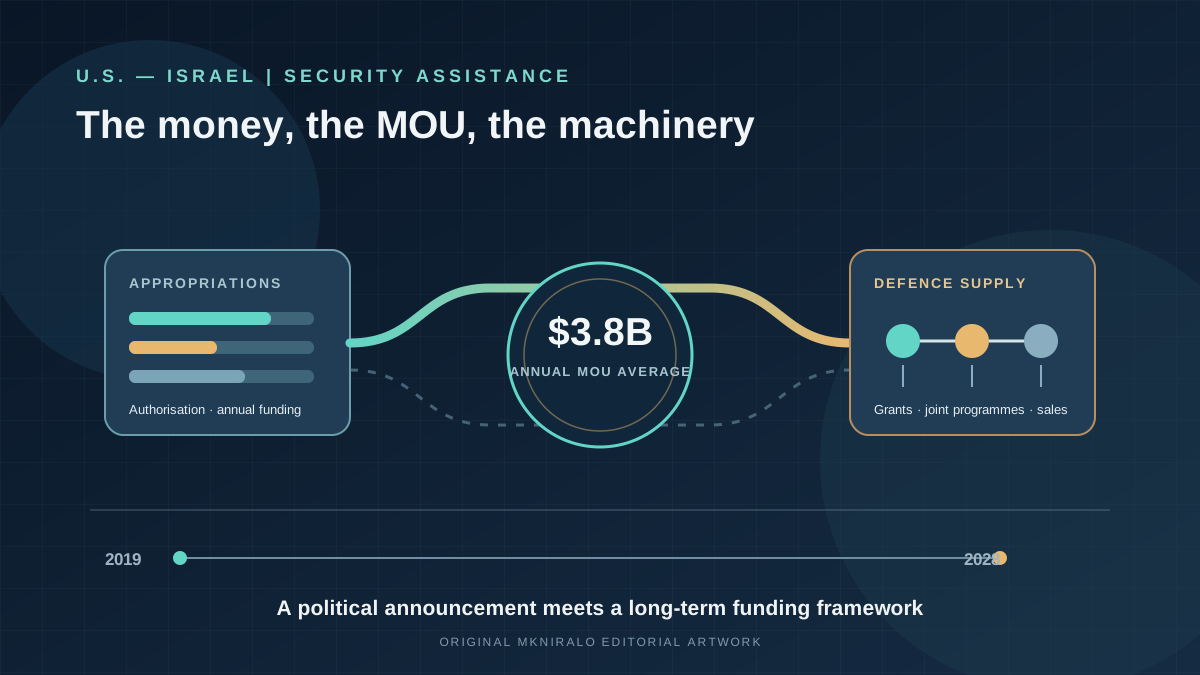
Trump's rounded figure is close to, but not identical with, the base amount in the current agreement. The 2016 memorandum set out $33 billion in Foreign Military Financing grants over fiscal years 2019–2028, or $3.3 billion a year, plus $5 billion over the same decade for cooperative missile and rocket-defence programmes, or $500 million annually. Together, those commitments total $38 billion, averaging $3.8 billion a year.
That $3.8 billion is not a single unrestricted transfer. Foreign Military Financing helps finance purchases of U.S. defence articles and services, while the missile-defence component supports cooperative programmes. Actual annual totals can differ when Congress provides supplemental funds or separate defence-cooperation appropriations. The Congressional Research Service describes the memorandum as the framework for regular assistance, not a complete inventory of every security-related dollar.
Sources: Memorandum of Understanding Between the United States and Israel on Security Assistance for FY2019–FY2028 · Possible Changes in U.S. Military Aid to Israel: Considerations for Congress
Congress is not a footnote
A memorandum of understanding is a political and administrative framework, not a treaty. The Congressional Research Service noted in June 2026 that such memoranda are not legally binding like treaties and do not require Senate ratification; Congress retains the appropriations power over foreign assistance. The current framework's stated funding levels are also subject to the appropriation and availability of funds.
That does not mean a president can make a public statement and instantly unwind every existing commitment. The practical route would depend on what Congress has already appropriated, what funds have been obligated, which statutory authorisations remain in force and whether the administration seeks changes in future appropriations or a negotiated wind-down. CRS says Congress has historically appropriated assistance broadly in line with memorandum levels, while retaining the ability to change annual amounts or provide supplemental support.
Sources: Memorandum of Understanding Between the United States and Israel on Security Assistance for FY2019–FY2028 · Possible Changes in U.S. Military Aid to Israel: Considerations for Congress · Israel: Major Issues and U.S. Relations · As Americans Vote, Trump Says U.S. Will Stop $4 Billion in Aid to Israel
Military aid and arms sales are different things
Trump also said arms sales would continue. That is an important distinction. A grant-financed purchase is not the same as an Israeli-funded purchase from a U.S. supplier. The memorandum channels Foreign Military Financing toward U.S. military goods and services, and its schedule phases out the portion Israel could spend on domestic procurement by fiscal year 2028. The separate missile-defence funding supports joint development and procurement arrangements rather than a general cash allowance.
Ending or reducing grants would therefore not automatically mean a ban on U.S. weapons exports, nor would it instantly cancel equipment already ordered. AP noted that major weapons purchases can take years to build and deliver, leaving a pipeline of previously funded orders even if future aid changes. Whether Israel could maintain the same purchasing pace with its own budget is a different question from whether the United States would continue approving sales.
Sources: Trump Sends Election Day Message as Voters Head to the Polls · Memorandum of Understanding Between the United States and Israel on Security Assistance for FY2019–FY2028 · Possible Changes in U.S. Military Aid to Israel: Considerations for Congress · U.S. Will Halt $4B in Aid to Israel as the Mideast Ally Weans Itself From American Dependence
The consequences extend beyond the annual total
For Israel, the potential shift would change how a portion of its defence spending is financed, not simply whether it can obtain American equipment. CRS notes that U.S. aid has long helped finance procurement from U.S. contractors and that Israel's fighter fleet and missile-defence architecture remain closely tied to American supply chains and cooperation. A move toward Israeli-funded purchases or joint technology programmes could preserve some links while changing who pays and which oversight channels apply.
For U.S. companies, a phase-out could also change the source and timing of orders. Foreign Military Financing-supported purchases channel money toward U.S. defence suppliers; a transition to Israeli funding might preserve some sales but could change the mix of suppliers and the pace of procurement. The $500 million annual missile-defence component is a separate issue: if it were also ended, the consequences for joint programmes would differ from a decision to stop grants alone.
Sources: Memorandum of Understanding Between the United States and Israel on Security Assistance for FY2019–FY2028 · Possible Changes in U.S. Military Aid to Israel: Considerations for Congress · Israel: Major Issues and U.S. Relations · U.S. Will Halt $4B in Aid to Israel as the Mideast Ally Weans Itself From American Dependence
What would make the announcement operational?
The next evidence will be documentary, not rhetorical: a joint U.S.–Israeli statement or written agreement; details from the State and Defense departments; and the administration's fiscal year 2027 budget and appropriations position. Congress's treatment of the current authorisation and the 2027 defence legislation will also matter. AP reported that lawmakers were considering a deeper U.S.–Israeli defence-technology relationship, but the relevant 2027 National Defense Authorization Act provision had not yet been approved.
Until those details are available, the most accurate description is that Trump announced an intention to end roughly $4 billion in annual assistance by year-end, not that the existing agreement has already been formally terminated. The policy question is how Washington would reconcile that announcement with the 2019–2028 framework, congressional funding decisions, outstanding purchases and a defence relationship that extends beyond grants.
Sources: Memorandum of Understanding Between the United States and Israel on Security Assistance for FY2019–FY2028 · Possible Changes in U.S. Military Aid to Israel: Considerations for Congress · Israel: Major Issues and U.S. Relations · As Americans Vote, Trump Says U.S. Will Stop $4 Billion in Aid to Israel