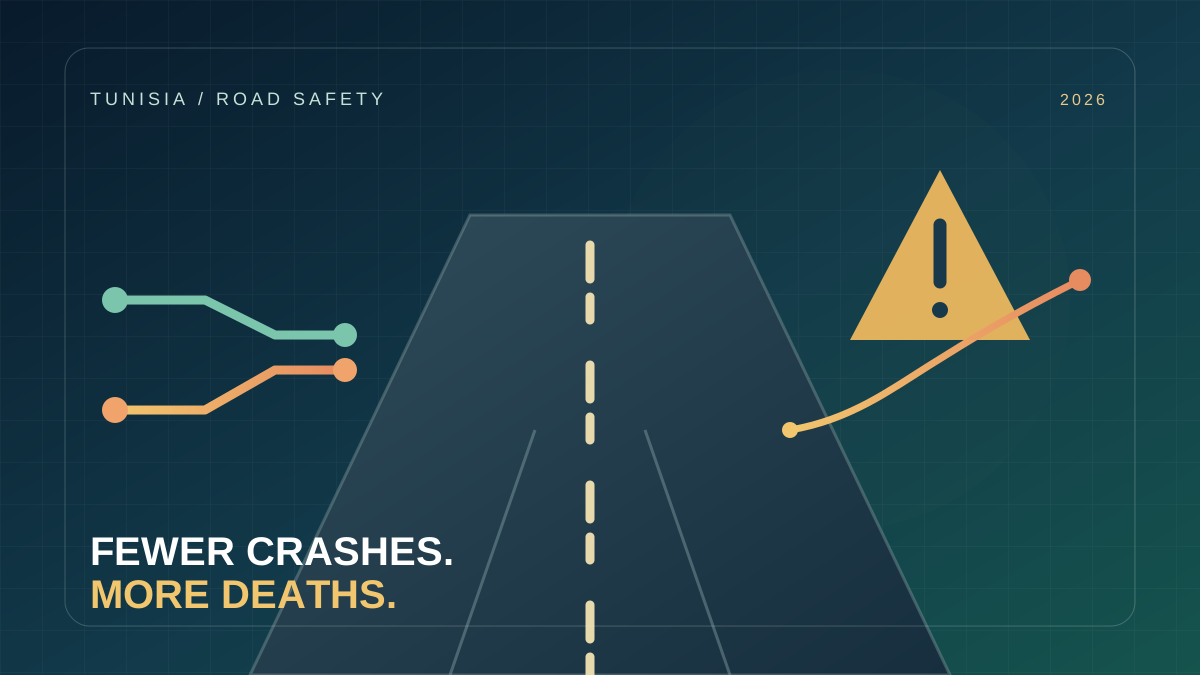
Tunisia’s road-safety figures appear to tell two different stories: fewer reported crashes, but more people killed. The latest comparable data show why a falling collision count cannot, on its own, be treated as proof that the roads are becoming safer.
The headline numbers are moving in opposite directions
Tunisia’s latest comparable road-safety figures show a striking split. From 1 January to 29 October 2026, the National Road Safety Observatory (ONSR) recorded 4,102 road crashes, compared with 4,555 over the same period in 2025 — a fall of 9.95%. Yet the number of people killed rose from 1,008 to 1,141, an increase of 13.19%. Recorded injuries moved in the opposite direction too, falling from 6,024 to 5,293, or 12.13%.
The comparison ends on 29 October. The observatory says current-year figures are preliminary and may be updated daily as new information arrives from official sources. These numbers should therefore be read as a dated snapshot, not a final annual total; comparisons with later updates need to preserve their different cut-off dates.
Sources: National Road Safety Observatory — 2026 road-crash and casualty comparison, updated through 29 October · Road safety: fewer accidents, but 1,141 deaths since the beginning of 2026
A rough severity signal — not a measure of individual risk
The divergence becomes clearer when the two headline totals are put side by side. A simple calculation gives about 22.1 deaths for every 100 recorded crashes in the 2025 comparison period, against 27.8 in 2026. That is roughly 25.7% higher. This is a derived ratio from the ONSR totals, not a separately published 2026 indicator.
The ratio is useful as a warning that the human consequences are not improving in line with the crash count. But it is not the probability that a person will die in a crash, nor a measure of risk per journey. One collision can kill several people; the ratio is also affected by the types of vehicles and road users involved, how far people travel, and whether crashes are reported consistently. The figures establish a worsening relationship between recorded crashes and deaths, but they do not by themselves explain why it has changed.
Speed has a larger share of fatal outcomes than of crashes
An earlier ONSR snapshot, reported by La Presse on 20 September and covering the period through 18 September, offers context on the causes recorded at the time. In that period, inattention and distractions were associated with 1,021 crashes, about 30.17%, while speed was associated with 740, or 21.87%. But speed was the leading recorded factor among fatal outcomes: 360 deaths, or 36.73% of the total, compared with 177 deaths attributed to inattention and distractions.
This is an earlier snapshot, not a cause breakdown for the full period through 29 October. It does not prove the cause of each death or explain the year-on-year increase. It does show why road safety needs more than one metric: a factor that appears in fewer crashes may be associated with a much larger share of fatal outcomes.
Sources: Road deaths up 11.11% through 18 September; speed leads fatal-outcome categories
Tunisia has a national strategy; implementation is the test
Tunisia’s national road-safety strategy is framed around reducing deaths, not only counting collisions. In February 2025, the ONSR’s communications chief said the multisectoral strategy aimed to cut road deaths by 50% by 2034. He described five axes: infrastructure and safe speeds; protection and awareness for road users; multimodal urban transport; safer vehicles; and post-crash response, including work towards a unified emergency number.
An ONSR communiqué reported by La Presse in September 2025 also described legal reform, training, infrastructure and vehicle safety as central parts of the strategy. These priorities match several signals in the current data: speed is prominent in fatal outcomes, while safer road design, vehicle standards and emergency response can influence what happens when a crash occurs. But a target is not an outcome. The public sources reviewed here do not establish which actions have been implemented at scale or which have already reduced deaths in 2026.
Sources: ONSR: the multisectoral strategy aims to reduce road deaths by 50% by 2034 · National Road Safety Strategy: reduce road deaths by 50% by 2034
The available data cannot explain the whole reversal
The current comparison is a count of reported crashes and casualties. It does not show how much road travel took place in each period, how many vehicles were on the road, or how the mix of motorcycles, cars, heavy vehicles and pedestrians changed. Without exposure measures — such as vehicle-kilometres travelled or deaths per population — it is not possible to say from these totals alone whether the risk per trip increased.
The observatory also warns that its geographic rankings are based on raw case counts and do not adjust for differences in population or socio-economic conditions. A region with more recorded crashes is not automatically more dangerous for each person who uses its roads. The 2026 figures are provisional, so the totals may change as official records are updated.
Progress should be measured in lives, not only in collisions
A lower crash count is encouraging, but it is not enough to declare that roads are becoming safer. The 2026 figures point to a more demanding test: whether the national strategy reduces deaths and serious injuries as well as collisions, and whether its actions can be traced to changes in speed, infrastructure, road-user protection and post-crash care. The earlier ONSR cause breakdown makes the distinction visible: inattention appeared most often among recorded crashes, while speed accounted for the largest share of deaths in the categories shown.
The next useful public update would therefore do more than repeat a year-to-date total. It would show where fatal crashes occur, which road users are being killed, how severity varies by road type and time, and whether enforcement and emergency-response measures are being delivered. Those details would not automatically identify a single cause, but they would make the policy response easier to test. Tunisia’s central road-safety question is no longer simply whether there are fewer crashes. It is why fewer recorded crashes are still leaving more families bereaved — and what measurable action can change that.
Sources: National Road Safety Observatory — 2026 road-crash and casualty comparison, updated through 29 October · Road safety: fewer accidents, but 1,141 deaths since the beginning of 2026 · Road deaths up 11.11% through 18 September; speed leads fatal-outcome categories · ONSR: the multisectoral strategy aims to reduce road deaths by 50% by 2034 · National Road Safety Strategy: reduce road deaths by 50% by 2034