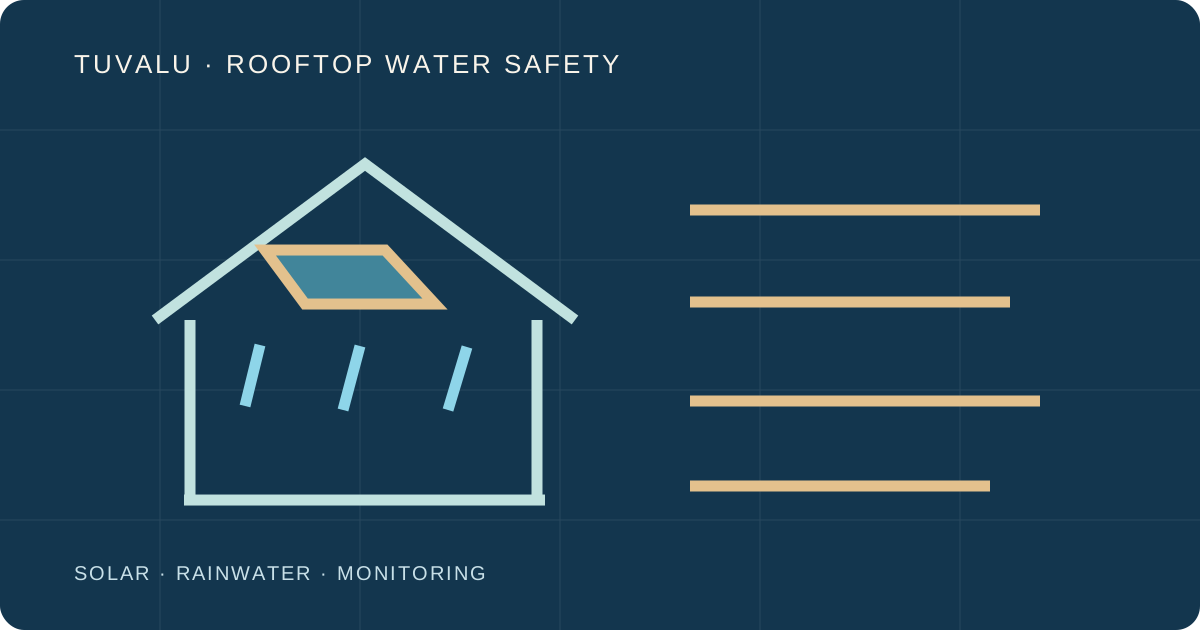
For households on Tuvalu's low-lying islands, a roof can serve two essential purposes: catching rainfall for freshwater and carrying solar panels that support a cleaner electricity supply. A field assessment in Funafuti reported on 30 October found no statistically detectable difference in stored rainwater quality associated with the presence of rooftop photovoltaic systems. Yet investigators also found evidence of microbial contamination. That means the useful lesson is more precise than either 'solar panels contaminate water' or 'solar-roof water is safe'.
What the Funafuti project actually examined
The Secretariat of the Pacific Regional Environment Programme (SPREP) worked with the Tuvalu Climate Change Department and Teulava Consultancy to examine harvested rainwater at homes, schools and other locations. Field sampling and community consultation took place in July 2026, followed by a validation workshop on 21–22 October.
The study was designed to investigate whether solar PV installations had measurable associations with water quality in rooftop collection systems. It did not set out to compare every kind of panel, roofing material, storage tank and maintenance programme across all Pacific islands.
Sources: Funafuti study finds no detectable rooftop-solar effect on stored rainwater; E. coli risk highlighted · SPREP and Tuvalu launch technical study on rooftop solar PV and rainwater quality · SPREP technical study procurement and methodology requirements
What 'no statistically detectable difference' actually means
The findings presented at the workshop reported no statistically detectable difference in stored rainwater quality associated with rooftop solar PV installations. Measured heavy-metal concentrations were reported below the applicable World Health Organization benchmarks.
A result that does not detect a difference is not proof that all possible effects are zero. Sampling coverage, weather, roof materials, installation ages, tank conditions and statistical power limit what any local assessment can establish. The publicly available summary does not provide enough detail to independently reproduce all statistical comparisons.
Sources: Funafuti study finds no detectable rooftop-solar effect on stored rainwater; E. coli risk highlighted · SPREP and Tuvalu launch technical study on rooftop solar PV and rainwater quality
Why microbiological contamination became the more urgent issue
SPREP's reported findings identified E. coli in a significant share of harvested-water samples, indicating that microbial contamination should be a primary concern when managing stored rainwater. The public summary does not give a definitive percentage for all systems and does not attribute every positive sample to one source.
Contamination can enter through catchments, gutters, first-flush arrangements, tanks or handling practices. The investigation's message is not to abandon solar power; it is to improve catchment hygiene, water-treatment practices and routine monitoring while assessing sources of contamination.
Sources: Funafuti study finds no detectable rooftop-solar effect on stored rainwater; E. coli risk highlighted · SPREP technical study procurement and methodology requirements
Why two national priorities share the same roof
Rainwater harvesting is a fundamental freshwater source in Tuvalu, while distributed solar power supports the country's energy transition. Roof space is limited and already performs both roles in many community settings.
Keeping both services reliable requires considering panel mounting and drainage as part of the wider water system. Regulations for installation, inspection and cleaning can help manage risks, but the October workshop recommendations had not yet become a verified nationwide enforcement programme.
Sources: SPREP and Tuvalu launch technical study on rooftop solar PV and rainwater quality · SPREP technical study procurement and methodology requirements
Which actions the participants recommended
Workshop recommendations covered stronger water-quality surveillance, better first-flush and rainwater-catchment arrangements, standards for point-of-use treatment devices, and clearer solar installation and inspection practices.
Those recommendations are proposed responses rather than evidence that each household now has a tested filter or that every public building has received upgrades. Delivery will require resources, maintenance and decisions by local authorities and communities.
Sources: Funafuti study finds no detectable rooftop-solar effect on stored rainwater; E. coli risk highlighted · SPREP and Tuvalu launch technical study on rooftop solar PV and rainwater quality
What researchers and officials need to show next
The final case-study report should document sample numbers and locations, laboratory methods, differences between storage systems, panel and roofing characteristics, uncertainty ranges and any limitations identified during validation.
The meaningful follow-up is whether Tuvalu publishes its final findings and turns the water-safety recommendations into affordable, verifiable practice. The evidence to date supports a balanced response: do not blame solar panels without proof, and do not ignore microbial hazards simply because metals were within benchmark values.
Sources: Funafuti study finds no detectable rooftop-solar effect on stored rainwater; E. coli risk highlighted · SPREP and Tuvalu launch technical study on rooftop solar PV and rainwater quality · SPREP technical study procurement and methodology requirements