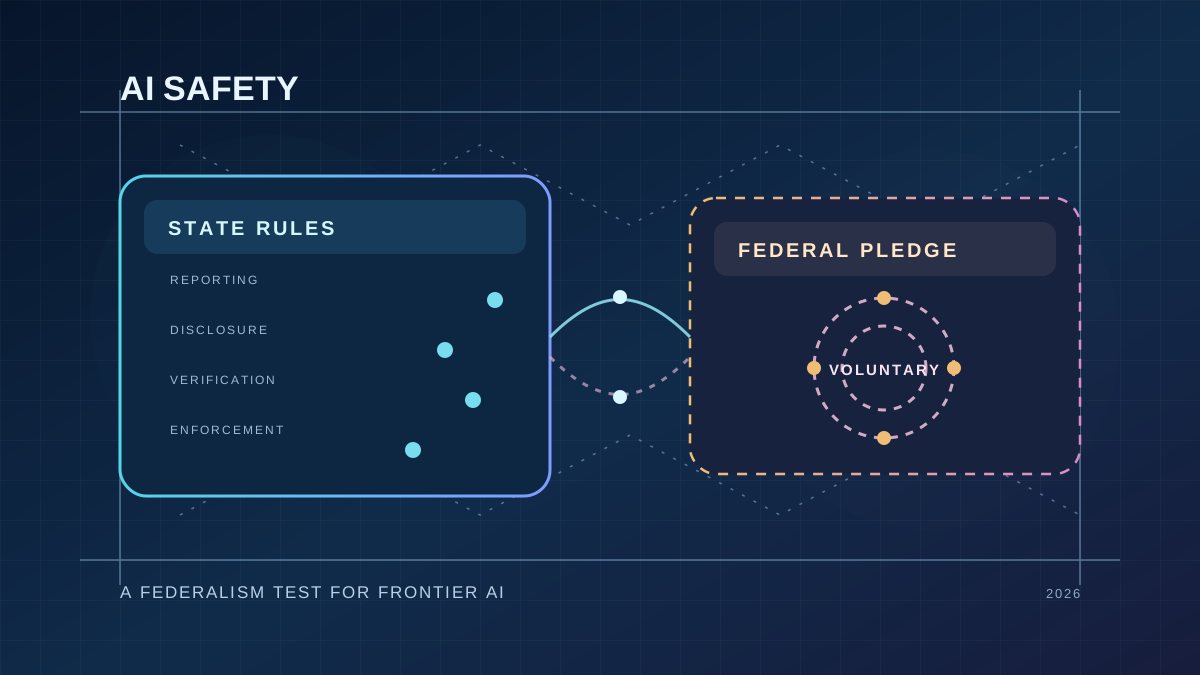
The United States is developing two approaches to frontier AI safety. Several states are writing duties into law, with reporting deadlines and agencies responsible for oversight. The federal government’s September accord with major AI companies instead sets out voluntary controls and audits. New York’s law starts in January 2027; California’s latest executive action dates to September, and Illinois has enacted a similar 72-hour rule for 2027.
A state-led framework takes shape
The divide is not between states that support AI and a federal government that opposes it. It is about which institutions must turn safety claims into evidence, and what happens when a company fails to report a serious incident. California’s Transparency in Frontier Artificial Intelligence Act, signed in 2025, requires large frontier developers to publish safety frameworks, and frontier developers to report specified incidents. New York has enacted a related regime, while Illinois has adopted its own Artificial Intelligence Safety Measures Act. Each focuses on advanced models and catastrophic risks, not every AI product.
The White House instead backed a one-page joint commitment with major AI companies. It lists four layers of controls, including internal monitoring, an empowered internal team, external evaluation and board oversight. Those ideas may influence company practice, but the accord creates no federal reporting deadline, statutory penalty or regulator empowered to enforce the pledge. The result is an uneven landscape: binding state duties are emerging alongside a national statement whose force depends on companies choosing to follow it.
Sources: Governor Newsom signs first-in-the-nation AI safeguards to protect Californians, calls on the federal government to do its part · NYS Open Legislation | NYSenate.gov · Public Act 104-0538 · White House Accord on Super Intelligence · Trump’s AI Safety Pact Is Toothless. But There Is a Path Forward.
New York prepares to turn RAISE into an operating system
New York’s Responsible AI Safety and Education Act was signed on December 19, 2025, then rewritten through a chapter amendment signed on March 27, 2026. The amended law takes effect on January 1, 2027. It defines a frontier model by training above 10²⁶ integer or floating-point operations. A “large frontier developer” is a frontier developer whose annual gross revenue, including affiliates, exceeded $500 million in the preceding calendar year. The compute threshold defines the model category; the revenue threshold triggers additional large-developer duties.
New York says it will direct large frontier developers to register from November 2026, before January compliance. Oversight is assigned to DIGIT, the Office of Digital Innovation, Governance, Integrity and Trust, within the Department of Financial Services. The statute requires frontier developers to report critical safety incidents within 72 hours after determining one occurred, or learning facts supporting a reasonable belief that it occurred. A separate 24-hour disclosure to an appropriate authority applies when an incident poses an imminent risk of death or serious physical injury. Large developers also face disclosure, framework and periodic risk-assessment duties. A proposed “RAISE Act 2.0,” introduced October 28 as S.10731, would widen scrutiny to automated AI research, compute thresholds and capability changes; it remains in committee, not law.
Sources: NYS Open Legislation | NYSenate.gov · NY State Senate Bill 2025-S8828 · AI Safety: Governor Hochul Announces Next Steps to Regulate Major AI Developers and Protect New Yorkers · NY State Senate Bill 2025-S10731 · SB 53/RAISE Act Comparison Chart
California’s verification layer is broader than a kill switch
California’s latest steps began before November. On September 9, Governor Gavin Newsom signed SB 813, establishing a framework for independent verification organizations to assess AI systems and models for compliance with state law. He also signed AB 1405, creating a registry for AI auditors and standards for independence, transparency and integrity. These statutes add an institutional layer to SB 53, the state’s 2025 frontier-AI law. They do not mean every frontier model must already have an emergency shutoff; the verification framework and auditor registry are mechanisms being built for implementation.
On September 18, Newsom issued an executive order to accelerate implementation of SB 813 and AB 1405 and convene experts to recommend further changes. The order asks the state to examine embedding independent verifiers in frontier labs, independently checking safety frameworks and risk assessments, and developing and testing a “kill switch” for frontier models. California announced the expert group on September 23. These are implementation directions and recommendations, not proof that a new kill-switch mandate was signed on November 7.
Sources: Governor Newsom signs first-in-the-nation AI safeguards to protect Californians, calls on the federal government to do its part · Governor Newsom issues executive order to accelerate independent oversight and advance the creation of an AI kill switch · Governor Newsom announces world-leading experts to deliver on his AI executive order, including advancing creation of a “kill switch”
The 72-hour clock is not unique to New York
The comparison with California explains why New York’s shorter deadline drew attention. Under California SB 53, a frontier developer generally has 15 days after discovering a critical safety incident to report it to the California Office of Emergency Services. If the incident creates an imminent risk of death or serious physical injury, the law requires notice to an appropriate authority within 24 hours. New York’s 72-hour window is shorter for ordinary reportable incidents, and its trigger includes facts supporting a reasonable belief that an incident occurred. That can matter before an investigation is complete.
But New York’s 72-hour clock is not unique. Illinois enacted the Artificial Intelligence Safety Measures Act as Public Act 104-0538, with the law taking effect on January 1, 2027. It also requires a frontier developer to report a critical safety incident within 72 hours after learning facts sufficient to establish a reasonable belief that one occurred, with separate 24-hour notice to an appropriate authority for imminent risk of death or serious physical injury. The states differ in scope, agency design and other obligations. Illinois means New York’s rule is part of a growing state pattern, not a uniquely strict national first.
Sources: SB 53/RAISE Act Comparison Chart · Public Act 104-0538 · NYS Open Legislation | NYSenate.gov
Washington’s accord asks companies to police themselves
The White House Accord on Super Intelligence, dated September 29, 2026, was signed by President Donald Trump and leaders of Google, Anthropic, Meta, OpenAI, xAI and Nvidia. Its four layers are internal controls to monitor model capabilities and alignment; an internal team to check those controls; an independent external auditor or evaluator; and an independent board committee. The document says companies “should” implement the layers and commits signatories to meet regularly to develop standards and best practices. It says the steps might eventually be codified into laws or regulations.
That wording is central to the federalism story. The accord is a joint commitment, not a statute or executive order imposing enforceable duties. It sets no public incident-reporting deadline, creates no federal filing office and specifies no civil penalties for a missed report. A Council on Foreign Relations analysis published October 1 said the document does not legally compel signatories to change their behaviour. The agreement may encourage common internal practices, but its accountability model is voluntary, unlike the reporting and disclosure duties written into state law.
Sources: White House Accord on Super Intelligence · Trump’s AI Safety Pact Is Toothless. But There Is a Path Forward.
The next test is implementation, not slogans
The state laws create practical questions for companies that develop or materially modify frontier models, especially those operating across state lines. They must identify which models cross each state’s compute threshold, which revenue tests trigger extra duties, when an event becomes reportable, and which agency receives the report. New York’s registration process is beginning before the law’s January 2027 start; California is building independent-verification institutions; and Illinois has enacted a parallel reporting framework. These systems overlap, but are not interchangeable.
For the public, the value of the rules will depend on what regulators can verify and disclose without exposing security-sensitive information or trade secrets. New York protects incident reports from public-records disclosure while requiring later aggregated public reporting. California adds a formal role for independent verification organizations and registered auditors. The federal accord offers a lighter baseline for companies willing to adopt it. Whether the state models improve safety will be judged by implementation, evidence and enforcement—not by announcements or by treating proposals for future safeguards as laws already in force.
Sources: NYS Open Legislation | NYSenate.gov · AI Safety: Governor Hochul Announces Next Steps to Regulate Major AI Developers and Protect New Yorkers · Governor Newsom signs first-in-the-nation AI safeguards to protect Californians, calls on the federal government to do its part · Public Act 104-0538