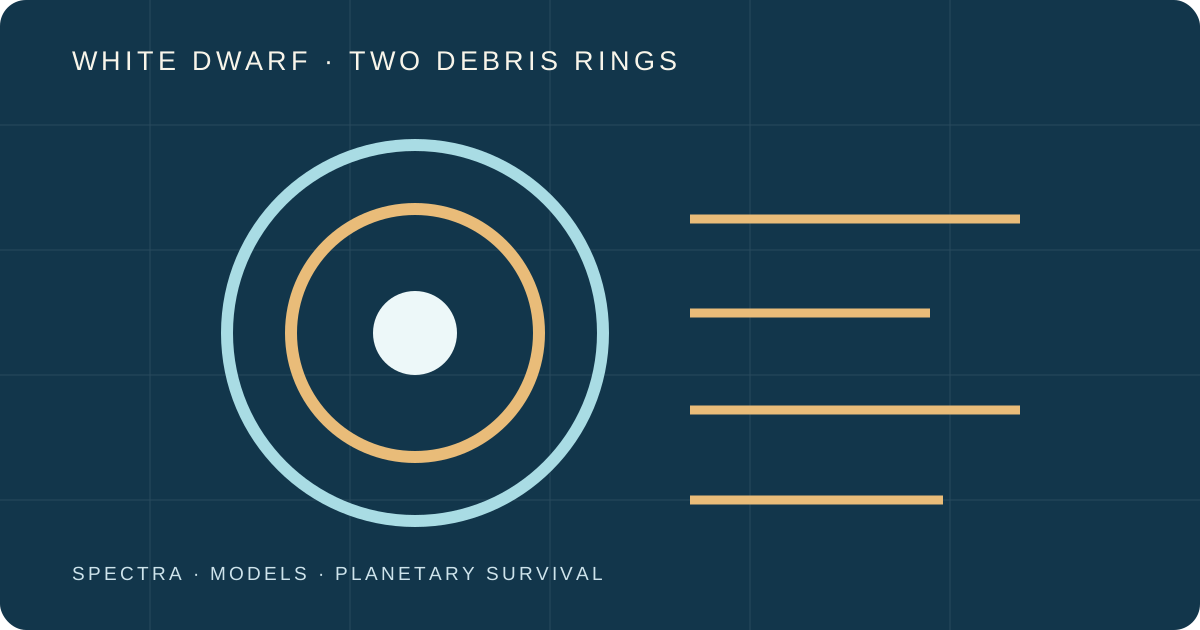
A white dwarf identified as J1328−1450 appears surrounded by not one but two rings of gas-rich planetary debris. The finding, published in Nature Astronomy on 26 October and announced by the European Southern Observatory on 27 October, offers an unusual glimpse of what can remain after a star like the Sun ends its ordinary life. Researchers suggest surviving rocky bodies may be shaping the rings, but this is a model derived from observations rather than a direct photograph of two planets.
Why white dwarfs can have planetary debris
When a Sun-like star exhausts its main fuel, it expands and eventually leaves a compact white-dwarf core. Some nearby planets may be engulfed, while surviving rocky bodies can be perturbed and broken into fragments.
Those fragments can collide or vaporise, producing gas and dust structures whose chemical fingerprints are detectable with telescopes. Finding debris around a white dwarf is not itself new; the two separately structured gas rings in this system are the unusual part.
Sources: Dead star and planetary bodies: rare double debris disc · A double debris disc around a white dwarf sculpted by two planetary bodies
What did the Very Large Telescope actually measure?
The team used the X-shooter spectrograph at ESO's Very Large Telescope in Chile to examine light from J1328−1450. Spectral emission features provided evidence of two rotating gas components separated by a gap.
The researchers inferred disc geometry by modelling emission lines; they did not obtain a normal photograph resolving both rings as a pair of bright circles. That distinction matters when interpreting popular artist impressions accompanying the announcement.
Sources: Dead star and planetary bodies: rare double debris disc · A double debris disc around a white dwarf sculpted by two planetary bodies
Why two unseen bodies could matter
The authors propose that two surviving planetesimals or planetary bodies on different orbits help maintain the separated structures. One inferred body could be a few kilometres across, while another might be comparable in size to Pluto or even the Moon.
Those sizes describe model estimates for possible surviving objects, not directly measured diameters. Alternative configurations and further observations could change the explanation of the rings' long-term stability.
Sources: Dead star and planetary bodies: rare double debris disc · A double debris disc around a white dwarf sculpted by two planetary bodies
The two rings do not have identical chemistry
Spectral analysis indicated elements including calcium, oxygen, magnesium and iron. The inner ring appears relatively magnesium-rich, while the outer component shows substantial magnesium depletion.
This difference might mean debris came from two distinct parent bodies, or from different layers of one differentiated body. Scientists have not proved which interpretation is correct, so composition should be described as evidence rather than as a confirmed family tree of former planets.
Sources: Dead star and planetary bodies: rare double debris disc · A double debris disc around a white dwarf sculpted by two planetary bodies
Does this predict the Earth's exact future?
The research offers a physical analogue for planetary systems evolving after a star becomes a white dwarf. Our Sun is expected to go through late evolutionary stages that could destroy nearby planets and disturb surviving material.
It does not calculate a specific eventual orbit for Earth or demonstrate that J1328−1450 is a duplicate of our Solar System. Different masses, orbital histories and compositions mean the findings are an illustration of possibilities, not a deterministic forecast.
Sources: Dead star and planetary bodies: rare double debris disc · A double debris disc around a white dwarf sculpted by two planetary bodies
What would make the planetary interpretation stronger?
Follow-up spectroscopy can test whether the gas structures and chemical features persist, change with time or reveal dynamics consistent with orbiting perturbers. Additional modelling might distinguish one parent body from multiple sources.
For now, the confirmed discovery is a rare double-disc spectral signature around a white dwarf. Two surviving planetary bodies remain a persuasive hypothesis that further data can test.
Sources: Dead star and planetary bodies: rare double debris disc · A double debris disc around a white dwarf sculpted by two planetary bodies