The question is not whether governments need another climate document. It is whether a practical framework can help them coordinate the decisions that turn existing commitments into energy, land-use and financing choices.
A follow-through, not a fresh climate agreement
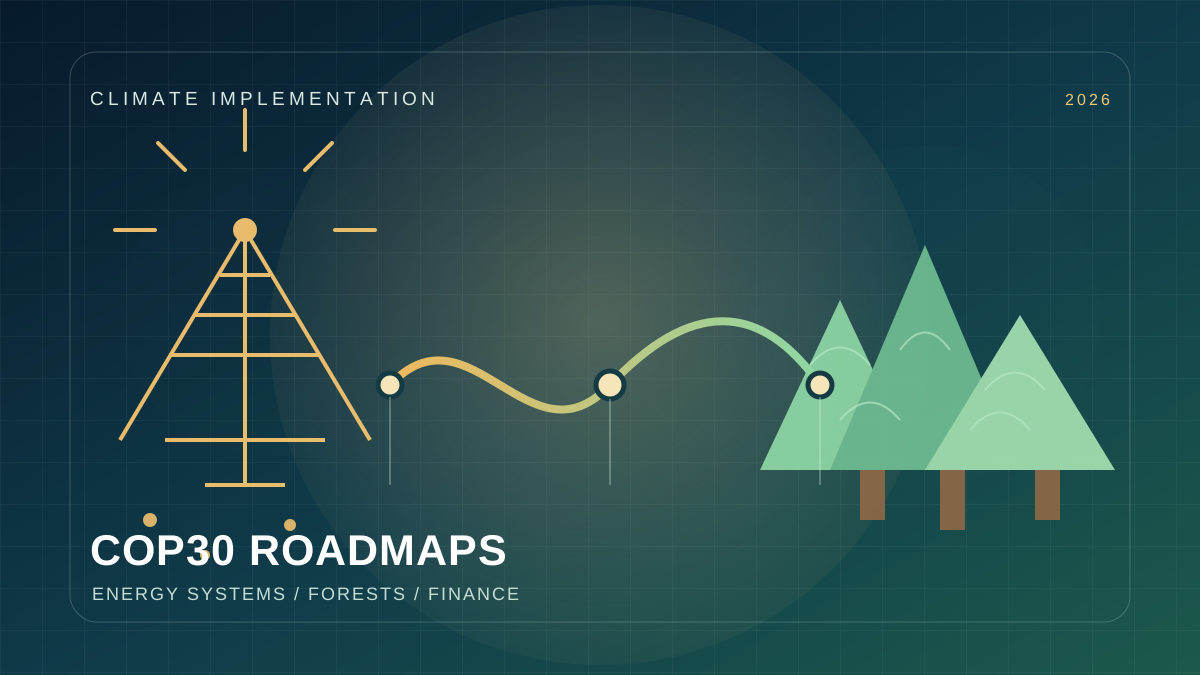
On 3 November 2026, Brazil’s COP30 presidency presented two international roadmaps in Brasília. One addresses the transition away from fossil fuels in energy systems; the other seeks to halt and reverse deforestation and forest degradation by 2030. Their publication fulfils a commitment made at the closing plenary of COP30 in Belém, where the Brazilian presidency promised to develop practical pathways after the summit.
The status of the documents matters as much as their subject. The presidency describes both as voluntary, non-prescriptive contributions that are not subject to negotiation. Reuters reported that the fossil-fuel roadmap failed to win consensus at COP30 and that the forest roadmap also remained outside the final negotiated agreement. These are therefore not new treaty provisions, binding national targets or obligations imposed on governments.
The distinction is not a technical footnote. The roadmaps attempt to turn an existing political direction into practical choices, but they do not settle disagreements over the pace of fossil-fuel production cuts, the distribution of transition costs or the financing of forest protection. Their energy framework builds on the first Global Stocktake under the Paris Agreement, including its call for a just, orderly and equitable transition away from fossil fuels in energy systems.
Sources: COP30 Presidency launches international roadmaps to accelerate transition away from fossil fuels and halt deforestation and forest degradation by 2030 · Brazil wraps up COP30 with fossil fuel, forest roadmaps, urging shift from talks to action · COP30 Presidency Roadmap for Transitioning Away from Fossil Fuels in Energy Systems · COP30 Presidency invitation to submit contributions to the two Presidency roadmaps
The energy roadmap starts with national exposure
Rather than prescribing one timetable for every country, the energy roadmap begins with a diagnostic called the Belém Readiness Approach. It examines three connected dimensions: energy demand, energy supply and the wider economy. Demand includes how transport, industry and buildings use energy. Supply considers how fossil-fuel production can adapt as lower-emissions systems expand. The economic pillar looks at fiscal dependence, investment, the cost of capital and price signals.
That structure recognises that countries face different starting conditions. A government that relies heavily on hydrocarbon revenue has a different fiscal problem from one that imports most of its fuel. A country with limited grid access faces a different infrastructure challenge from one with a mature electricity network. The roadmap proposes indicators to identify exposure, constraints and existing strengths, then combines measures that could apply broadly with options tailored to different national circumstances.
The consultation process drew 267 contributions through an open call, including 21 submissions from parties or groups of parties representing 115 parties. That is evidence of a wide consultation process; it should not be read as proof that 115 governments endorsed every recommendation in the finished document.
Sources: COP30 Presidency launches international roadmaps to accelerate transition away from fossil fuels and halt deforestation and forest degradation by 2030 · COP30 Presidency Roadmap for Transitioning Away from Fossil Fuels in Energy Systems · COP30 Presidency invitation to submit contributions to the two Presidency roadmaps
Why supply and demand have to move together
One of the roadmap’s most useful insights is that a transition cannot be managed by looking at energy supply alone. If fossil-fuel production falls faster than demand and reliable alternatives can expand, shortages and price volatility may follow. If production remains high after demand begins to shift, investment can be left underused and dependence on fossil fuels can persist. The document argues that production, consumption, infrastructure and investment need to move in a coordinated sequence.
Reuters described a proposed sequence in which countries would assess their energy systems and prepare policies through 2028, put infrastructure upgrades and renewable-energy investment in motion by 2030, and accelerate renewable deployment and fossil-fuel replacement through 2033. These are implementation horizons set out in a voluntary roadmap, not enforceable deadlines. Their value will depend on whether governments can connect energy ministries with finance, transport, industry and workforce planning.
Sources: COP30 Presidency Roadmap for Transitioning Away from Fossil Fuels in Energy Systems · Brazil wraps up COP30 with fossil fuel, forest roadmaps, urging shift from talks to action
The forest roadmap looks beyond tree loss
The forest roadmap broadens the definition of the problem. Deforestation is the removal of forest, but degradation can occur while trees remain standing: a forest may lose some of its ability to store carbon, regulate water, sustain biodiversity or support local livelihoods. The document covers tropical, subtropical, temperate and boreal forests, along with related ecosystems such as peatlands and mangroves.
It identifies five areas for national strategies: conservation; sustainable forest management, agroforestry and bioeconomy; action against forest degradation; action against deforestation; and restoration, reforestation and afforestation. It also proposes a five-step cycle: diagnose forest conditions and drivers of loss; align policy, institutions and finance; target results; deliver while monitoring progress; and evaluate and adjust. This is broader than treating tree-cover change as a single performance measure.
The finance gap is where the plan meets politics
The forest roadmap’s financial challenge is substantial. The COP30 presidency cites a need to increase annual forest finance from about US$84.5 billion in 2023 to more than US$300 billion by 2030. UNEP’s 2025 State of Finance for Forests report puts the annual gap at roughly US$216 billion. The COP30 release also says domestic public budgets accounted for 88.3% of recorded forest finance in 2023, while international public finance represented only 3.4%.
Those figures expose a distribution problem as well as a funding problem. Many forests that provide global climate and biodiversity benefits are located in countries whose public budgets face competing demands. If the bulk of protection continues to depend on domestic spending, the costs may fall most heavily on governments and communities with limited fiscal room, while benefits extend well beyond their borders.
More money alone would not guarantee better outcomes. The roadmap examines 30 international financing mechanisms and argues for scaling their use, improving access and rewarding conservation and sustainable management. Whether support arrives as grants, concessional finance, results-based payments or market instruments affects who carries the risk, how quickly resources reach communities and what happens when promised results are not achieved.
Sources: COP30 Presidency launches international roadmaps to accelerate transition away from fossil fuels and halt deforestation and forest degradation by 2030 · COP30 Presidency Roadmap on Enhancing Efforts Towards Halting and Reversing Deforestation and Forest Degradation by 2030 · State of Finance for Forests 2025: Unlock. Unleash. Realizing Forest Potential requires Tripling Investments in Forests by 2030
What would make these roadmaps matter?
The documents will be judged by evidence outside their own pages: national plans that change investment decisions; electricity grids and transport systems that are actually upgraded; fiscal rules and incentives that change the economics of fossil fuels; forest monitoring that detects degradation as well as clearing; and finance that reaches the people expected to protect and restore ecosystems. The energy roadmap proposes a collective TAFF Mutirão through 2033 and continued international dialogue, including ahead of the second Global Stocktake in 2028. The forest roadmap sets out indicative milestones through 2030.
Their limitation is also their design boundary. A COP presidency can publish a practical guide, but it cannot compel a government to follow it. The roadmaps may make choices more visible, give ministries a common diagnostic and help future presidencies keep implementation on the agenda. They cannot substitute for domestic legislation, public budgets, investment decisions or negotiated international finance.
That leaves a clear test for the next phase of climate diplomacy: do these documents help governments coordinate the decisions that determine what gets built, what gets financed and what gets protected? If they do, they can bridge the distance between a climate commitment and an operational plan. If they do not, they will remain useful reference documents without the political leverage to change outcomes.
Sources: COP30 Presidency launches international roadmaps to accelerate transition away from fossil fuels and halt deforestation and forest degradation by 2030 · COP30 Presidency Roadmap for Transitioning Away from Fossil Fuels in Energy Systems · COP30 Presidency Roadmap on Enhancing Efforts Towards Halting and Reversing Deforestation and Forest Degradation by 2030 · Brazil wraps up COP30 with fossil fuel, forest roadmaps, urging shift from talks to action