The European Union has pledged up to €50 million to accelerate the creation of a Black Sea Maritime Security Hub and says it wants the project operating in 2027. The promise follows attacks on commercial shipping, but an announced budget and a working group do not amount to a functioning maritime warning system. EU officials have offered more detail about intended facilities in Romania and Bulgaria while leaving legal, staffing and delivery questions unresolved.
A Pledge, Not an Operational Centre
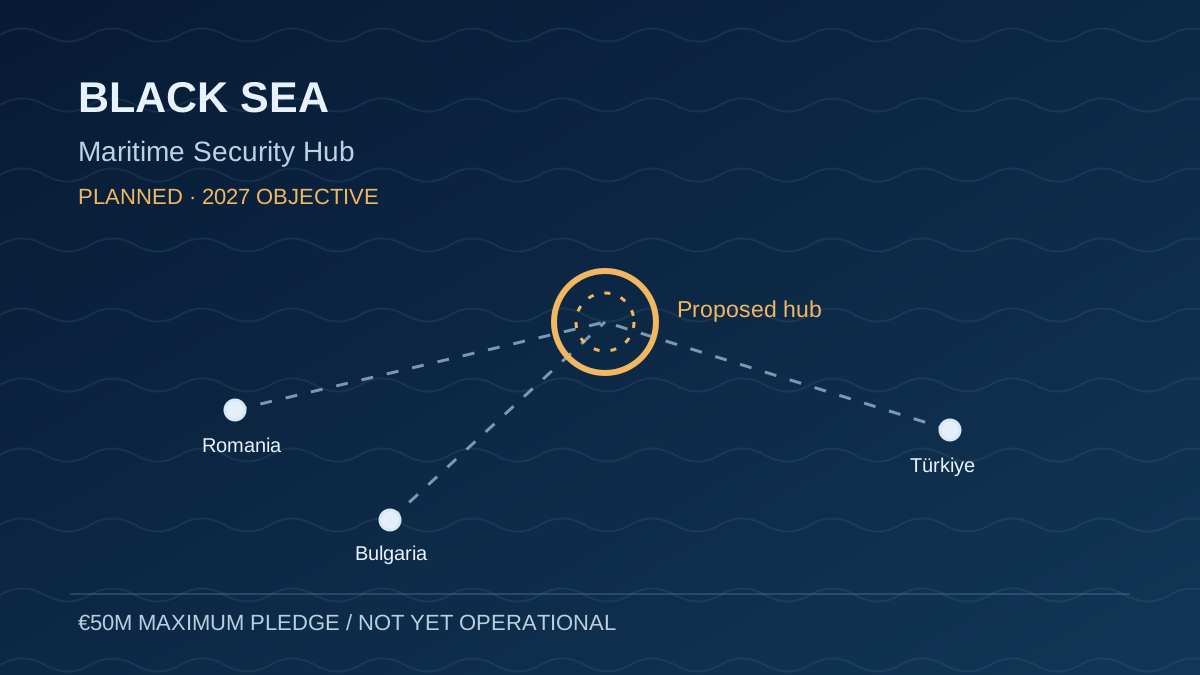
The European Commission has promised up to €50 million to help establish a Black Sea Maritime Security Hub, following President Ursula von der Leyen’s visits to Romania on November 9 and Bulgaria on November 10. The sum is funding proposed for creating a security-coordination capability, not evidence that equipment has been installed, staff hired or a centre placed on operational duty. A Commission spokesperson said on November 10 that the objective is to have the hub operational in 2027. That is a target rather than a confirmed start date.
The announcement gives an initiative previously discussed in the EU’s Black Sea strategy a funding figure and a more immediate political timetable. But it does not yet establish the terms under which money will be committed and spent. Neither the November 10 main briefing nor its follow-up gave a published financing instrument, an allocation schedule or an audited account of expenditure. The most accurate description today is a planned hub with promised support and important implementation questions still open.
Sources: EC Midday press briefing of 10/11/2026 — Black Sea Maritime Security Hub · President Ursula von der Leyen in the Black Sea region
Why Shipping Is Part of the Story
The urgency comes from mounting danger to vessels trading in the Black Sea. Reuters reported on November 10 that at least nine cargo ships had been struck by naval drones in the preceding month near Romania and Bulgaria, with seafarers killed or missing. Those are Reuters-reported figures; they are not an independently established count of every incident in the region. The Commission also linked its renewed push for the hub to recent strikes and the need to improve surveillance and awareness at sea.
This matters to crews as well as governments. A merchant ship does not become safer merely because a new coordination institution is announced. Masters, ship operators, port authorities and insurers still need timely, reliable warnings about hazards and routes. A functioning hub might eventually make that communication more consistent, but the public statements do not provide performance measures or demonstrate a reduction in attacks, delays or insurance costs. Those possible outcomes should not be treated as benefits already delivered.
Sources: EC Midday press briefing of 10/11/2026 — Black Sea Maritime Security Hub · EU's von der Leyen pledges €50 million to speed up security hub in the Black Sea
What the Joint Working Group Must Settle
In the Commission’s November 10 briefing, spokesperson Paula Pinho described a joint working group that will develop an integrated concept and a work plan specifying deliverables and deadlines. The announcement distinguishes preparatory design from actual operations: a working group can propose procedures, but it is not itself proof that those procedures are being applied to live maritime incidents.
No standalone published charter, complete membership list or approved project timetable was located in the official material examined for this report. The Commission did not give a month in 2027 when operations would begin. It also did not say exactly how much of the announced sum would be spent in each year or identify the legal instrument controlling the funds. These are outstanding documentation questions, not proof that the initiative has been abandoned or delayed. They are the records needed to assess delivery later.
Sources: EC Midday press briefing of 10/11/2026 — Black Sea Maritime Security Hub · EC Midday press briefing of 10/11/2026 — Black Sea Maritime Security Hub follow-up Q&A
Romania, Bulgaria and Türkiye Have Different Roles
The Commission welcomed closer maritime cooperation among Romania, Bulgaria and Türkiye. Its separate follow-up answer on November 10 gave more geographic detail than the initial briefing: Bulgaria and Romania were described as co-hosts, with activity envisaged across coastal and naval facilities in Varna and Constanța, and integration of an airbase in Romania. The reference to proposed facilities should not be mistaken for confirmation that a new hub has opened there.
Türkiye was mentioned in the cooperation context, but the public answer did not establish that it would co-host the facilities or publish a formal membership roster for the working group. Nor does the description justify adding unnamed EU states or partner organisations as formal hub members. Distinguishing political cooperation from defined institutional membership is especially important while personnel arrangements, civilian or military roles, and data-sharing rules have not been publicly detailed.
Sources: EC Midday press briefing of 10/11/2026 — Black Sea Maritime Security Hub · EC Midday press briefing of 10/11/2026 — Black Sea Maritime Security Hub follow-up Q&A
The €50 Million Still Needs a Spending Trail
The Commission’s precise wording was that the EU would fund the setup by up to €50 million. Its own account of von der Leyen’s visit also described dedicated funding to accelerate the hub. This article retains that euro-denominated sum without converting it into dollars: exchange-rate choices are unnecessary to explain the announced commitment. A ceiling or pledge must not be recast as a disbursement, signed procurement contract or completed operational budget.
The public briefings did not provide an itemised breakdown for software, sensors, training, staff or facilities. Those may be plausible requirements of maritime coordination, but allocating the money among them would be speculation. The concrete test will be whether the Commission publishes its funding decision and whether the working group produces a plan against which procurement, deployment and readiness can be checked. Until then, a headline funding amount is a measure of intention, not performance.
Sources: EC Midday press briefing of 10/11/2026 — Black Sea Maritime Security Hub · President Ursula von der Leyen in the Black Sea region
What Can Be Verified Next
The most sensitive unresolved question concerns the drone attacks themselves. Reuters described multiple strikes and reported differing positions among regional governments over responsibility. Romanian accusations about systematic strikes are political claims; Bulgaria did not assign responsibility in the same way, and Moscow denied involvement. None of those statements alone constitutes a technical or judicial attribution for each vessel incident. This report therefore names no perpetrator for an individual strike.
Three sets of evidence would mark genuine movement beyond the announcement: a formal financing decision showing what the EU has authorised; working-group documents setting out participation, responsibilities and milestones; and a verifiable demonstration that the proposed coordination capability is operating. Shipping operators and crews also need proof that useful alerts actually reach them. With a 2027 objective but no published launch month, the distinction remains straightforward: officials have described how a hub should be built, while its readiness and impact remain to be shown.
Sources: EC Midday press briefing of 10/11/2026 — Black Sea Maritime Security Hub · EU's von der Leyen pledges €50 million to speed up security hub in the Black Sea