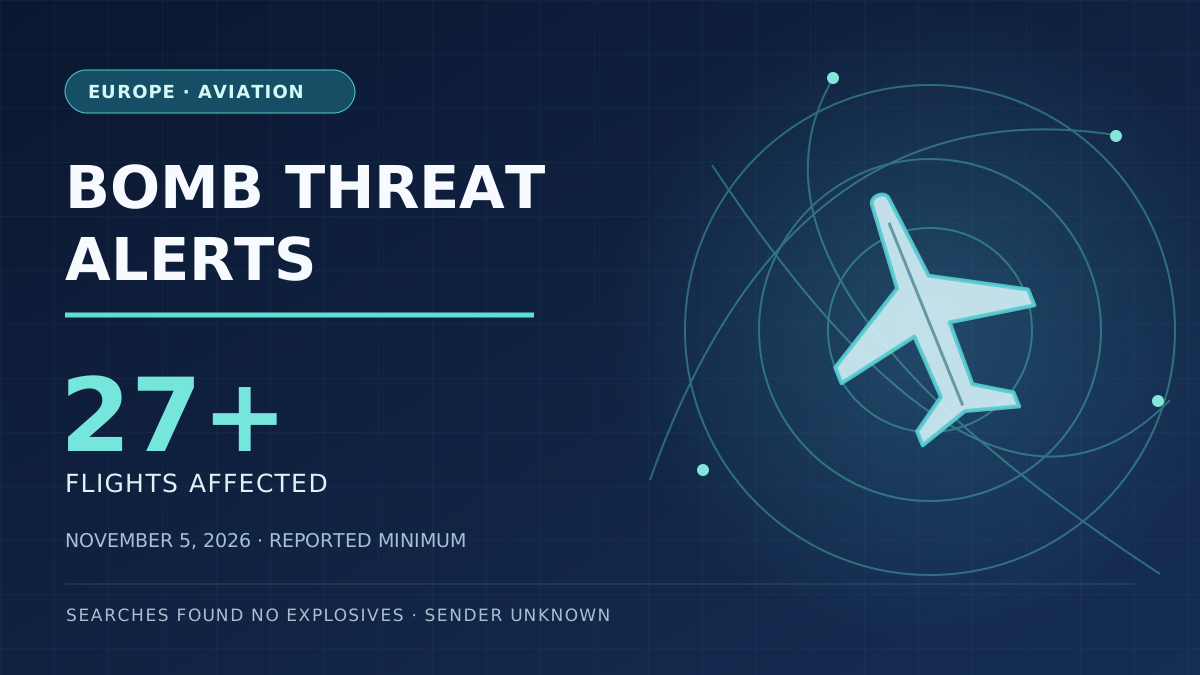
The aircraft reached the ground, but the questions did not. A wave of bomb warnings on November 5 triggered diversions, fighter escorts and aircraft inspections across Europe, following similar alerts earlier in the week. Officials found no explosive devices in the reported searches. That outcome establishes what the checks found—not who sent the messages or whether the incidents were orchestrated together.
A second wave reached across Europe
At least 27 passenger flights across Europe were affected by bomb threats on Thursday, November 5, according to Reuters and reporting by Spain’s El País. The alerts reached routes touching Ireland, France, Spain, Italy, Poland, Bulgaria and other European countries. Some planes changed their destinations; others landed as planned but were inspected, temporarily held or moved away from normal airport operations. The figure is a reported minimum for Thursday’s disruption, not a final, independently audited count of every alert received or a tally of flights carrying explosive devices.
It was not the week’s first episode. Seven European flights received similar warnings on Tuesday, November 3, following a separate alert involving a London-to-Sofia service on Monday that diverted to Budapest. That sequence explains the description of November 5 as a second wave, but the short interval does not itself prove one sender, a single coordinated campaign or a common technical origin. The public record captures responses by several national authorities rather than one completed, continent-wide investigation.
Sources: New wave of bomb hoaxes hits at least 27 passenger flights across Europe · Una nueva oleada de falsas amenazas de bomba afecta al menos a 27 aviones con destino a ciudades europeas · Flights across Europe face disruption after false bomb threats
Diversions and fighter escorts brought flights to safety
One of the most visible disruptions involved an Aer Lingus flight from Dublin to Rome. Instead of continuing to Italy, the Airbus A320 landed safely at the French military air base at Évreux after an alert. French officials said military aircraft were sent to intercept the flight, and explosive-disposal specialists examined the aircraft. The diversion moved a passenger service into an unusual operational setting, but the response should not be confused with evidence that a device was actually aboard.
Another Rome-bound aircraft, a Finnair service from Helsinki, arrived at its destination after an escort involving military aircraft. In Bulgaria, three Ryanair flights received security attention: services from Copenhagen and Madrid landed at Sofia, while one from London was diverted to Plovdiv. These were distinct operational decisions under different authorities and conditions. Reporting that a flight was escorted, diverted or searched says what officials did in response to a warning; it cannot by itself establish the warning’s authenticity.
Sources: Europe-wide bomb threats disrupt air travel · More than a dozen flights in Europe receive bomb threats that an official calls 'malicious' hoaxes
Airport checks affected more than the diverted aircraft
Not all incidents involved an aircraft already in flight. Reuters reported that Spain’s Guardia Civil received three threatening emails affecting six flights at Madrid-Barajas, including Iberia arrivals and Air Europa departures. Checks found no danger. In Poland, a LOT service from Warsaw to Brussels landed safely and was inspected; another LOT aircraft preparing to fly from Warsaw to Paris was stopped while taxiing, directed to a designated parking area and replaced before its journey continued. Ground responses can interrupt gates, stands and schedules even when aircraft are not diverted.
The pattern was visible farther east as well. Czech police checked four aircraft at Prague after threats and found nothing suspicious, according to the Associated Press. Earlier in the week, two Warsaw-bound flights had also triggered precautions at Chopin and Modlin airports, as reported by TVP World. Each episode depended on locally available information, and press tallies may differ as additional flights are reported. For passengers, a flight completing its landing does not necessarily mean the alert caused no disruption: it can still trigger a search, delay or change of aircraft. The Irish Times reported that Gardaí declared a bomb threat against a Ryanair flight from London Stansted to Cork a hoax after examining the aircraft on arrival.
Sources: Europe-wide bomb threats disrupt air travel · More than a dozen flights in Europe receive bomb threats that an official calls 'malicious' hoaxes · Two Warsaw-bound flights targeted by bomb threats · Irish passenger describes 'terrifying' incident as bomb threats affect almost 30 flights
What the searches proved—and what they did not
Authorities and airlines reported no explosives or dangerous materials in the inspections described by Reuters, the Associated Press and El País. No injuries were reported in the flights covered by their accounts. That is an important operational outcome: warnings were assessed, flights were brought to safe locations and teams checked aircraft and baggage. The absence of a discovered device does not make the initial alert imaginary. A communication containing a bomb threat can be real even when its claim about a bomb is false.
The stronger conclusion is narrower than some headlines suggest. At the time of the November 5 reports, searches described by officials had not validated the bomb allegations; that does not certify that every threatened plane had completed every possible check, nor does it solve the criminal investigation. Investigators still needed to establish who sent particular communications, which recipients received them and whether the messages were connected. Treating “no device found” as proof that one person orchestrated the disruption would leap beyond the evidence.
Sources: Europe-wide bomb threats disrupt air travel · More than a dozen flights in Europe receive bomb threats that an official calls 'malicious' hoaxes · Una nueva oleada de falsas amenazas de bomba afecta al menos a 27 aviones con destino a ciudades europeas
Claimed identities are not verified attribution
Some threat emails purported to speak for an anti-feminist group, according to the Associated Press, which reviewed one message provided by an airport official. Reuters also reported an email claiming a group identity. A signature in a message is not proof of who typed or sent it, and similar wording across messages does not conclusively identify a common organizer. The public reporting has not established whether the incidents were copycats, linked messages from one actor or separate attempts to disrupt travel.
The incidents occurred amid wider European concern about sabotage and so-called hybrid operations, and some analysts discussed those possibilities. But no government had publicly attributed this aviation threat wave to any country or organization in the reporting reviewed. EU Transport Commissioner Apostolos Tzitzikostas said it was too early to determine whether the reported incidents were linked, while national investigations remained under way. The distinction matters: geopolitical context can explain why officials are concerned; it does not amount to evidence of state responsibility for these specific emails.
Sources: New wave of bomb hoaxes hits at least 27 passenger flights across Europe · More than a dozen flights in Europe receive bomb threats that an official calls 'malicious' hoaxes · Una nueva oleada de falsas amenazas de bomba afecta al menos a 27 aviones con destino a ciudades europeas
What aviation security rules and the investigation mean next
A bomb warning activates decisions that must be made before authorities know whether an explosive exists. EASA’s standing European rules on suspected unlawful interference instruct air-traffic services to inform the relevant national authority and support the aircraft’s safe conduct when a bomb warning is received. Those provisions predate this week’s incidents; they are not a new EASA assessment or an EASA attribution statement about November 5. They help explain why a suspicious message can lead to coordination, diversion or a precautionary landing without requiring proof of a device first.
The EU transport commissioner said an aviation-security information-sharing mechanism had been activated, according to the Associated Press. National investigations must still determine whether the alerts came from the same source, whether any claims of responsibility are authentic and whether criminal charges follow. Meanwhile, airlines and airports must deal with interrupted itineraries and the cost of precautions, while passengers have limited visibility into real-time security decisions. The immediate story is a documented interruption of air travel; the identity and motive behind the warnings remain open questions.
Sources: More than a dozen flights in Europe receive bomb threats that an official calls 'malicious' hoaxes · Easy Access Rules for Standardised European Rules of the Air — Revision from August 2025; SERA.11005 and AMC1