Bomb threats reached news organisations across Europe on Friday, 6 November 2026, forcing evacuations in Dublin and Sofia and interrupting radio output. Ireland's RTÉ and Newstalk were among those affected, while Bulgaria's Nova TV and Britain's Sky confirmed alerts. Police found no explosives at the checked premises. The messages claimed a link to earlier threats against flights, but investigators have not established a common sender or any state involvement.
A Friday morning threat empties a national broadcaster
A threatening email sent on Friday, 6 November, prompted Ireland's public broadcaster RTÉ to evacuate buildings at its Donnybrook headquarters in Dublin. Police, known locally as gardaí, searched the campus while normal broadcasting was disrupted. Radio 1 switched temporarily to recorded material and music, making the disruption audible to listeners before any account of the sender could be established.
The warning reached media organisations shortly after 8:30 a.m., according to RTÉ's later examination of the episode. The message threatened an explosion within 45 minutes. Presenter David McCullagh's scheduled programme did not begin normally at 9 a.m.; he later broadcast from a mobile studio outside the main buildings. The evacuation was a precaution against a reported threat, not evidence that an explosive device existed.
By around lunchtime, police searches using sniffer dogs had cleared RTÉ's buildings, and staff returned. The broadcaster's account distinguished temporary schedule changes from a complete inability to transmit: backup facilities allowed parts of its output to continue or resume while the checks were under way. No bomb was reported found there.
Sources: Gardaí sweep RTÉ headquarters in Dublin after bomb threat · State will go after those responsible for bomb threats, Taoiseach says · RTÉ staff return to buildings as Irish police probe bomb threat · A week of cyberattacks and bomb threats: What do we know?
Other Irish newsrooms faced different responses
The alert extended beyond RTÉ. Newstalk staff left their Dublin premises and programming was interrupted. Broadcaster Claire Byrne later told listeners they had been advised they could return because the warning was regarded as a hoax. Reuters reported that Newstalk had resumed broadcasting by about 10 a.m. GMT. That judgment related to the immediate site response; it did not identify who sent the message.
Mediahuis, publisher of the Irish Independent, said it received threatening correspondence and evacuated its Dublin city-centre offices briefly for security checks. Virgin Media Television also confirmed receiving an email. Its response was different: the company said it followed its safety protocols, remained on air and did not evacuate. The distinction matters because early accounts sometimes grouped all recipients together as though all had closed their buildings.
These responses show how the same category of warning can produce different operational consequences. One organisation temporarily moves its newsroom, another pauses a live programme, and a third continues broadcasting. None of those differences establishes that the threat to one location was more credible than the threat to another; they reflect decisions taken under each organisation's security procedures.
Sources: Gardaí sweep RTÉ headquarters in Dublin after bomb threat · State will go after those responsible for bomb threats, Taoiseach says · Security threats against Irish media organisations force newsroom evacuations · RTÉ staff return to buildings as Irish police probe bomb threat
Reports from Sofia and London widen the picture
Outside Ireland, Bulgaria's Nova TV said its Sofia newsroom received a bomb threat. Police inspected the premises after an evacuation, found nothing dangerous and allowed staff to return, according to Reuters. Nova's broadcasts were not interrupted. In Britain, Sky confirmed receiving a security threat, though the available reports did not establish that Sky carried out a comparable newsroom evacuation.
Reuters said the emails received by RTÉ and Nova carried the subject 'Message to the West'. The purported sender used the name 'Mikhail Andropov' and claimed a connection to the recent threats involving passenger aircraft. The message also warned of further disruption to European transport. These are claims inside threatening correspondence, not independently verified details about a person, group or operational plan.
Reuters explicitly said it could not establish who authored the messages, where they originated or whether the newsroom and aviation emails shared a source. The name and political overtones of an email are not proof of national origin. Treating the purported signature as verified would turn a possibly deceptive message into a misleading attribution.
Sources: Newsroom bomb threats follow escalating European flight hoaxes · Bomb threats warning the clock is ticking disrupt TV channels across Europe · European flights and broadcasters are targeted with another wave of bomb threats
Police investigate; leaders urge care over attribution
Ireland's police service said it was liaising with affected media organisations and would investigate the threats. Taoiseach Micheál Martin said authorities would pursue those responsible. Justice Minister Jim O'Callaghan also condemned the threats and referred to strengthening cooperation and coordination. These responses confirm an investigation, not the result of one.
Martin said investigators had yet to determine whether the wider sequence arose from individuals or a coordinated operation. He cautioned against a premature conclusion about a Russian connection to the RTÉ incident. Europe's broader arguments over hybrid security threats form part of the political environment, but do not turn an unverified email into evidence of state responsibility.
The National Union of Journalists said threats to newsrooms affect both staff safety and the ability of the public to receive information. Its concern is concrete: moving staff, interrupting live output and searching buildings can impose costs even when no explosive is present. This is why public authorities and broadcasters responded rather than simply disregarding the messages as implausible.
Sources: Gardaí sweep RTÉ headquarters in Dublin after bomb threat · Newsroom bomb threats follow escalating European flight hoaxes · NUJ expresses concern over media threats in Dublin · RTÉ staff return to buildings as Irish police probe bomb threat · State will go after those responsible for bomb threats, Taoiseach says
The flight alerts are context, not a proven connection
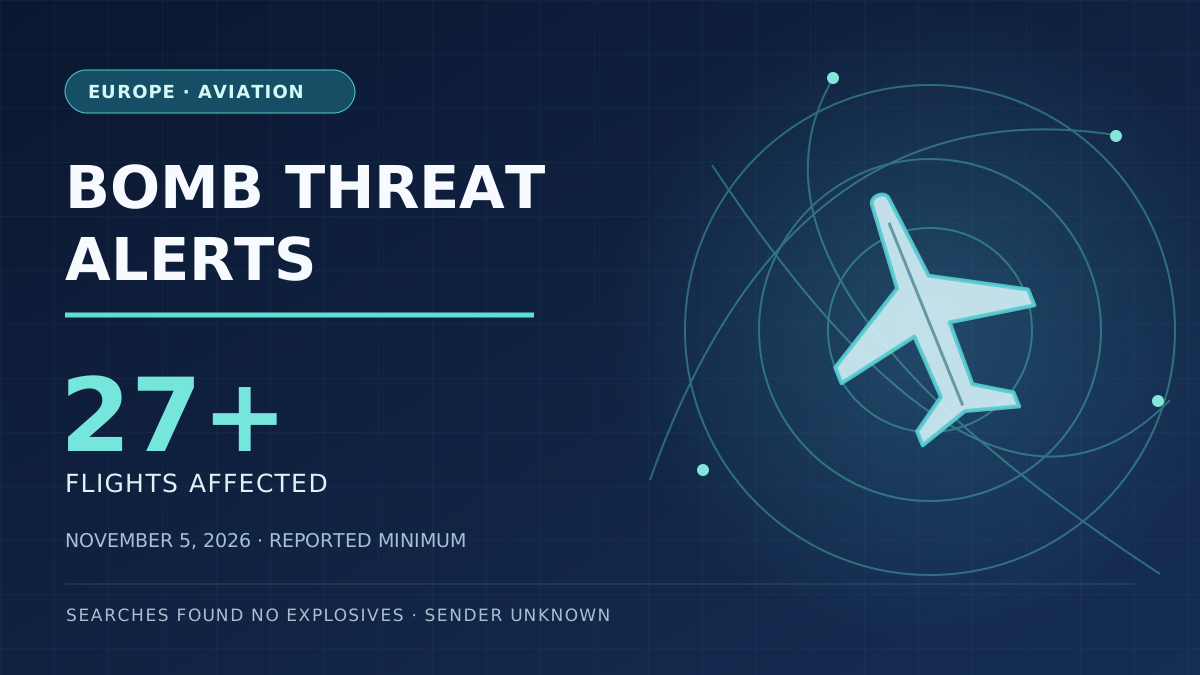
The newsroom warnings arrived during a separate, widely reported period of bomb hoaxes affecting European air travel. In a report published on 5 November, the Guardian counted at least 34 affected flights across the week, including emergency landings, diversions and security searches. That number was a dated minimum at the time of its report, not a final tally for the subsequent days.
Reuters and Associated Press reported additional aviation security responses on Friday, with aircraft landing safely and searches yielding no explosives. The flight developments help explain why the media emails received urgent attention and why their claims of responsibility attracted notice. They do not supply the missing evidence linking one set of threats to another.
The distinction is especially important because different messages may be imitated, forwarded or designed to misdirect investigators. A shared theme or asserted affiliation does not establish common authorship. Any eventual finding of coordination would require evidence beyond the words written by someone making an anonymous threat. The immediate verified news on Friday was that media organisations had been disrupted.
Sources: Bomb threats disrupt dozens of flights across Europe, raising hybrid war fears · Newsroom bomb threats follow escalating European flight hoaxes · European flights and broadcasters are targeted with another wave of bomb threats · A week of cyberattacks and bomb threats: What do we know?
What comes next for media security and public trust
The alerts came as Dublin was preparing to host major European political meetings the following week, including a European Political Community gathering and EU leaders' discussions. The timing added public sensitivity, but no verified announcement in the sources reviewed said that either meeting had been cancelled or moved because of the newsroom threats. Preparations and investigations should not be confused with changes to an event schedule.
For broadcasters, the immediate lessons are operational rather than speculative. RTÉ's use of a mobile studio demonstrates the value of alternative production facilities; Newstalk's interruption shows the vulnerability of live schedules. Police checks and employee evacuation decisions can consume attention even where every inspection proves negative. Neither the absence of a bomb nor a quick return makes the disruption inconsequential.
Three questions remain open: who sent the emails, whether recipients were selected as part of one operation and whether the messages have any genuine relationship to aviation threats. The investigation may eventually answer them, but the public record available on 7 November does not. For now, the established facts are newsroom evacuations, temporary broadcast disruption, safe returns and no explosives found, with attribution still unresolved.
Sources: Gardaí sweep RTÉ headquarters in Dublin after bomb threat · Newsroom bomb threats follow escalating European flight hoaxes · NUJ expresses concern over media threats in Dublin · RTÉ staff return to buildings as Irish police probe bomb threat · Security threats against Irish media organisations force newsroom evacuations