Artificial intelligence may be helping Anthropic advance its own models substantially faster, according to a November 5 assessment by independent evaluator METR. The group estimates that progress on well-defined benchmark tasks is now running at about twice its earlier rate and tentatively attributes most of the speedup to AI-assisted research. But the report is unusually frank about uncertainty—and about the important evidence that Anthropic did not permit it to disclose.
An acceleration estimate, not a stopwatch
An independent review by the nonprofit METR says Anthropic is probably improving its AI models' performance on well-specified tasks at roughly twice its earlier pace. The assessment covers internal evidence made available between August 12 and October 29, 2026, and compares the current trajectory with the period from March 2024 to October 2025. Its central conclusion concerns the rate of research progress, not a claim that every model is twice as intelligent or that every task is completed twice as quickly.
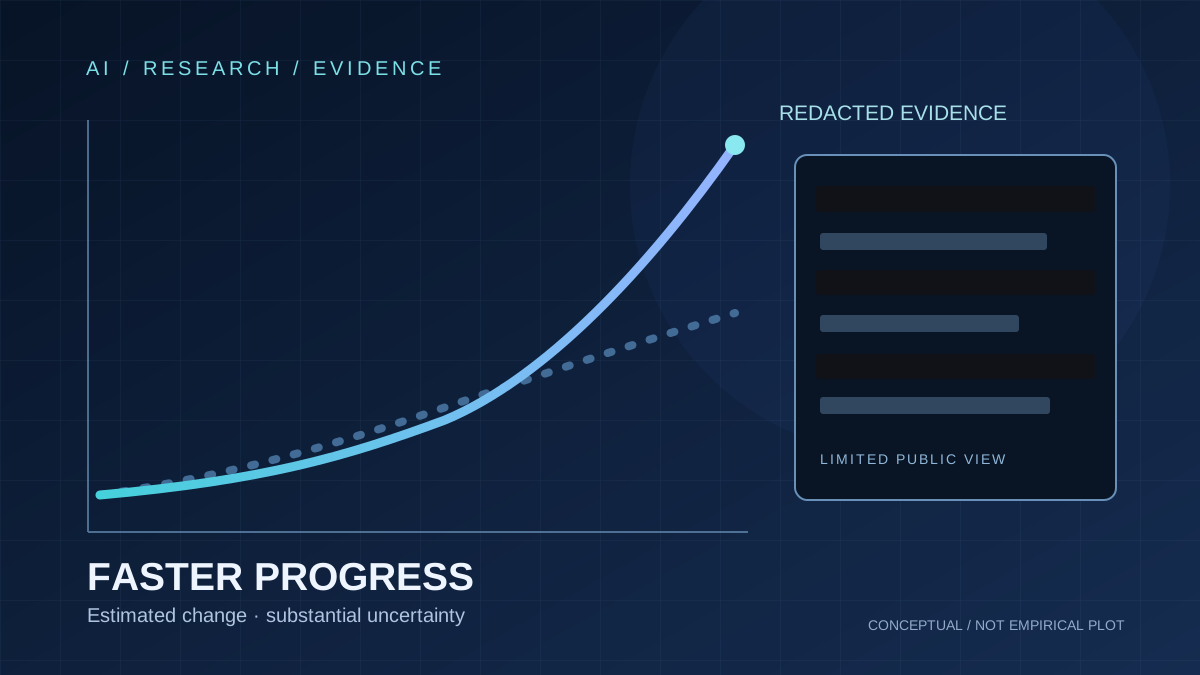
In the measured benchmark trend, METR estimates a 1.9-fold acceleration since October 2025, with a 95% confidence interval of 1.5 to 2.8. The group describes this as approximately two years of earlier benchmark progress occurring in one year. It repeatedly warns that the underlying estimate is uncertain: the actual pace could plausibly be nearer 1.3 or 3 times the historical rate. Those are judgments about a trend, not a precise universal speedometer for AI development.
Sources: Independent Assessment of AI R&D Acceleration at Anthropic in October 2026 · Why a new report on Anthropic automating AI development is alarming researchers · Anthropic is rapidly accelerating AI development amid slowdown calls, outside research group says
What the researchers examined
METR had unusually extensive access to Anthropic's internal model scores, research metrics, training-compute information and staff interviews. Its analysis used Anthropic's version of the Epoch Capabilities Index, an aggregate of model performance on tests with relatively clear scoring rules. The evaluators fitted trends across time and examined whether benchmark choice, model snapshots or saturation could change the outcome. Those tests generally pointed toward acceleration, although different analytical choices produced different estimates.
The analysis included three newer models that were not publicly released when METR examined them: Model 2, trained in July, Model 3 in August–September, and Model 4 in September–October 2026. These are labels given to the evaluators, not product announcements or confirmed launch plans. METR also considered an older unreleased 2022 model. Internal benchmarks can reveal trends that public product comparisons miss, but their concentration on tasks with verifiable answers leaves important uncertainty about open-ended work and real-world impact.
Sources: Independent Assessment of AI R&D Acceleration at Anthropic in October 2026 · Why a new report on Anthropic automating AI development is alarming researchers
The role attributed to AI assistance
METR's researchers judged that a majority of the current acceleration was probably caused by Anthropic using AI in its own research and development. They offered a tentative figure of about 80% for October 2026, explicitly describing it as a subjective guess with substantial uncertainty. It is not the result of an experiment that cleanly assigns four-fifths of every improvement to AI. Hiring, data, algorithms and other research changes may also have helped, especially during an earlier jump in late 2025.
The evaluators said they had convincing evidence that faster growth in training compute alone did not explain the observed change. That does not mean compute is unimportant or that the company's total compute use stopped rising. It means the rate of compute expansion did not itself accelerate enough to account for the faster benchmark trend. Researchers also considered staff interviews and internal accounts of AI-supported coding and experimentation, but could not publish the detailed breakdown that would let outsiders independently test the 80% judgment.
Sources: Independent Assessment of AI R&D Acceleration at Anthropic in October 2026 · Why a new report on Anthropic automating AI development is alarming researchers
Why a twelvefold figure needs context
One striking data point came from informal polls inside Anthropic's Slack workspace. Respondents using the strongest internal model in October reported average productivity uplift of about 12 times compared with working without AI. METR called the evidence loose: participation may not represent all staff, reactions required little reflection, and self-assessments can overstate actual output. The figure should not be read as a measured company-wide productivity increase, a controlled trial result or a twelvefold increase in the pace of model advancement.
The distinction between assistance and autonomy matters just as much. METR said AI was already supporting human researchers in valuable ways, but it did not find that AI systems could make highly significant, fully autonomous contributions to the central stages of model training. Interviews suggested early indications of greater autonomy in some parts of the workflow, yet the maturity of those efforts varied. The findings describe a research organization getting substantial help from its tools, not a verified self-running cycle of machines designing their successors without people.
Sources: Independent Assessment of AI R&D Acceleration at Anthropic in October 2026 · Why a new report on Anthropic automating AI development is alarming researchers
The redactions limit public scrutiny
The review also exposed a sharp transparency limit. Anthropic allowed METR access to sensitive internal information and did not pay the nonprofit, but its agreement gave Anthropic the right to redact non-public material from the public report. METR said a majority of the evidence most informative to its risk conclusions was withheld. Missing details include key measurements, finer estimates of AI's contribution, parts of the compute and algorithmic breakdown, and information relevant to possible research bottlenecks.
Anthropic co-founder Sam McCandlish acknowledged the resulting difficulty of checking METR's work. As reported by The Verge and the Associated Press, he argued that disclosure could reveal commercially sensitive methods or give rival developers a roadmap for accelerating their own systems. He said Anthropic planned a further report on its analysis and safety practices. Those considerations explain the company's position, but do not resolve the central public-interest problem: readers cannot inspect much of the evidence on which METR's consequential conclusions depend.
Sources: Independent Assessment of AI R&D Acceleration at Anthropic in October 2026 · Why a new report on Anthropic automating AI development is alarming researchers · Anthropic is rapidly accelerating AI development amid slowdown calls, outside research group says
Safety implications remain uncertain
METR did not identify clear near-term constraints from available data, experimental compute, training compute or algorithmic progress that would reliably stop additional capability gains. The researchers were careful not to call that proof of unlimited growth; their view of possible bottlenecks changed as new information arrived. In a separate review published the same day, METR also questioned how confidently Anthropic's August risk report treated an early-warning threshold based on acceleration attributable to AI. It did not establish that an imminent catastrophic event was underway.
The result is a serious warning with explicit limits. AI-assisted research appears to be reinforcing capability progress inside one frontier laboratory, but the estimate rests on partly inaccessible evidence, a benchmark-based model of progress and a disputed causal attribution. METR also disclosed that one assessor had been in job talks with Anthropic at the start of the project and received an offer, which the assessor declined; the group said all of that person's work was re-checked by an unconflicted colleague. What happens next depends on whether stronger systems can automate work that still requires expert supervision, whether constraints emerge, and whether independent reviewers can share more of what they learn. For policymakers and the public, the unresolved question is not only how quickly models improve, but how much of that speed can be independently checked.
Sources: Independent Assessment of AI R&D Acceleration at Anthropic in October 2026 · Review of the "Risks from automated R&D" section in Anthropic's Risk Report (August 2026) · Anthropic is rapidly accelerating AI development amid slowdown calls, outside research group says