A confrontation at Poland’s Constitutional Tribunal in Warsaw has escalated into a public standoff between Prime Minister Donald Tusk’s government, President Karol Nawrocki and the opposition Law and Justice party. Police were deployed around the court, protesters gathered outside and the president cut short a trip abroad to return to Poland. The immediate dispute is about who can lead the Tribunal. The deeper conflict concerns judicial independence, contested appointments and the limits of political power. This explainer separates confirmed events from competing claims. Information is current as of 1 November 2026.
What happened in Warsaw?
On 30 October, Judge Anna Korwin-Piotrowska announced that the Tribunal’s president, Bogdan Święczkowski, and vice-president, Bartłomiej Sochański, would be suspended from their duties for one month. She said she would take responsibility for directing the court. The move was immediately challenged by the suspended officials and their political allies.
Police officers were deployed around the Tribunal as supporters and opponents gathered. The police’s initial 30 October statement said three people were detained after crossing the fence. A follow-up account reported by WP on 31 October put the total at four: three for entering the grounds and a fourth for insulting an officer. AP’s earlier report reflected the initial three-person count. The dispute also involved conflicting claims about who could enter the court premises and who was entitled to exercise authority inside.
President Karol Nawrocki turned his plane around while travelling to Senegal and returned to Warsaw. In a statement published on 31 October, he described the events as a violation of Poland’s constitutional order, called for government forces to leave the Tribunal and summoned parliamentary representatives for urgent consultations. Prime Minister Donald Tusk defended the government’s actions as part of its effort to restore the rule of law.
Sources: Police detain 3 protesters during overnight rally as Polish president backs suspended judge · Statement by the President of the Republic of Poland Karol Nawrocki · Police statement concerning actions at the Constitutional Tribunal · Police issued a statement on the Tribunal events; four people detained
Why does the Constitutional Tribunal matter?
Poland’s Constitutional Tribunal reviews whether laws comply with the country’s constitution. Its rulings can affect whether legislation takes effect, so control of the institution and confidence in the independence of its judges have consequences well beyond the court building.
The present confrontation is not simply a personnel dispute. If rival groups disagree about which judges are lawfully appointed and who may direct the Tribunal, public authorities and citizens may also disagree about which decisions should be treated as authoritative. That uncertainty can weaken trust in the legal system.
Sources: Protests outside Poland’s constitutional court: What’s the crisis about? · Judgment in Case C-448/23: Commission v Poland
How did the dispute begin?
The roots go back to 2015, when Poland’s outgoing parliament and the incoming Law and Justice (PiS) majority made competing appointments to the Tribunal. The dispute over whether seats had been lawfully filled developed into a wider argument about the independence of the judiciary during PiS’s years in government from 2015 to 2023.
European courts later issued important rulings about the Tribunal’s composition. In 2021, the European Court of Human Rights found a violation of the right to a tribunal established by law in a case involving the participation of an improperly appointed Constitutional Tribunal judge. In December 2025, the Court of Justice of the European Union held that serious irregularities affecting the appointment of three judges and the Tribunal’s president meant the Polish Constitutional Tribunal did not meet the EU-law requirements of an independent and impartial tribunal. These judgments are important background, but they do not by themselves decide the legality of the latest one-month suspensions.
After returning to office in 2023, Tusk’s coalition pledged to restore judicial independence. In 2026, parliament elected new judges, but President Nawrocki administered the oath to only some of them. The remaining appointments and the Tribunal’s refusal to allow those judges to take up their duties became another point of conflict.
Sources: Protests outside Poland’s constitutional court: What’s the crisis about? · Judgment in Case C-448/23: Commission v Poland · Xero Flor w Polsce sp. z o.o. v. Poland (Application no. 4907/18)
What are the government and opposition arguing?
The government says Święczkowski obstructed the work of the Tribunal, including by preventing newly elected judges from taking up their posts. Tusk argues that decisive steps are needed to reverse the effects of earlier judicial changes and restore the rule of law. The justice minister has also sought steps that could lead to proceedings against the suspended officials.
Nawrocki, PiS politicians and the suspended Tribunal leadership reject the move. The president’s official statement says the constitutional order was violated and describes the events as a forcible takeover of a constitutional institution. The Tribunal’s own public statements have also described the actions as unlawful. Those are serious allegations made by the parties to the dispute; they should not be presented as a court finding that a coup has occurred.
The two sides therefore disagree not only about policy, but about the legal status of the judges involved, the authority to suspend senior Tribunal officials and which people are entitled to exercise the institution’s powers.
Sources: Police detain 3 protesters during overnight rally as Polish president backs suspended judge · Statement by the President of the Republic of Poland Karol Nawrocki · Chaos at Poland’s constitutional court as government-backed judges seek to oust chief justice
Why is the legality of the suspension disputed?
Reports say the suspension order relied on a provision of Polish law that allows a judge’s duties to be suspended in specified circumstances. The difficulty is whether that provision can be applied in this way to the Constitutional Tribunal and whether the judge who issued the order had authority to do so.
Some legal commentators have questioned whether the Justice Minister’s supervisory powers over ordinary courts extend to the Constitutional Tribunal. Other questions concern how the Tribunal’s own rules apply when the status of several judges is contested. The fact that an order has been published or announced establishes that the order exists; it does not, by itself, settle whether it is legally valid.
As of 31 October, the reporting reviewed for this explainer describes the immediate leadership dispute as unresolved. It would be premature to declare either side’s legal interpretation definitively correct without an authoritative ruling or a clearly established legal resolution.
Sources: Protests outside Poland’s constitutional court: What’s the crisis about? · Chaos at Poland’s constitutional court as government-backed judges seek to oust chief justice
October 31 update: rival staff instructions deepen the standoff
On October 31, an order published on the Tribunal’s website by Anna Korwin-Piotrowska revoked existing staff authorisations, limited the Chancellery to tasks she specified, suspended most employees’ duties with pay and suspended the registry office. A notice later that morning said entry to the Tribunal’s seat was not possible, that the Prosecutor General’s immunity motions concerning Święczkowski and Sochański had been received, and that the 3 November General Assembly was still scheduled to consider the 2027 budget. In a further statement reported at 22:19, Korwin-Piotrowska said the two suspended officials were not entitled to enter the building and that other judges should work outside the seat unless entry was arranged with her.
A separate document attributed to Święczkowski was circulated on social media by his adviser and reported by WP at 13:19. It declared 3–6 November paid days off for Tribunal employees and said Korwin-Piotrowska’s instructions had no legal effect. The text was publicly reproduced by the adviser, but it was not posted on the Tribunal’s official website; no court had assessed its legal effect. The 3 November assembly therefore remained on Korwin-Piotrowska’s published schedule, while the competing instructions created uncertainty about staff access and the practical operation of the institution.
The detention figures also changed with the reporting timeline. The Warsaw police’s initial 30 October statement said three people were detained after crossing the fence. A follow-up account reported by WP on 31 October put the total at four: three for entering the grounds and a fourth for insulting an officer. AP’s earlier report reflected the initial three-person count; the two figures describe different updates, not necessarily a factual contradiction.
The dispute also reached Poland’s diplomatic service. The ambassador to China, Jakub Kumoch, announced his resignation on 30 October; the ambassador to Romania, Paweł Soloch, followed on 31 October. Both cited the crisis around the Tribunal. The announcements were public, but formal recalls had not been independently confirmed in the reporting reviewed.
Sources: Live updates: the Tribunal dispute since 30 October 2026 · Święczkowski issued an order declaring days off and rejected Korwin-Piotrowska's document · Korwin-Piotrowska issued further instructions: duties outside the Tribunal's seat · Police statement concerning actions at the Constitutional Tribunal · Police issued a statement on the Tribunal events; four people detained · Polish ambassadors in Romania and China announce resignations amid constitutional crisis · Jakub Kumoch resigns as Poland’s ambassador to China amid Constitutional Tribunal dispute
What could happen next?
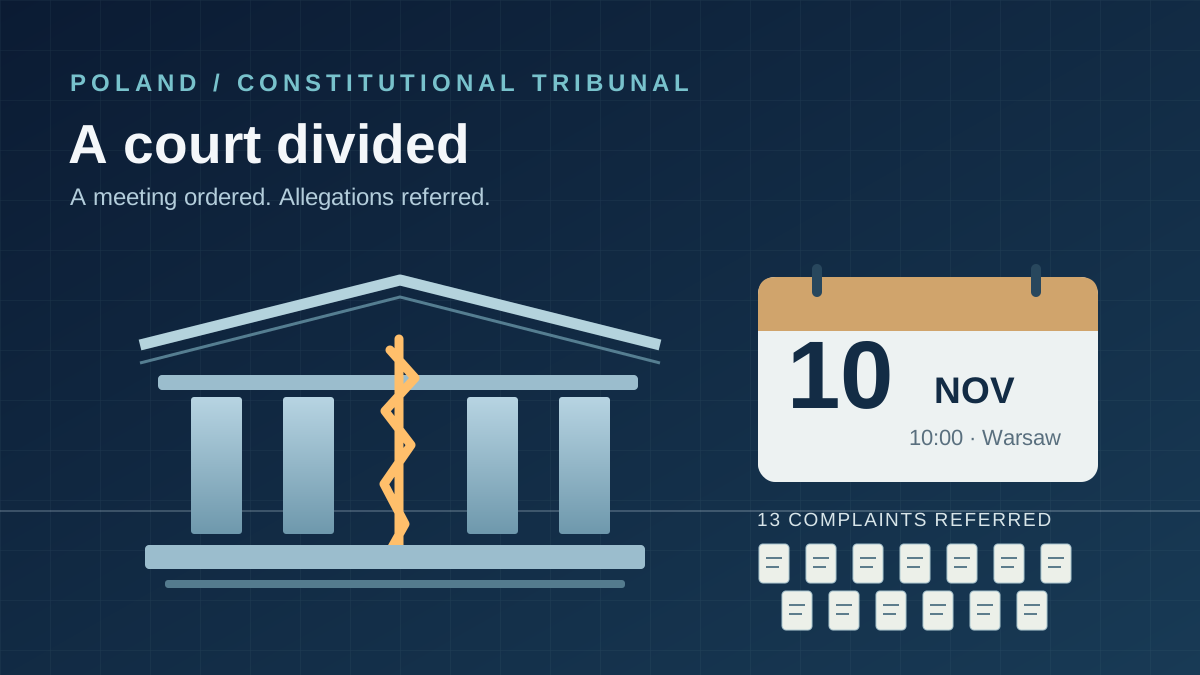
One near-term point to watch is a meeting of the Tribunal’s judges reported as scheduled for 3 November. Its composition, quorum and authority could become contested if the rival groups continue to disagree about who is entitled to participate.
The justice minister’s requests concerning the immunity of Święczkowski and Sochański may create another procedural test. Any decision on those requests could become a further source of dispute if the body asked to consider them is itself challenged.
President Nawrocki’s consultations with parliamentary groups may create an opportunity for political negotiation, but they do not automatically resolve the underlying legal questions. Watch for official notices from the Tribunal, statements from the government and presidency, court decisions and any response from European institutions.
Sources: Protests outside Poland’s constitutional court: What’s the crisis about? · Statement by the President of the Republic of Poland Karol Nawrocki
Why the crisis matters beyond Poland
The dispute is a test of how a democracy repairs institutions after years of disagreement over judicial appointments. Restoring judicial independence is important, but the methods used to do so must also be legally defensible and capable of being applied consistently by future governments.
The issue also matters to Poland’s relationship with the European Union. The Court of Justice’s 2025 judgment set out EU-law concerns about the Tribunal’s independence and composition. A prolonged domestic standoff could make it harder to establish a stable, trusted constitutional court and could deepen political tensions inside Poland and across the EU.
With parliamentary elections expected in 2027, both government and opposition have strong political incentives to frame the conflict in terms that mobilise supporters. That makes careful attribution especially important: political claims, legal arguments and verified events should remain distinct.
Sources: Protests outside Poland’s constitutional court: What’s the crisis about? · Judgment in Case C-448/23: Commission v Poland
What to watch next
The next concrete developments to watch are the Tribunal judges’ meeting reported for 3 November, any formal decisions on the immunity requests, and responses from Poland’s government, presidency and European institutions. Each could clarify how the competing claims of authority are being handled—or add another layer to the dispute.
For readers following Poland, the central question is whether the country’s institutions can reach a legally grounded and broadly accepted way to resolve who is entitled to lead and sit on the Constitutional Tribunal. The answer will depend on formal decisions and the legal reasoning behind them, not only on statements made during the confrontation.
Sources: Police detain 3 protesters during overnight rally as Polish president backs suspended judge · Protests outside Poland’s constitutional court: What’s the crisis about? · Statement by the President of the Republic of Poland Karol Nawrocki · Chaos at Poland’s constitutional court as government-backed judges seek to oust chief justice