Two decisions reported on November 5 have opened a new phase in Poland’s Constitutional Tribunal standoff. Judge Anna Korwin-Piotrowska issued an order for a General Assembly on November 10 to consider changes to the court’s operating rules. Separately, Warsaw prosecutors referred 13 criminal complaints over the confrontation around the Tribunal to the National Prosecutor’s Office. Both developments are concrete; neither establishes whose claim to run the court is lawful, whether the next meeting will proceed or whether anyone has committed a crime. The distinction between an order, an allegation and a verified outcome is central to what happens next.
A November 10 assembly is ordered, but its authority is contested
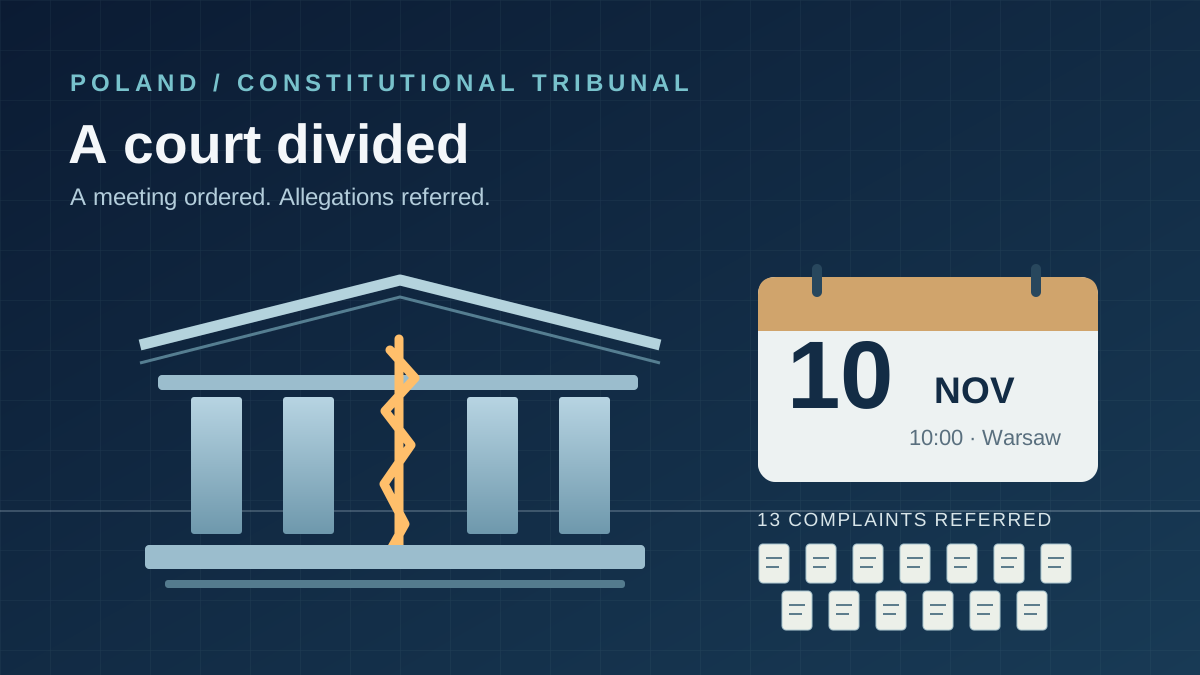
On Thursday, November 5, judge Anna Korwin-Piotrowska issued an order calling another General Assembly of Judges of Poland’s Constitutional Tribunal for Tuesday, November 10, at 10 a.m. in Warsaw, according to a report by the Polish Press Agency carried by Onet. The report says the order was published on the Tribunal’s website. The meeting is scheduled, not completed; the order’s existence as reported does not settle whether Korwin-Piotrowska had legal authority to convene it.
Korwin-Piotrowska had already signalled the plan on November 4, when she said a new assembly was needed to clarify the court’s administrative procedures and how cases are assigned. The November 5 order made that timetable more specific. Onet reported its terms, but the underlying order could not be checked directly on the Tribunal’s website during this review. That distinction matters in an institution where even competing procedural instructions are under challenge.
Sources: Anna Korwin-Piotrowska zwołuje sędziów Trybunału. Ogłosiła termin · Będzie kolejne zgromadzenie sędziów Trybunału Konstytucyjnego
Why the agenda matters for the cases before the court
The reported agenda includes consideration of draft changes to the Tribunal’s organisational rules, known in Polish as the regulamin organizacyjny, alongside questions about the method of composing judicial panels. It also includes a general item for “other matters.” Those subjects concern the machinery through which a constitutional court handles its work: who assigns a case, which judges sit on a panel, and how those choices are explained.
Korwin-Piotrowska has argued that clearer arrangements are needed for the efficient and transparent operation of the Tribunal. That is her stated justification, not an independent finding that the proposed changes would make assignments impartial or legally valid. No adopted rule changes have been established by the November 5 reporting. Even if the November 10 gathering proceeds, a proposed revision and a rule that has validly taken effect would remain two different things.
Sources: Anna Korwin-Piotrowska zwołuje sędziów Trybunału. Ogłosiła termin · Będzie kolejne zgromadzenie sędziów Trybunału Konstytucyjnego
Two rival accounts of who can call the judges together
Judges elected by the current Sejm have treated Korwin-Piotrowska, the longest-serving judge, as the person directing the Tribunal’s work. On October 30 she issued orders purporting to suspend Tribunal President Bogdan Święczkowski and Vice-President Bartłomiej Sochański from their duties. Their authority and the legal effectiveness of those suspension orders are disputed. Reporting the orders as actions taken must not be confused with accepting their validity.
Święczkowski and the President’s Office reject that transfer of authority. The office argues that only the Tribunal president may summon a General Assembly; Polish Radio also reported its objections to whether the participants in the previous assembly met the required quorum. The previously reported eight-judge November 3 sitting remains disputed on quorum grounds, while seven separately reported prosecutorial immunity applications are distinct from the 13 criminal complaints newly referred. No court resolution of these rival interpretations was identified in the sources reviewed for this article.
Sources: Anna Korwin-Piotrowska zwołuje sędziów Trybunału. Ogłosiła termin · Polish president's office threatens legal action over Constitutional Tribunal dispute · Disputed Polish constitutional court holds first meeting after takeover by government-backed judges
A boycott threatens the next sitting before it begins
Święczkowski said over the weekend that he and the lawful judges would not attend events organised by people he calls “usurper judges.” That language is his accusation, not this article’s description of the judges’ legal standing. The President’s Office takes a similar position on who may issue the summons. A boycott would place a further practical question beside the underlying legal one: who will actually be in the room on November 10?
As of November 6, there is no verified attendance list, and the reports reviewed do not establish that the gathering will go ahead as planned. A formal summons records an intention to meet; it does not guarantee participation, quorum or a legally effective outcome. Nor was there a General Assembly on November 5. The development that day was an order for a future meeting, alongside a separate prosecutorial referral.
Sources: Anna Korwin-Piotrowska zwołuje sędziów Trybunału. Ogłosiła termin · Polish president's office threatens legal action over Constitutional Tribunal dispute
Thirteen complaints are transferred, not decided
A separate development on November 5 came from the Warsaw District Prosecutor’s Office. It received 13 criminal complaints concerning the events around the Tribunal, according to Onet and further Polish reporting. The complaints included allegations from opposing sides of the confrontation. The office transferred all 13 to the National Prosecutor’s Office so that a specialist prosecutorial team could assess the related accusations together, Onet reported. A complaint is a request for scrutiny, not evidence that the alleged offence occurred.
The National Prosecutor’s Office had already announced a distinct investigation into incidents on the night of October 30–31; its November 3 notice gives that earlier proceeding its own scope. The new batch of 13 complaints is therefore a separate number, not a recount of judicial immunity applications or a statement of 13 proven crimes. None of the sources reviewed reports charges or indictments arising from these 13 complaints. Prosecutors must distinguish allegations, corroborated evidence and any eventual formal accusations.
Sources: Seria zawiadomień po wydarzeniach w Trybunale Konstytucyjnym. Śledczy przekazują sprawę wyżej · Spór o Trybunał Konstytucyjny trafia do prokuratury. Złożono 13 zawiadomień · Wszczęcie śledztwa w sprawie czynnej napaści na sędziów Trybunału Konstytucyjnego
What readers should watch on November 10
There are now two different tracks to follow. On the institutional track, the immediate questions are whether the November 10 assembly takes place, who attends and whether anyone challenges the procedure or any resolutions it claims to adopt. On the criminal track, the questions are what prosecutors decide to investigate, whether they formally accuse anyone and whether evidence supports any allegation. Movement on one track would not automatically settle the other.
The dispute has reached an especially sensitive stage because each camp contests the other’s ability to speak for the same constitutional institution. A reported meeting order cannot itself decide that dispute, just as the transfer of criminal complaints cannot prove a constitutional offence. Until there is a reliably documented procedural outcome or an authoritative legal determination, the most accurate account is a narrow one: November 10 is scheduled, 13 complaints have been referred, and both the meeting’s authority and its outcome remain unresolved.
Sources: Anna Korwin-Piotrowska zwołuje sędziów Trybunału. Ogłosiła termin · Seria zawiadomień po wydarzeniach w Trybunale Konstytucyjnym. Śledczy przekazują sprawę wyżej · Polish president's office threatens legal action over Constitutional Tribunal dispute · Wszczęcie śledztwa w sprawie czynnej napaści na sędziów Trybunału Konstytucyjnego