A new World Health Organization assessment says six climate-and-health actions could avert an average of 1.56 million deaths each year if scaled up across 187 countries. It also estimates trillions of dollars in annual welfare and fiscal benefits. But the headline totals describe different kinds of value: one includes monetized health and environmental gains, while the other is tied to fossil-fuel pricing. The report is a modelled case for investment, not a guarantee of results or a new government revenue forecast.
A modeled annual average, not a forecast for next year
The World Health Organization released a new technical report on November 4 arguing that six climate-and-health interventions, scaled up across 187 countries, could avert an average of 1.56 million expected deaths each year. The report also estimates that the package could avoid 16.67 billion tonnes of carbon-dioxide-equivalent emissions annually. These are modelled annual averages across a projection period, not a promise that 1.56 million people will be saved in the next calendar year.
The technical assessment covers different time horizons for different interventions, within a broader projection framework running from 2024 to 2075. WHO combines epidemiological, environmental and economic evidence with mathematical models to estimate what could happen if countries expanded the measures. The central question is therefore not whether the numbers describe an event that has already happened, but what the models say could be achieved if governments build and fund the required systems.
Sources: Six climate and health actions could save 1.6 million lives and deliver trillions in benefits each year · Global benefits and costs of prioritized actions on climate change and health: technical report · Frequently asked questions: Global benefits and costs of prioritized actions on climate change and health
Six actions connect climate policy to everyday health
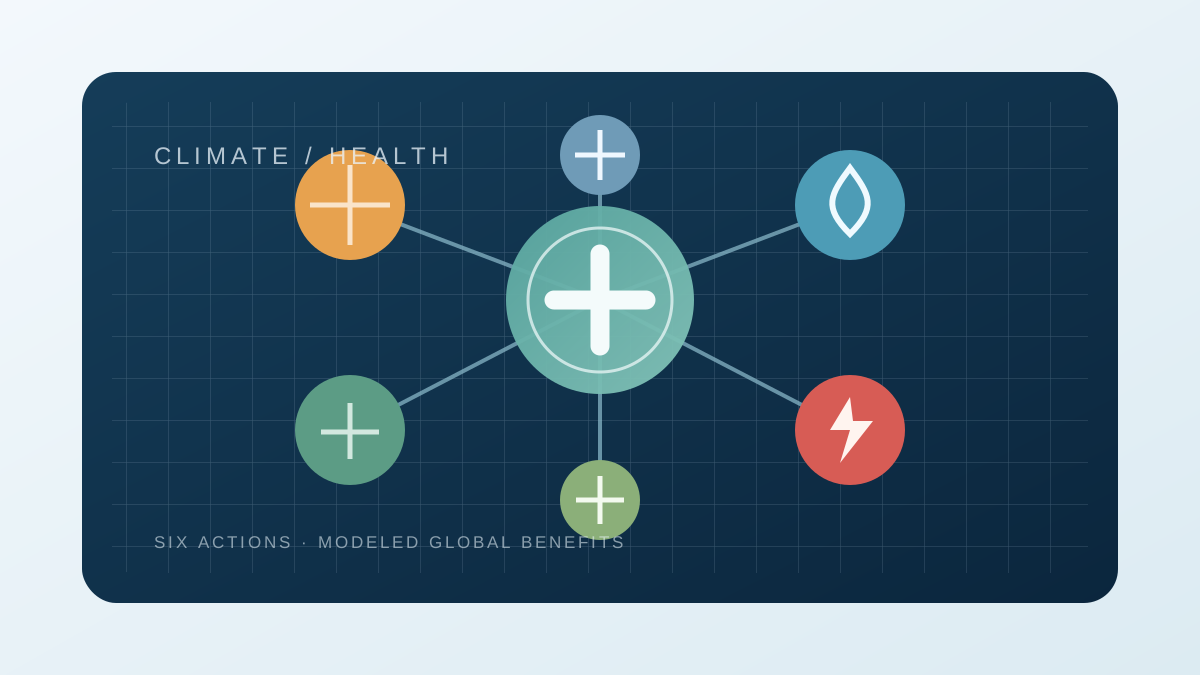
The package is more practical than a single promise to “act on climate”. It includes heat-health warning systems; climate-resilient, safely managed drinking-water services; climate-resilient basic sanitation; climate-resilient hand-hygiene facilities; cleaner household fuels and technologies for cooking and heating; and fiscal policies that price fossil fuels more efficiently.
The interventions work through different pathways. Heat warnings can help people and services prepare for dangerous temperatures. Water, sanitation and hygiene systems protect health when floods, droughts or other climate stresses disrupt basic services. Cleaner household energy can reduce exposure to harmful pollution, while fossil-fuel pricing is intended to change incentives around energy use and public support for high-emission fuels. They are not interchangeable projects, and each requires different institutions, infrastructure and funding.
Sources: Six climate and health actions could save 1.6 million lives and deliver trillions in benefits each year · Frequently asked questions: Global benefits and costs of prioritized actions on climate change and health · Compendium of WHO and other UN guidance in health and environment: 2024 update
The trillions are not one pot of money
WHO’s headline estimate separates two categories: about US$3.9 trillion a year in economic-welfare benefits and a further US$5.4 trillion in fiscal benefits. The first category combines the estimated value of health, environmental and economic effects. The second is a government-revenue estimate. Treating the two figures as one pool of cash would misrepresent what the report has measured.
The distinction becomes clearer in the WHO methodology FAQ. The estimated US$5.44 trillion in fiscal benefits comes from the fossil-fuel-pricing intervention, including the removal of inefficient subsidies and corrective taxes; it is not a fiscal return generated equally by all six actions. That intervention also accounts for about US$3.04 trillion of the US$3.92 trillion welfare estimate. The other five interventions contribute the remaining welfare benefits, and their costs were assessed separately.
Sources: Six climate and health actions could save 1.6 million lives and deliver trillions in benefits each year · Global benefits and costs of prioritized actions on climate change and health: technical report · Frequently asked questions: Global benefits and costs of prioritized actions on climate change and health
The value of a life saved is a welfare measure, not cash
Part of the economic-welfare total comes from assigning a monetary value to reductions in mortality risk. WHO’s FAQ says the assessment uses a Value per Statistical Life approach: a method for representing how society values small reductions in the risk of death. This can make different policy options comparable in an economic analysis, but it does not mean that the same amount of money enters a government account or is paid to a household when a death is prevented.
WHO explicitly distinguishes these welfare-accounting values from real economic flows such as productivity gains, tax receipts or increases in gross domestic product. The underlying research develops country-specific estimates using income data and notes uncertainty in extrapolations. The large headline number is therefore a measure of modelled social value, not a forecast of new cash income.
Sources: Frequently asked questions: Global benefits and costs of prioritized actions on climate change and health · Valuing reductions in the risk of death in benefit-cost analyses of environment- and climate-health actions
The equity case depends on who benefits—and how value is measured
The WHO assessment says low- and middle-income countries, taken as a group, could experience proportionally larger reductions in health losses and larger economic-welfare benefits than high-income countries. That is an important part of the report’s case for climate-health investment: the people and systems most exposed to climate-related risks may also have much to gain from basic protection and resilient infrastructure.
There is a measurement question alongside that equity argument. Because the monetary value assigned to mortality reductions uses country-specific estimates linked to income, the value of the same reduction in risk can differ between countries. The WHO-linked research says these valuations should be supplemented by distributional analysis. A global total can help compare policy options, but it cannot by itself show how benefits, costs and implementation burdens are shared within a country.
Sources: Frequently asked questions: Global benefits and costs of prioritized actions on climate change and health · Valuing reductions in the risk of death in benefit-cost analyses of environment- and climate-health actions
Implementation is the decisive test
The report’s strongest limitation is also visible in its ambition. WHO’s FAQ describes the scale-up scenarios as aspirational at the global level. Some measures require new infrastructure or systems; some interventions were modelled without fully capturing synergies between them; and the evidence base for certain actions remains limited. Long-term projections also carry unavoidable uncertainty. The model is useful for comparing possible returns, but it does not prove that every country can reach the assumed coverage on the same timetable.
WHO is asking governments, development partners and financing institutions to prioritize and fund the measures, and to integrate health into climate policy ahead of the next climate negotiations. The practical test will be national: which ministry pays, which agency delivers, what coverage is realistic, and whether the people facing the greatest risks can access the services. The report makes a case for treating health as part of climate investment; it does not remove the political and administrative work needed to make that investment real.
Sources: Six climate and health actions could save 1.6 million lives and deliver trillions in benefits each year · Global benefits and costs of prioritized actions on climate change and health: technical report · Frequently asked questions: Global benefits and costs of prioritized actions on climate change and health · Compendium of WHO and other UN guidance in health and environment: 2024 update