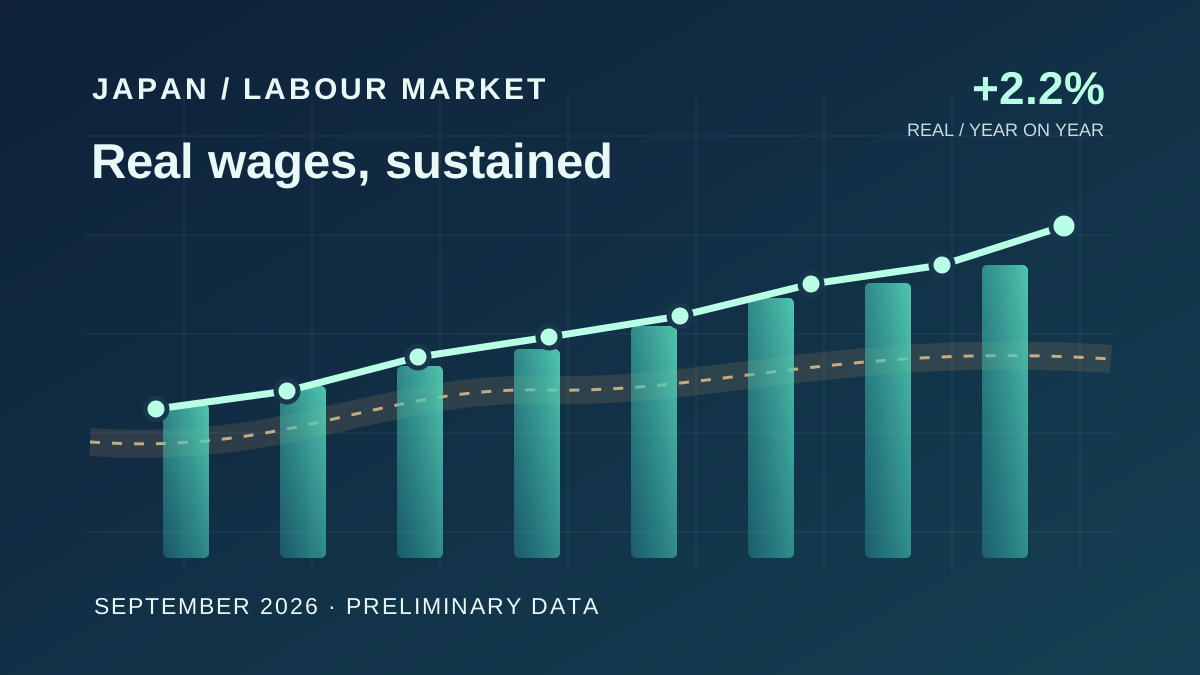
Japanese workers' inflation-adjusted pay rose again in September, extending a recovery that matters for household spending and for the Bank of Japan's interest-rate debate. The preliminary government survey showed a 2.2% annual real-wage gain and a 4.6% increase in nominal total cash earnings. But the headline needs care: a 32.6% leap in special payments, attributed by the ministry to a statistical quirk, helped lift the overall total. The more revealing measure is the continuing improvement in scheduled salaries, which suggests the recovery is not resting solely on bonuses.
A stronger September reading, with an important qualification
Japan's preliminary Monthly Labour Survey recorded a 2.2% rise in inflation-adjusted total cash earnings in September from a year earlier, extending the advance to nine consecutive months. August's increase was revised to 1.6%. The September reading beat a 1.3% consensus estimate cited in market reporting, adding evidence that workers' purchasing power has been recovering even as living costs continue to rise.
The Ministry of Health, Labour and Welfare released the survey on November 6. Its headline figures cover establishments employing at least five people and describe average earnings per worker, not the change in any particular household's take-home pay. The ministry warns that preliminary estimates can be revised when the final results become available.
Nominal total cash earnings rose 4.6% year on year to ¥311,409. Reuters described that growth rate as the quickest since January 1997. Those figures are related but not interchangeable: the nominal measure shows pay before adjusting for consumer prices, while the 2.2% real increase measures how the survey's earnings index moved after a defined inflation adjustment.
Sources: 毎月勤労統計調査 2026(令和8)年9月分結果速報等 · 毎月勤労統計調査 2026(令和8)年9月分結果速報等 · Japan's real wages rise for ninth month in September, backing BOJ rate hike
Base pay matters more than the headline total
The most durable part of the report is scheduled earnings, which exclude overtime and irregular special payments. They increased 3.7% from September 2025 to ¥279,182 per worker. Such pay is more closely connected to ongoing salary arrangements than to a payment made only in one particular month, although future bargaining rounds and company decisions can still change it.
A separate official category, regularly paid earnings, includes overtime as well as scheduled pay. It reached ¥299,151, up 3.6%. Keeping those categories distinct is essential. Calling ¥279,182 all regular pay would understate the broader recurring-payment total, while calling it the entire wage packet would incorrectly fold overtime and bonuses into basic salary.
Overtime earnings rose 3.6% on the year, according to Reuters, slower than August's revised 4.9%. The survey therefore does not describe a uniform acceleration in every component of compensation. For readers assessing whether pay gains can persist, the scheduled-pay series offers a clearer signal than an unusually strong monthly total alone.
Sources: 毎月勤労統計調査 2026(令和8)年9月分結果速報等 · 毎月勤労統計調査 2026(令和8)年9月分結果速報等 · Japan's real wages rise for ninth month in September, backing BOJ rate hike · 毎月勤労統計調査 2026(令和8)年9月分結果速報(厚労省)|労働行政最新情報|労働新聞社
The 32.6% jump that should not be mistaken for a bonus boom
Special payments increased 32.6% from a year earlier to ¥12,258 per worker, compared with a revised 1.8% rise in August. In an ordinary reading of payroll data, that might suggest a sudden burst of extra compensation. The ministry's explanation, as reported by Reuters, points in the opposite direction: the surge reflected a statistical quirk rather than a broad underlying increase in bonuses.
This distinction matters because total cash earnings combine scheduled pay, overtime and special payments. A volatile or distorted contribution from the last component can make a single month's aggregate growth appear stronger than its underlying pattern. The 4.6% nominal rise is an official survey result, but it is not a clean measure of sustainable wage increases by itself.
The official release also supplies comparisons for establishments observed in both periods, intended to reduce some changes caused by the survey sample. In that like-for-like comparison, scheduled pay increased 3.3% across employment types and 3.1% for general workers. These figures reinforce evidence of genuine pay growth while cautioning against treating the exceptional special-payment figure as a lasting trend.
Sources: 毎月勤労統計調査 2026(令和8)年9月分結果速報等 · Japan's real wages rise for ninth month in September, backing BOJ rate hike
Spring bargaining is feeding through, but unevenly
Japan's annual spring wage negotiations, known as shunto, provide an important backdrop. The Japanese Trade Union Confederation, Rengo, published its final 2026 bargaining tallies in July, documenting the negotiated settlement process. Those union results and the government's September payroll survey answer different questions: agreed increases are not identical to earnings actually recorded across the wider labour market.
Reuters quoted a labour ministry official pointing to the steady increase in basic salaries this year as one reason real earnings improved. That interpretation is consistent with the sequence of stronger scheduled-pay readings, rather than depending entirely on a one-off September payment. It does not establish that every employer or type of worker has received the same improvement.
The ministry's September release illustrates the variation. Total cash earnings for general workers increased 5.0% to ¥401,722, while the figure for part-time workers rose 4.2% to ¥114,412. Part-time scheduled hourly earnings increased 5.4%. These are different populations and payment bases; comparing their yen levels as if they described the same hours would obscure the distribution of gains.
Sources: 毎月勤労統計調査 2026(令和8)年9月分結果速報等 · Japan's real wages rise for ninth month in September, backing BOJ rate hike · 連合|労働・賃金・雇用 春季生活闘争 2026年春闘
Why inflation and the Bank of Japan remain in the frame
Real wage growth depends on both pay and prices. The inflation measure used for the survey's main real-wage calculation, the consumer price index excluding imputed rent for owner-occupied housing, rose 2.4% in September, compared with 2.2% in August and 3.4% a year earlier. The release also reports a separate real-wage calculation using the overall consumer price index; that alternative produced a 2.3% real gain.
The Bank of Japan's price-stability target is 2% inflation, and its October outlook was released before the September wage data. Meanwhile, Tokyo's October core consumer inflation reached 2.6%, Reuters reported, remaining above that target. Tokyo's local core measure is neither the national payroll deflator nor the same inflation series used in the ministry's headline real-wage number.
For monetary policy, firmer wage growth may help establish that inflation is accompanied by rising household earnings, rather than only eroding purchasing power. Reuters said the September figures strengthen the case for further rate increases, while analysts see the possibility of another move. That is a market interpretation, not a decision or a promise from the central bank.
Sources: 毎月勤労統計調査 2026(令和8)年9月分結果速報等 · Japan's real wages rise for ninth month in September, backing BOJ rate hike · Outlook for Economic Activity and Prices · Price Stability Target of 2 Percent · Tokyo core inflation exceeds BOJ target in October
What would prove the recovery can last
The nine-month sequence is encouraging, but endurance will be tested beyond this preliminary release. Future reports will show whether scheduled earnings remain robust once the statistical distortion in special payments subsides, whether overtime demand stabilizes and whether inflation again absorbs a larger share of nominal raises. A single strong headline is less persuasive than sustained gains across these separate indicators.
More broadly, wage data cannot on their own establish the condition of all households. The survey measures payrolls at covered establishments; it is not a household budget survey and does not directly reveal taxes, benefits, rent burdens or the experience of people outside its coverage. Nor do average earnings indicate that every worker has enjoyed an increase in purchasing power.
For now, the verified story is not that Japan has solved its cost-of-living pressures or that an interest-rate increase is inevitable. It is that rising scheduled salaries are supporting an unusually persistent stretch of positive real earnings, even after inflation is considered. Whether that improvement becomes a lasting wage-price balance remains a question for subsequent data and Bank of Japan decisions.
Sources: 毎月勤労統計調査 2026(令和8)年9月分結果速報等 · 毎月勤労統計調査 2026(令和8)年9月分結果速報等 · Japan's real wages rise for ninth month in September, backing BOJ rate hike · 連合|労働・賃金・雇用 春季生活闘争 2026年春闘 · Outlook for Economic Activity and Prices · Price Stability Target of 2 Percent · Tokyo core inflation exceeds BOJ target in October · 毎月勤労統計調査 2026(令和8)年9月分結果速報(厚労省)|労働行政最新情報|労働新聞社