New Zealand’s seasonally adjusted unemployment rate rose to 5.7 percent in the September 2026 quarter, its highest reading since 2015, according to figures released by Stats NZ on 4 November. The rate was 5.6 percent in June, and the number of unemployed people increased to 174,000. Yet the employment headcount changed only slightly. The more revealing story is in the surrounding measures: participation and the employment rate edged down, more people worked part-time while full-time employment fell, and wage-rate growth remained below headline inflation. For the Reserve Bank, the data adds a labour-market warning to an inflation outlook that is still unsettled.
The headline is a rise, not a collapse
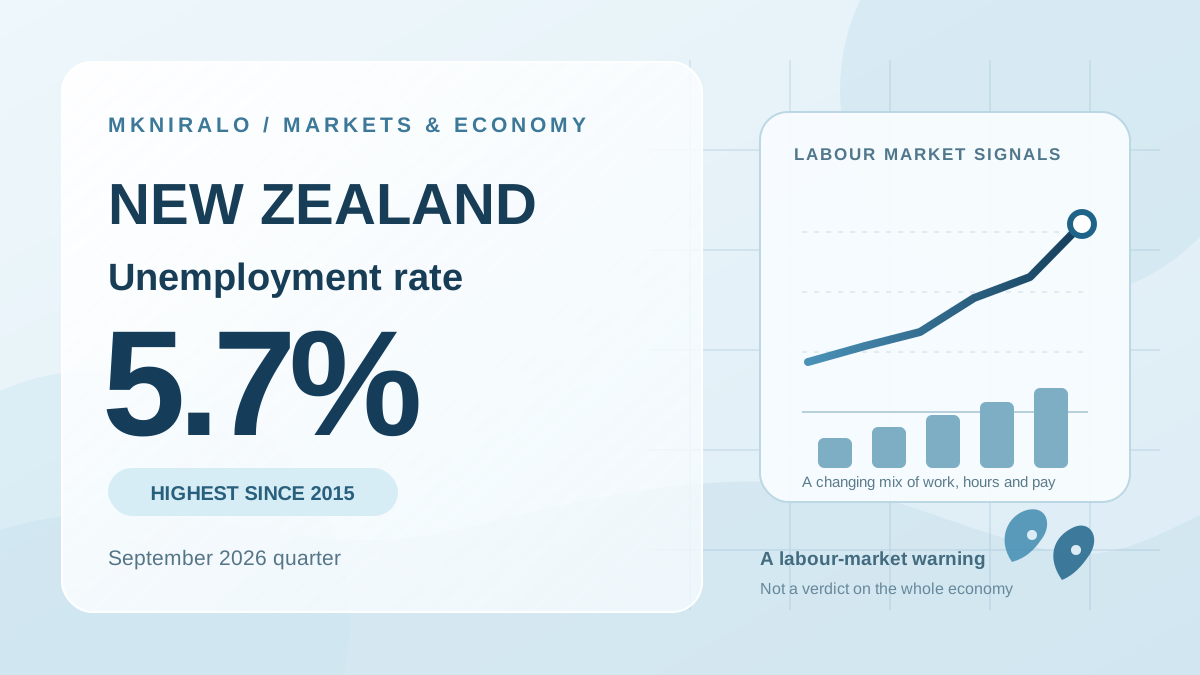
New Zealand’s seasonally adjusted unemployment rate rose to 5.7 percent in the September 2026 quarter, from 5.6 percent in June. Stats NZ counted 174,000 unemployed people, compared with 171,000 in the previous quarter. The number in employment was 2.891 million, down by about 5,000 over the quarter. The figures point to a labour market that has weakened, but they do not show an abrupt collapse in the total number of people working.
The historical comparison gives the headline its weight. The latest 5.7 percent reading matches the level recorded in September 2015; no quarter in between reached a higher rate. The result was also weaker than market expectations: a Reuters poll had forecast unemployment at 5.5 percent and employment growth of 0.4 percent for the quarter. A forecast miss is evidence that conditions were softer than expected, not proof that the economy has entered recession.
The unemployment rate is the number of unemployed people divided by the labour force, not by the entire working-age population. Under New Zealand’s Household Labour Force Survey definition, a person is counted as unemployed if they have no paid job, are available for work and have actively sought work in the previous four weeks, or have a job due to start within the next four weeks. People who are not actively seeking work may fall outside this measure.
Sources: Labour market statistics: September 2026 quarter · Unemployment rate at 5.7 percent in the September 2026 quarter · Employment and unemployment · Labour Market Statistics · New Zealand jobless rate hits 11-year high in run-up to polls
Employment is barely holding steady
The employment rate fell to 66.4 percent from 66.7 percent in the June quarter. The labour-force participation rate also slipped by 0.2 percentage points to 70.4 percent. Employment was still 0.7 percent higher than a year earlier, but the working-age population had grown by 1.0 percent. That difference helps explain why a near-stable employment headcount can coexist with a lower share of working-age people in jobs.
The quarterly changes were not identical across groups. The unemployment rate for men was unchanged at 5.6 percent, while the rate for women rose to 5.7 percent from 5.5 percent. These are national survey estimates, not a complete account of every worker’s circumstances, but they show why a single headline rate should not be treated as a uniform experience.
Sources: Labour market statistics: September 2026 quarter · Unemployment rate at 5.7 percent in the September 2026 quarter
Underutilisation shows what unemployment leaves out
The broader underutilisation rate remained at 13.8 percent, equal to the June quarter but 0.9 percentage points higher than a year earlier. Stats NZ counted 438,000 underutilised people. That total included 174,000 unemployed people, 151,000 people who were employed but wanted and were available for more hours, and 113,000 people in the potential labour force.
This is why underutilisation matters alongside unemployment. A worker with a part-time job who wants more hours is employed, so that person is not included in the unemployment rate. Someone who wants work but does not meet the survey’s availability or job-search conditions may also be outside the official unemployed count. The 13.8 percent figure is not an alternative unemployment rate; it is a wider measure of spare labour capacity.
Sources: Labour market statistics: September 2026 quarter · Unemployment rate at 5.7 percent in the September 2026 quarter · Employment and unemployment · Labour Market Statistics
The mix of work is changing
Stats NZ reported a shift towards part-time work over the quarter: seasonally adjusted part-time employment increased by 15,000, while full-time employment decreased by 17,000. Usual weekly hours worked fell by 0.5 percent to 106.5 million, and actual weekly hours fell by 1.6 percent to 94.7 million. Those movements point to less labour being used, even though the total number employed changed only slightly.
The hours figures need a qualification. Stats NZ noted that the Matariki public holiday fell in the September quarter in 2026, whereas it fell in the June quarter in 2024 and 2025. Holiday timing affected the number of people reporting fewer hours than usual. The decline in actual hours should therefore not be read as a pure measure of weaker employer demand.
The composition of employment also deserves attention. Over the year, the number of paid employees in casual roles rose by 19,100, or 19.5 percent, to 116,900; fixed-term employees increased by 8,100, or 18.9 percent, to 50,900. These figures are not seasonally adjusted. Most paid employees—91.3 percent—still held permanent positions. The data indicates a changing mix, but it does not tell us whether each person chose a non-permanent arrangement or how secure they consider it.
Sources: Labour market statistics: September 2026 quarter · Unemployment rate at 5.7 percent in the September 2026 quarter
Pay growth is not keeping pace with headline prices
The Labour Cost Index showed all salary and wage rates, including overtime, rising 2.1 percent in the year to September. Consumer prices rose 3.7 percent over the same period. The gap is a warning that measured wage-rate growth has been slower than headline inflation, although it is not a direct calculation of every household’s change in purchasing power. Private-sector wage rates rose 2.1 percent annually and public-sector rates rose 1.9 percent.
A second wage measure tells a somewhat different story. Average ordinary-time hourly earnings in the Quarterly Employment Survey rose 2.9 percent over the year to NZ$44.86. The measures should not be confused: the Labour Cost Index tracks changes in pay rates for a fixed quantity and quality of labour, while average earnings can move when the mix of industries, hours or workers changes. A higher average hourly figure does not automatically mean every employee received a 2.9 percent pay rise.
Sources: Labour market statistics: September 2026 quarter · Labour Market Statistics
The Reserve Bank faces two competing signals
The Reserve Bank of New Zealand held its Official Cash Rate at 2.75 percent on 28 October, in a 4–3 vote. Annual CPI inflation was 3.7 percent in the September quarter, above the Bank’s 1–3 percent target range. The Bank said wage growth had been subdued and medium-term inflation expectations remained stable, but core inflation was around the top of the target band and price increases had become more broad-based.
The committee was divided over timing. Four members supported holding the rate to assess the effects of two earlier increases; three favoured a further 25-basis-point rise to 3.00 percent. All members agreed that tighter monetary policy was likely to be required, but that the decision remained conditional on the outlook. The Bank also expected annual inflation to rise to 4.4 percent in the December quarter, largely because of fuel prices, while stressing the uncertainty around energy costs.
The new labour-market figures add weight to the argument that domestic demand and wage pressure are not uniformly strong. They do not, by themselves, settle the rate debate: unemployment is rising, but inflation remains above target and energy costs could keep prices elevated. The 5.7 percent reading is therefore best understood as a warning about labour-market slack—not as proof of recession or a reliable prediction of the next OCR decision. The next readings to watch are employment, participation, underutilisation, hours worked, wage growth and inflation together.
Sources: Labour market statistics: September 2026 quarter · Labour Market Statistics · OCR held at 2.75%