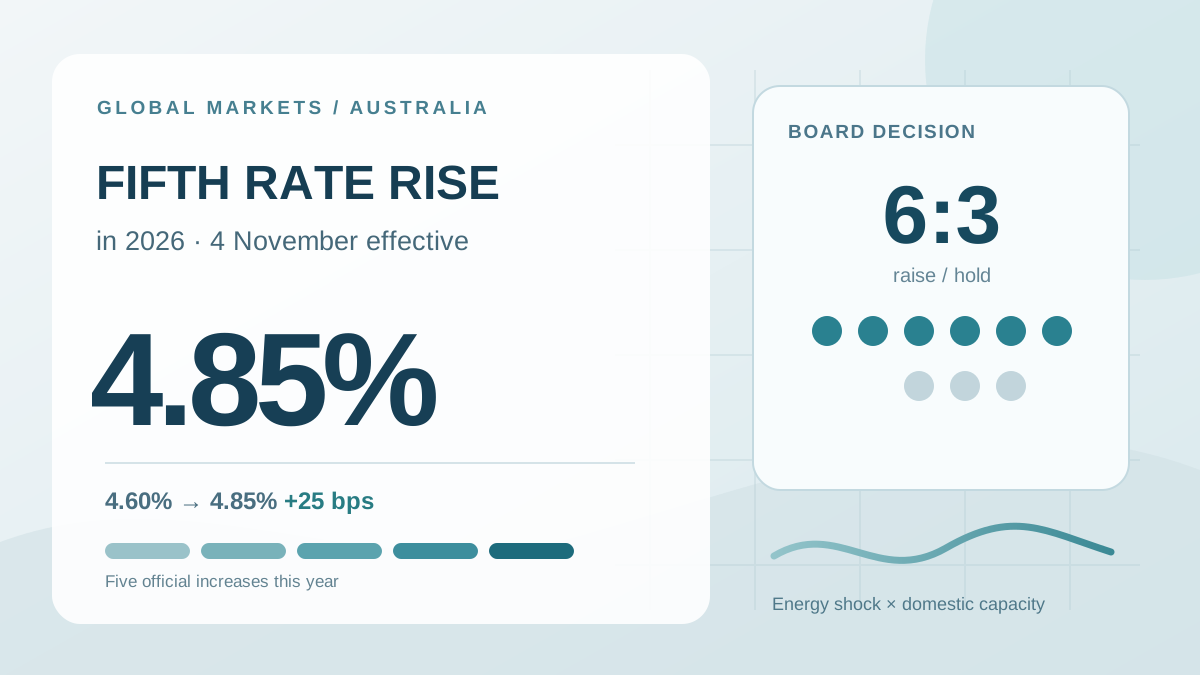
Australia's central bank has lifted its cash rate target to 4.85%, marking a fifth increase in 2026. The Reserve Bank of Australia announced a 25-basis-point rise on 3 November, with the new rate taking effect on 4 November. The move came on a divided 6–3 vote and followed a year in which inflation proved harder to contain than policymakers had expected. Global oil prices are part of that story, but the RBA says the decision was also driven by domestic pressures that were present before the latest energy shock. That distinction matters: interest rates cannot bring down the world price of oil, but they can change how much pressure the economy puts on its available capacity.
Five increases in one year—and a divided decision
The Monetary Policy Board raised the target from 4.60% to 4.85%, an increase of 0.25 percentage points. Six members supported the rise; three wanted to leave the rate at 4.60%. That split makes this more than a mechanical response to the latest inflation number. It shows that policymakers agreed on the importance of price stability but weighed the costs of further tightening differently. The decision took effect on 4 November, the day after it was announced.
The RBA's published rate history identifies five increases during 2026: 4 February to 3.85%, 18 March to 4.10%, 6 May to 4.35%, 30 September to 4.60%, and 4 November to 4.85%. The central bank held the target steady at its June and August meetings. Starting from the 3.60% rate recorded in December 2025, the cumulative rise is 1.25 percentage points. Governor Michele Bullock separately confirmed that November was the fifth increase of the year.
A policy rate is a target for overnight money-market transactions, not a direct instruction setting every mortgage or deposit rate. The financial effects spread through borrowing costs, credit decisions, asset prices and household spending over time. That is why the November move should be read alongside the four earlier increases, rather than as a fresh quarter-point change acting in isolation.
Sources: Statement by the Monetary Policy Board: Monetary Policy Decision · Cash Rate Target — historical decisions · Media Conference: Monetary Policy Decision — 3 November 2026 (Michele Bullock)
The RBA says the problem is not simply expensive oil
The bank acknowledged that the Middle East conflict had pushed up oil and other commodity prices. Those increases lift fuel bills directly and raise the costs of moving people and goods. But Bullock drew a sharp distinction between the first price shock and the reason for tightening monetary policy: the bank cannot create more oil or reverse international prices by changing the cash rate. Its concern is that Australia's demand and supply conditions may allow higher costs to spread into more prices for longer.
The RBA said domestic capacity had been tighter than previously assessed, partly because productivity growth has been weak while some spending and investment have proved stronger than expected. It singled out data-centre-related investment as one source of demand strength and noted rapid price increases for technology-related goods associated with AI investment. Those are components of its broader diagnosis, not proof that one industry caused the rate rise. The key claim is that the economy has less room to absorb extra spending without prices moving higher.
One route from an oil shock to persistent inflation runs through businesses. Fuel and transport are inputs into many products and services; firms may try to pass those costs to customers, while workers seek pay increases to protect purchasing power. When demand remains strong relative to supply, price increases can be easier to sustain. The RBA worries that repeated increases could influence expectations about future inflation. That mechanism is a policy risk, not a declaration that a self-reinforcing wage-price spiral has already begun: Bullock explicitly rejected that label in her press conference.
Sources: Statement by the Monetary Policy Board: Monetary Policy Decision · Media Conference: Monetary Policy Decision — 3 November 2026 (Michele Bullock) · Statement on Monetary Policy — November 2026: Overview
The inflation evidence has two different measurement clocks
The Australian Bureau of Statistics reported that its monthly Consumer Price Index was 4.3% higher in September 2026 than a year earlier, up from 4.0% in August. The monthly trimmed-mean measure, which aims to limit the influence of unusually large price movements, stood at 3.6% over the year, compared with a revised 3.5% in August. Both measures were above the RBA's 2–3% inflation target range. The readings help explain why the November decision was taken against an already uncomfortable price backdrop.
The November Statement on Monetary Policy uses quarterly comparisons as well: headline inflation was 3.9% over the year to the September quarter, and quarterly trimmed-mean inflation was 3.7%. Those figures do not contradict the ABS's September monthly annual readings of 4.3% and 3.6%. They refer to different reference periods and statistical constructions. Treating them as interchangeable would make it appear that one agency had revised or contradicted the other when it had not.
The bank's new forecast makes the stakes clearer. The RBA projects headline and underlying inflation remaining above 3% until the end of 2027, with the midpoint of its 2–3% target range reached around mid-2028. It also cautions that energy disruptions and domestic capacity pressures could push inflation higher than expected, while a sharper slowdown could bring inflation down faster. These are conditional forecasts—not measurements of future inflation and not a guarantee that more rate rises will follow.
Sources: Statement by the Monetary Policy Board: Monetary Policy Decision · Statement on Monetary Policy — November 2026: Overview · Consumer Price Index, Australia — September 2026
The jobs and housing data show the cost of restraint
Price pressure is not the only part of the economy moving. The ABS reported a seasonally adjusted unemployment rate of 4.7% in September, with employment down by about 39,000 people and the number unemployed up by around 9,000 over the month. The agency cautioned that a recent survey-method change may have a residual effect on the seasonally adjusted September results, and recommended considering trend estimates when assessing the underlying labour market. The RBA's separate September-quarter average unemployment figure was 4.6%, reflecting a different period rather than a conflicting count.
The RBA says higher rates have already tightened financial conditions; spending has slowed and housing prices have fallen. In its November outlook, it expected GDP growth to remain below potential and unemployment to rise further, reaching a little over 5% by the end of 2028. Employment, however, was still forecast to grow. Those projections describe a difficult balancing act: a slower economy may be necessary to restrain inflation, but the burden can arrive through weaker hiring, more expensive debt and pressure on households long before prices return to target.
Bullock acknowledged that mortgage holders were already struggling with large repayments, but pointed out that renters and lower-income households also bear a heavy cost when food, electricity, insurance and other essentials become more expensive. The distributional issue is therefore not just borrowers versus savers. Different households face different combinations of rising prices, housing costs and employment risk; tightening monetary policy imposes costs even as the bank argues that failing to contain inflation would be worse.
Sources: Statement by the Monetary Policy Board: Monetary Policy Decision · Media Conference: Monetary Policy Decision — 3 November 2026 (Michele Bullock) · Statement on Monetary Policy — November 2026: Overview · Unemployment rate at 4.7% in September
Why three board members wanted to wait
The published vote did not identify the three dissenters by name, and the official statement did not provide individual written explanations. In the press conference, Bullock said those favouring a hold placed more weight on the downside risks. Housing had already reacted to higher rates; unemployment was drifting up; wage growth showed no obvious acceleration; and four previous increases were still working through the economy. Their argument, as she described it, was partly about allowing time for more evidence rather than necessarily dismissing inflation risks.
That disagreement is especially important in a year of repeated tightening. Bullock said monetary policy can take roughly 12 months or longer to have its full effect. The final two increases had barely begun to work through when the November board met. Raise rates too slowly, and inflation expectations could become harder to contain; move too quickly, and the economy could weaken more sharply than forecast. The 6–3 result documents a judgment under uncertainty, not an assurance that the majority's preferred path will prove correct.
Sources: Statement by the Monetary Policy Board: Monetary Policy Decision · Media Conference: Monetary Policy Decision — 3 November 2026 (Michele Bullock) · Statement on Monetary Policy — November 2026: Overview
What the 4.85% rate does—and does not—tell us
A rate of 4.85% confirms the RBA chose to lean further against inflationary pressure on 3 November. It does not establish the exact cash rate at the next meeting. Bullock declined to give forward guidance on whether another rise would follow, stressing that the board would watch incoming data and assess how earlier tightening was affecting the economy. Predictions derived from market pricing or a single forecast should not be mistaken for a decision already taken.
Three developments bear watching: whether broad-based inflation and firms' cost pressures begin to ease; whether the pass-through from energy prices proves temporary or persistent; and whether unemployment, housing and household demand weaken faster than the bank expects. The RBA's central forecast is one possible path, not the only one. Its latest decision is best understood as an attempt to prevent a temporary external shock and a pre-existing domestic capacity problem from reinforcing each other—without losing sight of the damage that sustained restraint can do.
Sources: Statement by the Monetary Policy Board: Monetary Policy Decision · Media Conference: Monetary Policy Decision — 3 November 2026 (Michele Bullock) · Statement on Monetary Policy — November 2026: Overview · Consumer Price Index, Australia — September 2026 · Unemployment rate at 4.7% in September