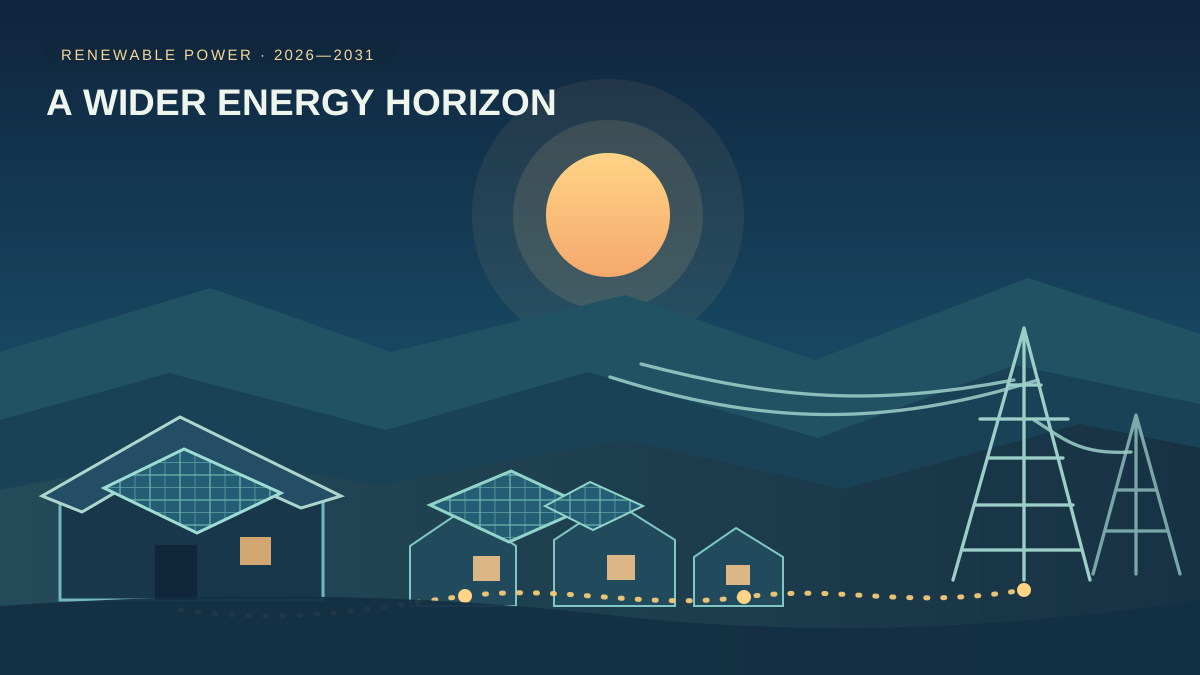
The map of renewable-energy growth is widening. In a report released on November 6, the International Energy Agency forecasts that emerging and developing economies outside China will install as much additional renewable-power capacity between 2026 and 2031 as advanced economies. That would be a notable break from the previous six years, when the former group expanded at about half the advanced-economy pace. The agency sees energy security, falling solar costs and policy support behind the shift. Yet a forecast of installed equipment is not a guarantee of electricity that consumers can use. Grid connections, finance and storage will determine how much of the predicted expansion becomes dependable supply.
An almost 4,800-gigawatt forecast—not completed construction
The IEA's main case projects more than 4,770 gigawatts of renewable-power capacity growth worldwide during 2026–2031, conventionally rounded to almost 4,800 GW. That is 57% more than in 2020–2025, a six-year comparison. Solar photovoltaics make up more than three-quarters of the forecast expansion. These are projected net additions to generating capacity, not a count of completed plants or a measure of electricity actually produced.
A rated gigawatt describes the size of installed equipment under specified conditions. A gigawatt-hour describes energy generated or consumed over time. A solar array may reach its rated output in strong sunshine, yet produce less in clouds and nothing after sunset without storage or another source. Transmission bottlenecks can also prevent available power from reaching customers.
The long-range headline also hides a near-term retreat: the agency expects global annual renewable additions to fall 11% in 2026, after 21 consecutive years of annual records, largely because solar growth in China has slowed.
Sources: Renewables 2026 — Executive summary · Renewables 2026 — Renewable electricity
Why the comparison excludes China
The new balance is not a claim that emerging markets collectively have overtaken the world's biggest renewable investor. China is deliberately separated from the comparison. The IEA expects it to account for about 53% of global renewable-capacity expansion during 2026–2031, down from more than 60% in 2025. Reuters reports forecast additions of roughly 2,550 GW in China and about 1,100 GW apiece in advanced economies and other emerging and developing economies.
India is projected to be the second-largest contributor after China, while Southeast Asia, the Middle East and Africa are expected to accelerate from very different starting points. The IEA estimates that additions across ASEAN, the Middle East and North Africa, and sub-Saharan Africa collectively grow at about three times their previous six-year pace.
The agency's forecast for sub-Saharan Africa has risen sharply since last year's edition, partly because customers are installing distributed solar systems where grid supply is unreliable. Utility-scale projects, meanwhile, can face limited financing and network capacity.
Sources: Renewables 2026 — Executive summary · Renewables 2026 — Renewable electricity · Emerging economies set to match advanced nations' renewable capacity additions, IEA says
Energy security matters—but so does the household bill
The Middle East conflict and disruption to flows through the Strait of Hormuz have amplified concerns about imported oil and gas. The IEA says domestically available renewable resources offer a way to diversify energy supplies and reduce repeated purchases of fossil fuels. That is an energy-security argument, not proof that any individual solar project was prompted by the conflict.
The shift extends beyond national tenders. The agency estimates from solar-module trade data and other indicators that extra rooftop installations have improved electricity access or the quality of electricity service for at least 70 million households since 2022. This is a model-based estimate, not an independently checked census of newly connected homes. For a household already linked to an unreliable grid, better service can mean fewer outages rather than a first connection.
But the savings depend on local tariffs, equipment costs and maintenance. Adding rooftop panels cannot by itself resolve affordability for everyone, especially where access to credit or usable roof space is limited.
Sources: Renewables 2026 — Executive summary · Renewables 2026 — Energy security and renewables · Energy security concerns spur faster renewables growth across a widening constellation of countries
The grid could become the binding constraint
Building generating capacity is only one stage of delivering electricity. Power systems also need transmission lines, transformers, forecasting, dispatch, flexible demand and storage to accommodate more weather-dependent output. The IEA says advanced-stage renewable projects in global grid-connection queues rose by 60% over the past year to about 3,000 GW. Battery and hybrid project applications account for that increase. A queue entry indicates a project seeking access, not a commissioned generator.
The consequences of inadequate flexibility are already visible in curtailment: available wind or solar output is reduced because networks or markets cannot absorb it. Under the IEA's projections, technical curtailment in key markets could rise from almost 200 terawatt-hours in 2025 to more than 800 TWh by 2031.
Financing and approvals matter alongside hardware. Transmission frequently requires different permits, land agreements and longer lead times than solar modules. Higher borrowing costs can make an otherwise inexpensive plant difficult to finance, while an auction award without a viable grid connection may not progress to operation. The report's accelerated scenario explicitly depends on faster auctions, infrastructure investment, storage deployment and permitting reform.
Sources: Renewables 2026 — Renewable electricity · Energy security concerns spur faster renewables growth across a widening constellation of countries
Renewable generation and the 2030 target are separate measures
The detailed electricity chapter forecasts renewable sources supplying 43% of global electricity generation in 2031, up from 33% in 2025. That percentage concerns actual electricity output in the model, not the percentage of installed capacity. The report's executive summary separately uses the less precise wording 'almost 45%'; the detailed chapter provides the 43% figure used here. Differences in annual sunshine, wind patterns and system operation help explain why capacity share and generation share should never be interchanged.
At the 2023 COP28 climate conference, governments endorsed the ambition of tripling global renewable-power capacity by 2030 relative to 2022. The IEA's main case instead reaches approximately 9,710 GW in 2030, about 2.6 times the 2022 level. In its accelerated case, more rapid implementation would still bring the world to the tripling milestone in 2031 rather than the target year. A forecast shortfall is not evidence that the technologies cannot work; it reveals a gap between stated ambition and the pace supported by current conditions.
The agency's main case does not represent an official inventory of what will definitely be built. The tripling goal is an international objective, not a finding that every country is legally bound to deliver one uniform share of the increase.
Sources: Renewables 2026 — Executive summary · Renewables 2026 — Renewable electricity
What would prove that the expansion reaches people
The IEA's new geography is significant because it places more of the forecast expansion in places where power demand is growing and imported fuels can expose households and firms to volatile prices. Yet capacity totals alone cannot show whether those risks have diminished. The evidence will be in projects that reach financial close, enter service, connect to a functioning grid and deliver measurable electricity at prices consumers can afford.
Country-level follow-up should compare projected additions with commissioned megawatts, kilowatt-hours delivered, connection waiting times, curtailment, electricity costs and outage duration. Distributed systems need a separate accounting of households obtaining first access versus those gaining more reliable service. These indicators would reveal whether the forecast describes an enduring change in energy provision or primarily a growing pipeline of proposed projects.
The promise is not that sunlight eliminates the need for a grid, a lender or effective regulation. It is that more countries may now have viable ways to reduce fuel dependence and expand electricity supply. Whether the opportunity delivers on that promise depends on the less visible investments that follow the first panel or turbine.
Sources: Renewables 2026 — Executive summary · Renewables 2026 — Renewable electricity · Renewables 2026 — Energy security and renewables · Energy security concerns spur faster renewables growth across a widening constellation of countries · Emerging economies set to match advanced nations' renewable capacity additions, IEA says