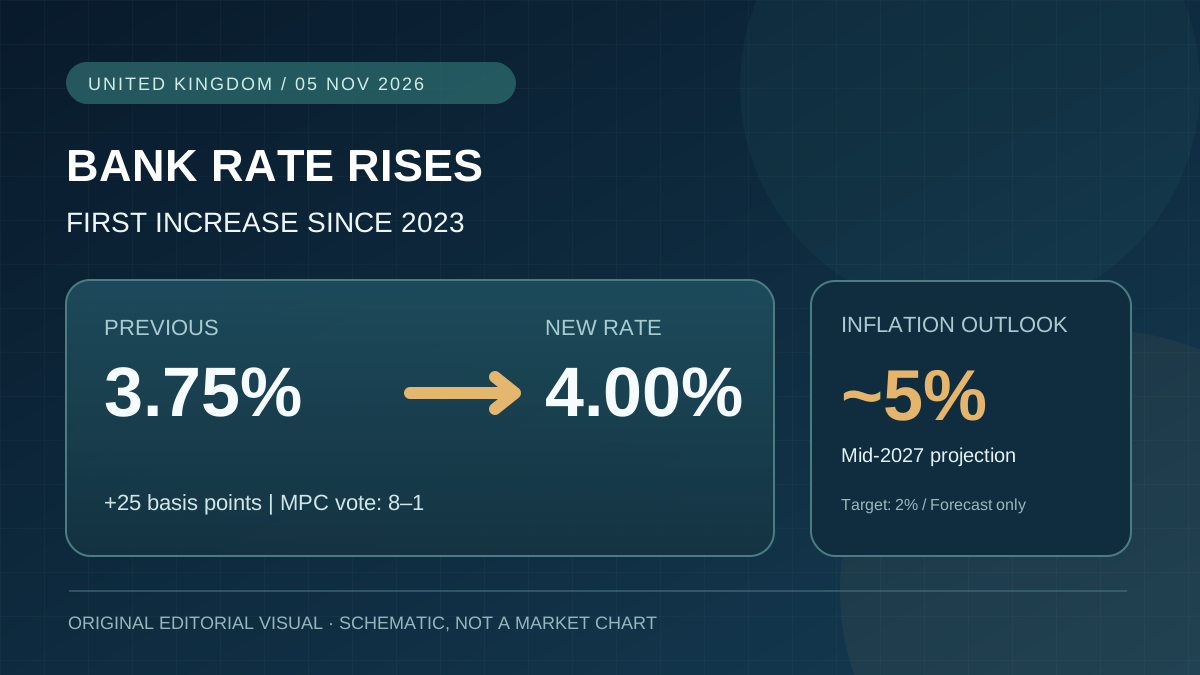
The Bank of England raised its benchmark interest rate from 3.75% to 4.00% on Thursday, 5 November, its first increase since August 2023. Eight members of the nine-person Monetary Policy Committee supported the quarter-point move. The lone dissenter, Catherine Mann, wanted a larger half-point increase to 4.25%—not a pause. The decision follows a prolonged Middle East energy shock that has lifted fuel costs and pushed the Bank’s inflation forecast to around 5% by mid-2027. Policymakers signalled that another increase could be needed, but said the path is not automatic.
The first increase since 2023—and an unusual 8–1 split
The MPC voted 8–1 to lift Bank Rate by 25 basis points to 4.00% at the meeting ending on 4 November, with the result announced on 5 November. It was the first increase in more than three years. The Bank had held its rate at 3.75% before the meeting. For borrowers and savers, the policy move raises the benchmark that influences loan pricing and deposit rates, although individual products do not all reset at once.
Catherine Mann was the only member to vote against the quarter-point proposal, but her objection ran in the opposite direction from a call for restraint: she preferred a 50-basis-point increase to 4.25%. The minutes say she was concerned about the risk of longer-lasting price and wage increases. This distinction also overturned the direction of dissent envisaged in some pre-decision polling. All nine members supported an increase of some size; they did not agree on the size of this one.
Sources: Bank Rate increased to 4% — November 2026 Monetary Policy Summary and Minutes · Bank of England raises rates for first time since 2023, says more may come · Bank of England raises interest rates to 4%, the first increase for more than three years · UK interest rates: Bank of England expected to raise them for first time in over three years
Energy prices are pushing the inflation forecast higher
UK consumer-price inflation reached 3.5% in September, compared with the Bank’s 2% target. The central bank now expects inflation to rise to roughly 5% by the middle of 2027, more than twice its target, as higher global oil, gas and refined-fuel costs reach household bills and business supply chains. Its November forecast places the central peak at about 4.8% in the second quarter of 2027, a more precise figure than the rounded headline projection.
The conflict involving the United States and Iran is central to the energy shock, but the Bank cannot lower international fuel prices by raising UK interest rates. Its concern is a second stage: businesses may eventually pass on costs, and workers may seek higher pay to offset bills, allowing inflation to spread beyond energy. The MPC said there was still limited direct evidence of such second-round effects. It raised rates because the risk of those effects had grown, not because it had declared them inevitable.
Sources: Bank Rate increased to 4% — November 2026 Monetary Policy Summary and Minutes · Monetary Policy Report — November 2026 · Bank of England raises rates for first time since 2023, says more may come · Bank of England raises interest rates to 4%, the first increase for more than three years
A stronger growth outlook makes the decision more complicated
The Bank lifted its annual UK growth forecasts to 1.6% for 2026 and 1.3% for 2027, up from the estimates presented in July. Stronger-than-expected activity, including investment associated with artificial intelligence, has made the economy more resilient than policymakers previously assumed. That reduces the case for leaving rates unchanged solely out of concern for weak growth, while not proving the economy is overheating.
There is a cost on the other side of the balance. Higher energy bills reduce the purchasing power of wages, and higher borrowing costs squeeze mortgage holders, companies and consumers. The Bank’s forecast is conditional on assumptions about energy prices, financial markets and the economy; it is not a guarantee. Stronger headline GDP growth can coexist with households feeling poorer and with vulnerable businesses facing tighter credit.
Sources: Monetary Policy Report — November 2026 · Bank of England raises rates for first time since 2023, says more may come · Bank of England raises interest rates to 4%, the first increase for more than three years · UK interest rates: Bank of England expected to raise them for first time in over three years
Policymakers leave the door open to another rise
Deputy Governor Clare Lombardelli warned that, unless inflation pressure weakens, “there is likely to be a case for a further increase in rates in the near term.” Chief Economist Huw Pill described the quarter-point move as “a significant step” toward the monetary stance needed to contain threats to price stability; he also argued that one move alone was unlikely to be enough. Those statements signal concern about persistence, but they do not constitute an MPC commitment to vote for another increase.
Governor Andrew Bailey similarly said that another rise could be warranted if the Middle East conflict keeps energy prices elevated. At the same time, he rejected the idea that this decision begins an inevitable long sequence of increases. MPC member Alan Taylor was particularly explicit that the next move could be higher, lower or unchanged, depending on the evidence. This mix of warnings and caveats matters: a forecast or an individual policymaker’s view is not a scheduled policy decision.
Sources: Bank Rate increased to 4% — November 2026 Monetary Policy Summary and Minutes · Bank of England raises rates for first time since 2023, says more may come · Bank of England policymakers set out views on rates outlook · Bank of England raises interest rates to 4%, the first increase for more than three years
Gilt yields rise, but the market snapshot needs a time stamp
Sterling strengthened against the dollar following the decision, and the yield on the interest-rate-sensitive two-year UK government bond rose by around four basis points in a Reuters trading snapshot following the announcement. A basis point is one-hundredth of a percentage point, so that market move is about 0.04 percentage points—not a four-percentage-point jump. Earlier market dispatches captured smaller moves as prices shifted during the session.
Bond-market reactions help reveal how investors reassess the likely direction of interest rates, but they should not be mistaken for a final closing price or a direct change in mortgage quotations. Much of the 25-basis-point increase had already been anticipated. What can still move markets is the tone of the MPC’s minutes, the inflation and growth projections, and fresh geopolitical developments that change the expected duration of the energy shock.
Sources: Bank of England raises rates for first time since 2023, says more may come · Bank of England delivers first rate hike in three years, gilt yields rise
What households and businesses should watch next
The immediate effect of a higher Bank Rate depends on the financial contract. Borrowers on tracker mortgages may see payments change more quickly; households with existing fixed-rate deals generally face the change when they refinance, while lenders can adjust new offers earlier in response to market funding costs. Savers may benefit if banks pass on higher rates, but there is no uniform or instantaneous adjustment. The Bank’s decision therefore arrives unevenly across the economy.
The next scheduled MPC announcement is on 17 December. Between now and then, the central questions are whether oil and gas prices remain high, whether wage settlements and company pricing start to reflect the energy shock, and whether demand weakens enough to offset those pressures. Britain has made a clear rate decision today; it has not set a fixed timetable for the next one. That distinction matters more to future costs than an assumption that a single quarter-point rise settles the inflation problem.
Sources: Bank Rate increased to 4% — November 2026 Monetary Policy Summary and Minutes · Monetary Policy Report — November 2026 · Bank of England raises rates for first time since 2023, says more may come · UK interest rates: Bank of England expected to raise them for first time in over three years · Interest rates and Bank Rate: our latest decision